

Home
Class 12
PHYSICS
The piston cylinder arrangement shown co...

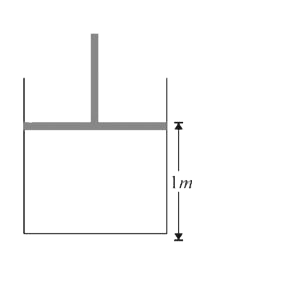
The piston cylinder arrangement shown contains a diatomic gas at temperature 300 K The cross sectinal area of the cylinder is 1m2. Initially the height of the piston above th base of the cyclinder is 1 m. The temperature is now raised to 400 K at constant pressure. There is no heat loss in the process..

Find the new height (in m) of the piston above the base of the cylinder.

Promotional Banner

Similar Questions

Explore conceptually related problems

Consider a sample of a gas in a cylinder with a movable pistom. Show digramatically the charges in the position of piston if Temperature is decreased from 300 K to 150 K at constant pressure

A cylinder whose inside diameter is 4.00 cm contains air compressed by a piston of mass m = 13.0 kg which can slide freely in the cylinder. The entire arrangement is immersed in a water bath temperature can be controlled. The system is initially in equilibrium at temperature t_i = 20^@ C . The initial height of the piston above the bottom of the cylinder is h_i = 4.00 cm . The temperature of the water bath is gradually increased to afinal temperature t_f = 100^@ C . Calculate the final height h_f of the piston. .

A cylinder fitted with a piston contains an ideal monoatomic gas at a temperature of 400K . The piston is held fixed while heat DeltaQ is given to the gas, it is found the temperature of the gas has increased by 20K . In an isobaric process the same DeltaQ heat is supplied slowely to it. Find the change in temperature in the second process?

A cylinder fitted with a piston contains an ideal monoatomic gas at a temperature of 400K . The piston is held fixed while heat DeltaQ is given to the gas, it is found the temperature of the gas has increased by 20K . In an isobaric process the same DeltaQ heat is supplied slowely to it. Find the change in temperature in the second process?

A diatomic gas is enclosed in a vessel fitted with massless movable piston. Area of cross section of vessel is 1m^2 . Initial height of the piston is 1m (see the figure). The initial temperature of the gas is 300K. The temperature of the gas is increased to 400K, keeping pressure constant, calculate the new height of the piston. The piston is brought to its initial position with no heat exchange. Calculate the final temperature of the gas. You can leave answer in fraction.

A diatomic gas is enclosed in a vessel fitted with massless movable piston. Area of cross section of vessel is 1m^2 . Initial height of the piston is 1m (see the figure). The initial temperature of the gas is 300K. The temperature of the gas is increased to 400K, keeping pressure constant, calculate the new height of the piston. The piston is brought to its initial position with no heat exchange. Calculate the final temperature of the gas. You can leave answer in fraction.

A diatomic gas is enclosed in a vessel fitted with massless movable piston. Area of cross section of vessel is 1m^2 . Initial height of the piston is 1m (see the figure). The initial temperature of the gas is 300K. The temperature of the gas is increased to 400K, keeping pressure constant, calculate the new height of the piston. The piston is brought to its initial position with no heat exchange. Calculate the final temperature of the gas. You can leave answer in fraction.

A freely sliding massive piston is supported by a spring inside a vertical cylinder as shown. When all air is pumped out of the container, the piston remains in equilibrium with only a tiny gap between the piston and the bottom surface of the cylinder. An ideal gas at temperature T_(0) is slowly injected under the piston so that it rises to height h_(0) (see figure). Calculate the height of the piston from the bottom of the container if the temperature of the gas is slowly raised to 4 T_(0) .

The pressure of a gas contained in a cylinder with a movable piston is 300 Pa. The area of the piston is 0.5 m2. Calculate the force that is exerted on the piston.