

Home
Class 12
PHYSICS
A particle is moving along a straight li...

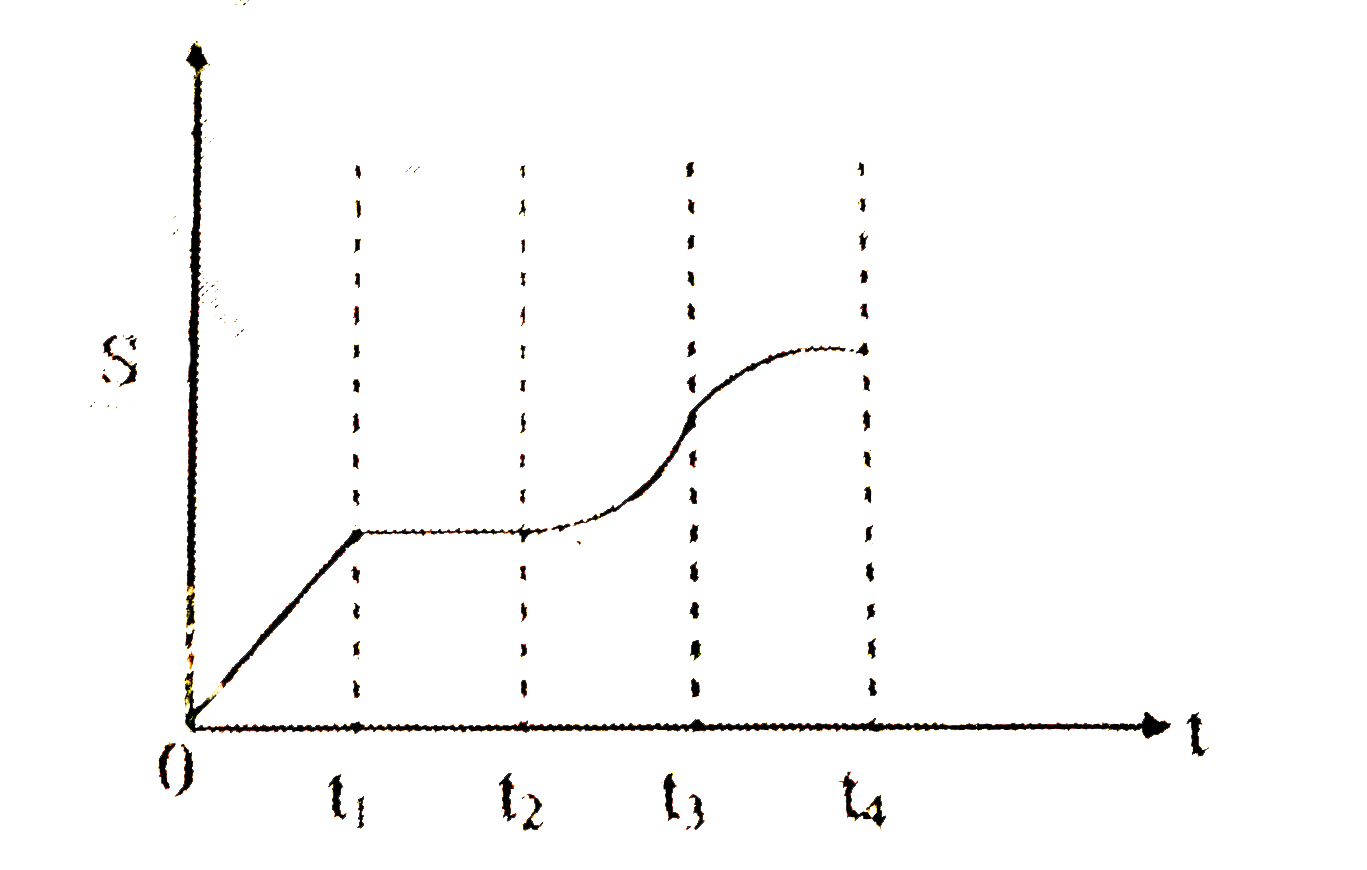
A particle is moving along a straight line. Its displacement-time graph is shown

`{:(,,"Column-I",,"Column-II"),(,(A),"Work done on particle from 0 to "t_(1),(P),"Positive"),(,(B),"Work done on particle from " t_(1) " to " t_(2),(Q),"Negative"),(,(C),"Work done on particle from " t_(2) " to " t_(3),(R),"zero"),(,(D),"Work done on particle from " t_(3) " to " t_(4),(S),"Unpredectible"):}`

Promotional Banner

Similar Questions

Explore conceptually related problems

A particle starts motion from rest and moves along a straight line. Its acceleration-time graph is shown. Find out speed of particle at t=2s and at t=3s .

A particle starts motion from rest and moves along a straight line. Its acceleration-time graph is shown. Find out speed of particle at t=2s and at t=3s.

A particle starts motion from rest and moves along a straight line. Its acceleration-time graph is shown. Find out speed of particle at t=2s and at t=3s.

A particle starts motion from rest and moves along a straight line. Its acceleration-time graph is shown. Find out speed of particle at t=2s and at t=3s.

A particle starts motion from rest and moves along a straight line. Its velocity-time graph is shown. Find out speed of particle at t=2s and at t=3s .

A body is moved along a straight line by a machine delivering a power proportional to time (P prop t) Then match the following : {:(,"Column-1",," Column-2"),("(A)","Velocity is proportional to",,"(P) t"),("(B)","Displacement proportional to",,(Q) t^(2)),("(C)","Work done proportional to",,(R) t^(3)):}

A particle moves along a straight line such that its displacement at any time t is given by s = 3t^(3)+7t^(2)+14t + 5 . The acceleration of the particle at t = 1s is

A particle moves along a straight line such that its displacement at any time t is given by s = 3t^(3)+7t^(2)+14t + 5 . The acceleration of the particle at t = 1s is

Position time graph of a particle of mass 2 kg is shown in figrure. Total work done on the particle from t=0 to t=4s is

Position time graph of a particle of mass 2 kg is shown in figrure. Total work done on the particle from t=0 to t=4s is