

Home
Class 11
PHYSICS
A particle starts moving with initial ve...

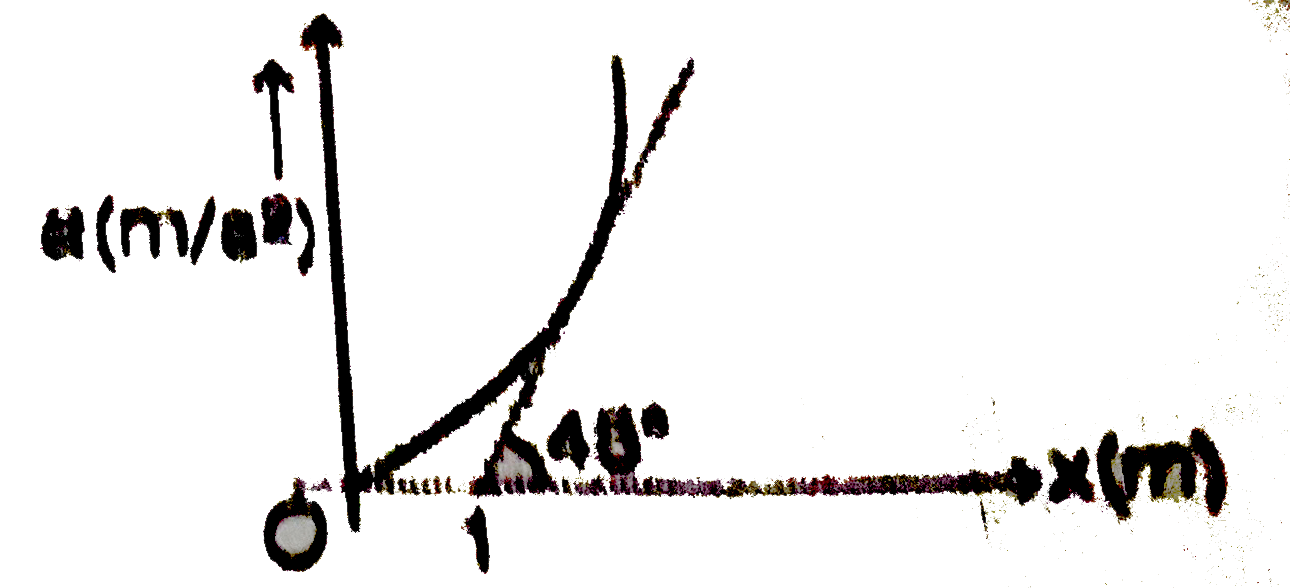
A particle starts moving with initial velocity `3m//s` along `x`- axis from origin. Its acceleration is varying with `x` co-ordinate in parobalic nature as shown in the figure. At `x=1m `, tangent to the graph makes an angle `45^(@)` with positive `x`- aixs. Then at `x=3m`,

Promotional Banner

Similar Questions

Explore conceptually related problems

A particle starts moving with constant, velocity v=(m)/(s) , from position x=5m The position time graph will be

A particle starts moving with constant, velocity v=2(m)/(s) , from position x=5m The position time graph will be

A particle is moving along x -axis. Its velocity v with x co-ordinate is varying as v=sqrt(x) . Then

A particle is moving along x -axis. Its velocity v with x co-ordinate is varying as v=sqrt(x) . Then

A particle starts from rest at the origin and moves along the positive x direction. Its acceleration a versus position x graph is shown in the figure. The velocity of the particle at x = 6 m is?

The acceleration vs distance graph for a particle moving with initial velocity 5 m/s is shown in the figure. The velocity of the particle at x = 35 m will be

A point initially at rest moves along x-axis. Its acceleration varies with time as a = (6t + 5) m//s^(2) . If it starts from origin, the distance covered in 2 s is:

A point initially at rest moves along x-axis. Its acceleration varies with time as a = (6t + 5) m//s^(2) . If it starts from origin, the distance covered in 2 s is:

If a particle starts moving along x-axis from origin with initial velocity u=2m/s and acceleration 4m//s^(2) the relation between displacement and time is given as x=2t+2t^(2) . Draw the displacement time graph for t ul(gt)0 .

Two particles A and B start moving with velocities 20 m/s and 30 sqrt(2) m/s along x-axis and at an angle 45^(@) with x- axis respectively in xy-plane from origin the relative velocity of B w.r.t A