

Home
Class 12
PHYSICS
In the system shown in the figure , a be...

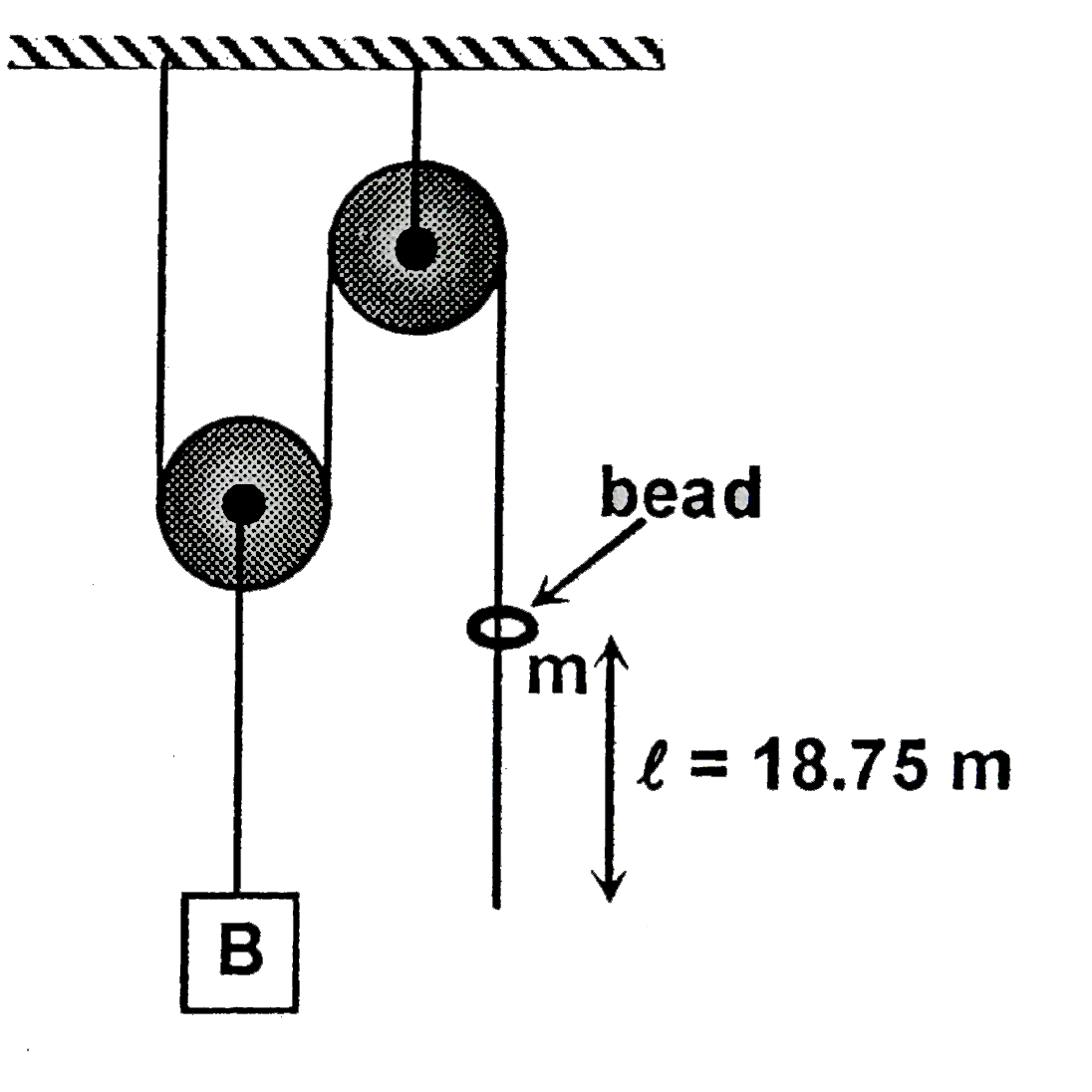
In the system shown in the figure , a bead of mass `m` can slide on the string. There is friction beween the bead and the string. Block `B` has mass equal to twice that of the bead. The system is released from rest with lenth `l=18.75m` of the string hanging below the bead. Assuming the pulley and string to be massless. Find the distance (in meter) moved by the block `B` before the bead slips out of the thread.

Promotional Banner

Similar Questions

Explore conceptually related problems

In the system shown in the fig., the bead of mass m can slide on the string. There is friction between the bead and the string. Block has mass equal to twice that of the bead. The system is released from rest with length l of the string hanging below the bead. Calculate the distance moved by the block before the bead slips out of the thread. Assume the string and pulley to be massless.

The time period of block of mass m is (Assume pulleys and string are massless) .

In the system shown in figure, the block A is released from rest. Find Tension in the string.

In the figure shown, friction force between the bend and the light string is (mg)/4 . Find the time in which the bead loose contact with the string after the system is released from rest.

A ring of mass m can slide on the vertical smooth rod. Ring is connected by block with string as shown in figure. Pulley is of mass-less and smooth the system is released from reast. Initial tension in string is

A ring of mass m can slide on the vertical smooth rod. Ring is connected by block with string as shown in figure. Pulley is of mass-less and smooth the system is released from reast. Initial tension in string is

The system shown in fig, is released from rest. Calculate the tension in the string and the force exerted by the string on the pulleys, assuming pulleys and strings are massless.

The system shown in fig, is released from rest. Calculate the tension in the string and the force exerted by the string on the pulleys, assuming pulleys and strings are massless.

In the system shown all the surfaces are frictionless while pulley and string are massless. The mass of block A is 2m and that of block B is m. The acceleration of block B immediately after system is released from rest is