

Home
Class 11
PHYSICS
Figure shows an arrangements of masses h...

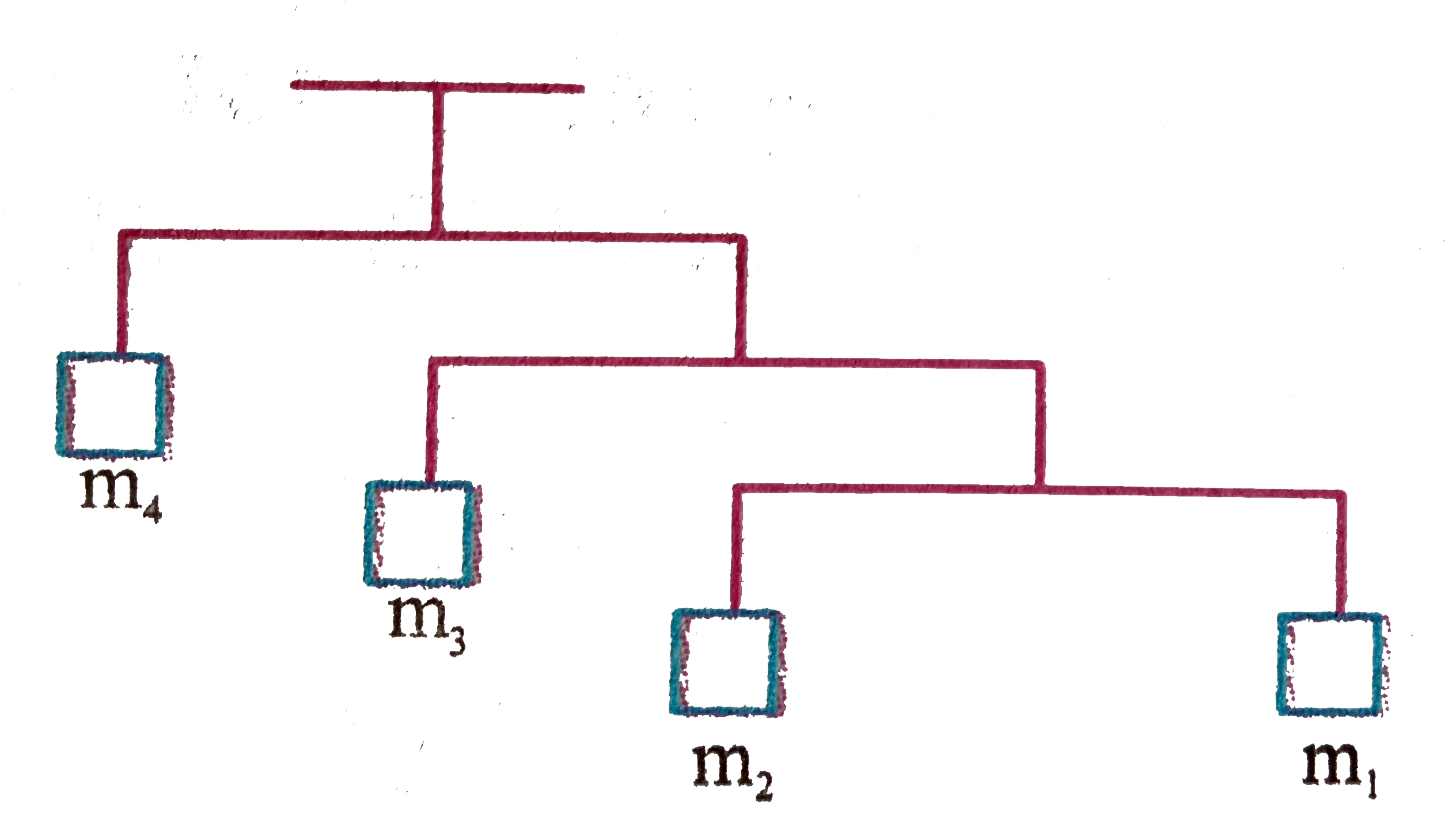
Figure shows an arrangements of masses hanging from a ceilling. In equilibrium each rod is horizontal, has negligible mass and extends three times as far to the right of the wire supporting is as to the left. If mass `m_(4)` is `48 kg,` then `(m_(3))/(m_(2))` is

Promotional Banner

Similar Questions

Explore conceptually related problems

Figure shows an arrangement of masses hanging from a ceiling. In equilibrium, each rod is horizontal, has negligible mass and extends three times as far to the right of the wire supporting it as to the left. If mass m_(4) is 48 kg then mass m_(1) is equal to

Figure shows an arrangement of masses hanging from a ceiling. In equilibrium, each rod is horizontal, has negligible mass and extends three times as far to the right of the wire supporting it as to the left. If mass m_(4) is 48 kg then mass m_(1) is equal to

Figure-1 to Figure -4 shows four different spring arrangements . Mass m in each arrangement is displacement from its equilibrium position and released Neglec mass of the springs. Choose the correct statement (s)

Figure-1 to Figure -4 shows four different spring arrangements . Mass m in each arrangement is displacement from its equilibrium position and released Neglec mass of the springs. Choose the correct statement (s)

Four masses m, 2 m, 3 m and 4 m are connected by a rod of negligible mass. The moment of inertia of the system about the axis AB is

Two masses m_(1) and m_(2) are hanging from the two corners of a triangular frame of wire as shown in the adjacent figure. The arm AC of the triangular frame is horizontal. The ratio of m_(1) and m_(2) is

In each of the three arrangements, the block of mass m_(1) is being pulled left with constant velocity. There is no friction anywhere. The string are light and anextensible and pulleys are massless. The ratio of the speed of the block of mass m_(2) in the three cases respectively is: