

Home
Class 11
PHYSICS
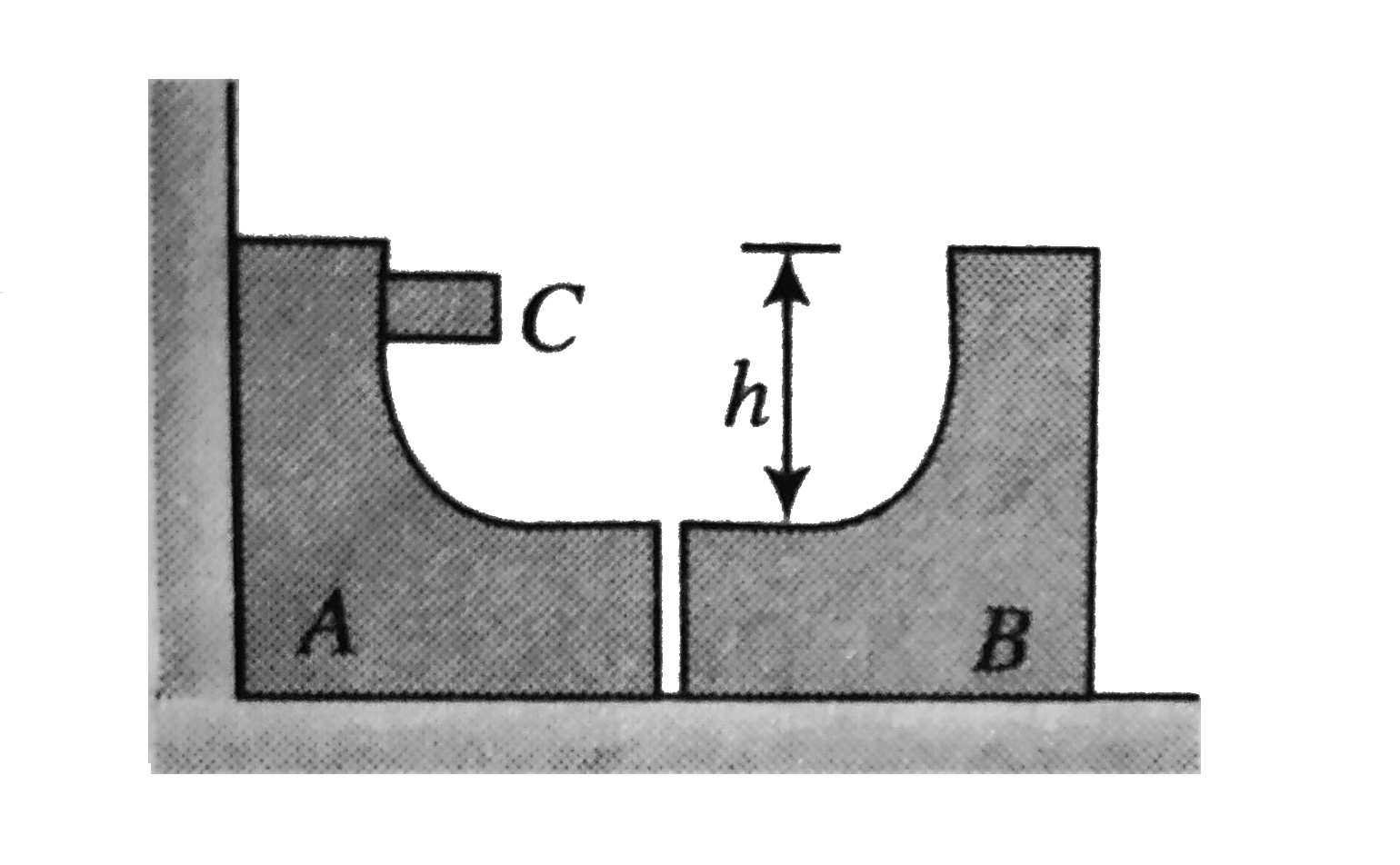
Two identical blocks, each having mass M...

Two identical blocks, each having mass M, are placed as shown in figure. These two blocks A and B are smoothly conjugated, so that when another block C of mass m passes from A to B there is no jerk. All the surfaces are frictionless, and all three blocks are free to move. Block C is released from rest, then

Promotional Banner

Similar Questions

Explore conceptually related problems

Three identical blocks, each having a mass m are pushed by a force F on the Frictionless table as shown in figure. What is the net force on the block A?

Three identical blocks, each having a mass m are pushed by a force F on the Frictionless table as shown in figure. What force does B apply on C?

A small block B of mass m_2 is placed on another block A of mass m_1 A constant horizontal force F is applied to the block A. All the surfaces are assumed to be frictionless. Find the acceleration of center of mass of the system

Three blocks A,B and C are suspended as shown in the figure. Mass of each block A and C is m. if the system is in equilibrium and mass of B is M, then

Three blocks A,B and C are suspended as shown in the figure. Mass of each block A and C is m. if the system is in equilibrium and mass of B is M, then

Three blocks A,B, and C are suspended as shown in fig. Mass of each of blocks A and B is m. If the system is in equilibrium, and mass of C is M then

Three blocks A,B, and C are suspended as shown in fig. Mass of each of blocks A and B is m. If the system is in equilibrium, and mass of C is M then

A block of mass M is placed on the top of a bigger block of mass 10M as shown in fig. All the surfaces are frictionless. The system is releated from rest. The distance moved by the bigger block by the time the smaller block reaches the ground is

A block of mass m is placed on the inclined sufrace of a wedge as shown in fig. Calculate the acceleration of the wedge and the block when the block is released. Assume all surfaces are frictionless.