

Home
Class 12
MATHS
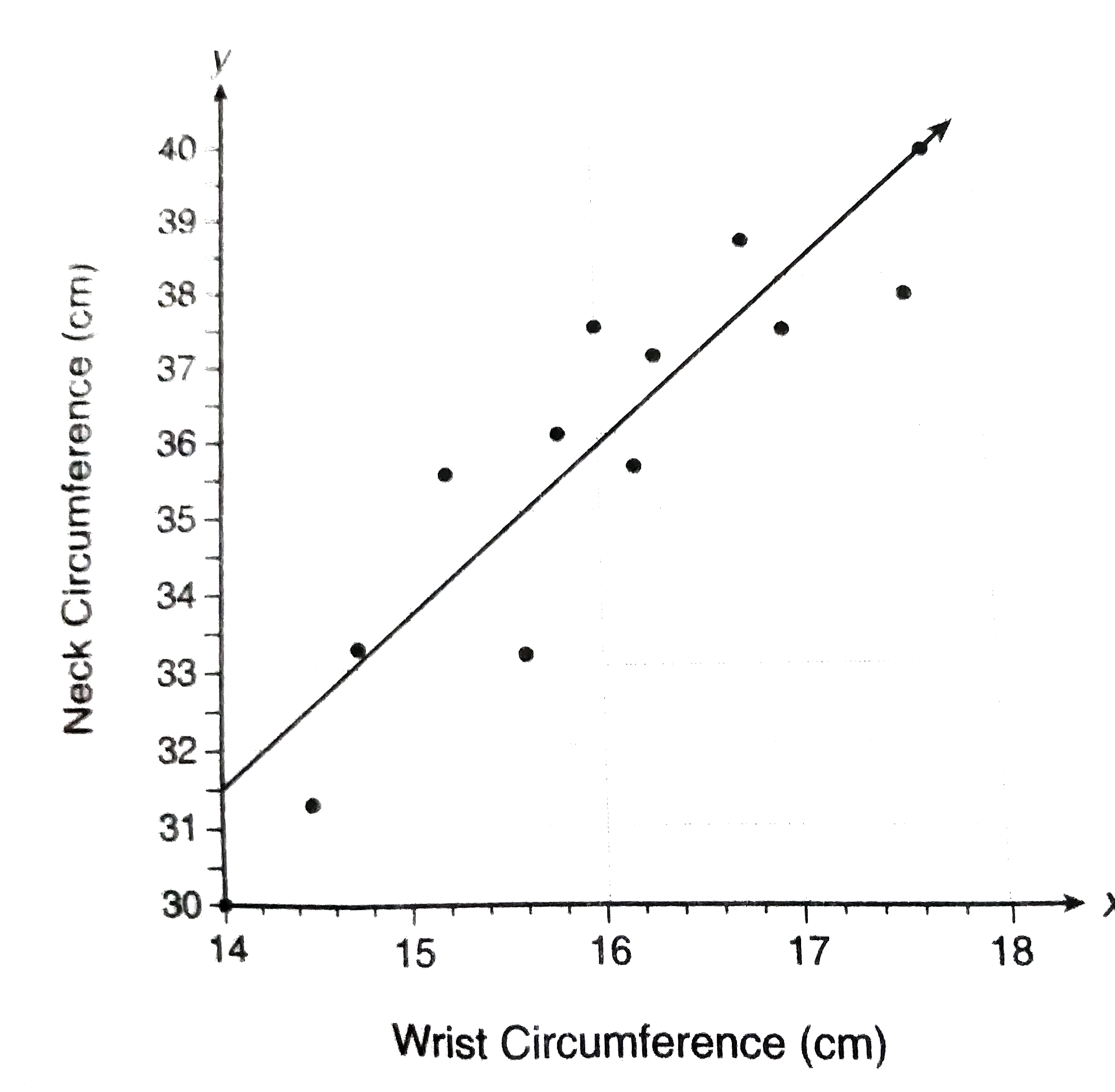
Question 1-3 refer to the above scatterp...


Question 1-3 refer to the above scatterplot, which shows wrist and neck cicumference measurements, in centimeters, for 12 people. The line of beat fit is drawn.
Q.What is the predicted neck circumference centimeters, for someone whose wrist circumference is 17.0cm?

Promotional Banner

Similar Questions

Explore conceptually related problems

The scatterplot above summarizes the wrist and neck circumference measurements, in centimeters, for 12 people. The line of best fit is drawn. What proportion of the measurements satisfy the inequality |o-p|led , where o is the observed measurement, p is corresponding measurement predicted by the line of best fit, and d is 0.5cm?

A new fitness class was started at several fitness clubs owned by the same company. The scatterplot shows the total number of people attending the class during the first five months in which the class was offered. The line of best fit is drawn. Q. For month 4, the predicted number of people attending the class was approximately what percent greater than the actual number of people attending the class?

Question 5-7 refer to the scatterplot above. A new fitness class was started at several fitness clubs owned by the same company. The scatterplot shows the total number of people attending the class during the first five months in which the class was offered. The line of best fit is drawn. Q. At the beginning of which month did the actual number of people attending the class differ by the greatest amount from the number predicted by the line of best fit?

The scatterplot above shows the height in centimeters for both the drop and bounce of eight different balls of the same type. The line of best fit for the data is also shown. According to the lines of best fit, which of the following is closest to the predicted increase in bounce height, in centimeters, for every increase of 100 centimeters in drop height?

A water tank has a small hole in its wall and a tapering nozzle has been fitted into the hole (figure). The diameter of the nozzle at the exit is d_(0)=1cm . The height of water in the tank above the central line of the nozzle is h=2.0m. Calculate the dischargerate in m^(3)s^(-1) through the nozzle. Another nozzle which is diverging outwards is fitted smoothly to the first nozzle. The pressure at the neck of the two nozzle (where diameter is d_(0) ) drops ot 2.5m of water. Calculate the exit diameter (d) of the nozzle. Atmosphere pressure =10m of water and g=10ms^(-2)

Covalent molecules formed by heteroatoms bound to have some ionic character. The ionic character is due to shifting of the electron pair towards A or B in the molecule AB. Hence, atoms acquire small and equal charge but opposite in sign. Such a bond which has some ionic character is described as polar covalent bond. Polar covalent molecules can exhibit dipole moment. Dipole moment is equal to the product of charge separation, q and the bond length, d for the bond. The unit of dipole moment is Debye. One Debye is equal to 10^(-18) esu cm. Dipole moment is a vector quantity. It has both magnitude and direction. Hence, dipole moment of molecules depends upon the relative orientation of the bond dipoles, but not on the polarity of bonds alone. A symmetrical structure shows zero dipole moment. Thus, dipole moments help to predict the geometry of the molecules. Dipole moment values can be used to distinguish between cis-and traps-isomers, ortho-, meta-and para-forms of a substance, etc. The percentage of ionic character of a bond can be calculated by the application of the following formula : % " ionic character " = ("Experimental value of dipole moment ")/("Theoretical value of dipole moment ") xx 100 A diatomic molecule has a dipole moment of 1.2 D. If the bond length is 1.0 xx 10^(-8) cm, what fraction of charge does exist on each atom?