

Home
Class 12
PHYSICS
Two indentical point charges having magn...

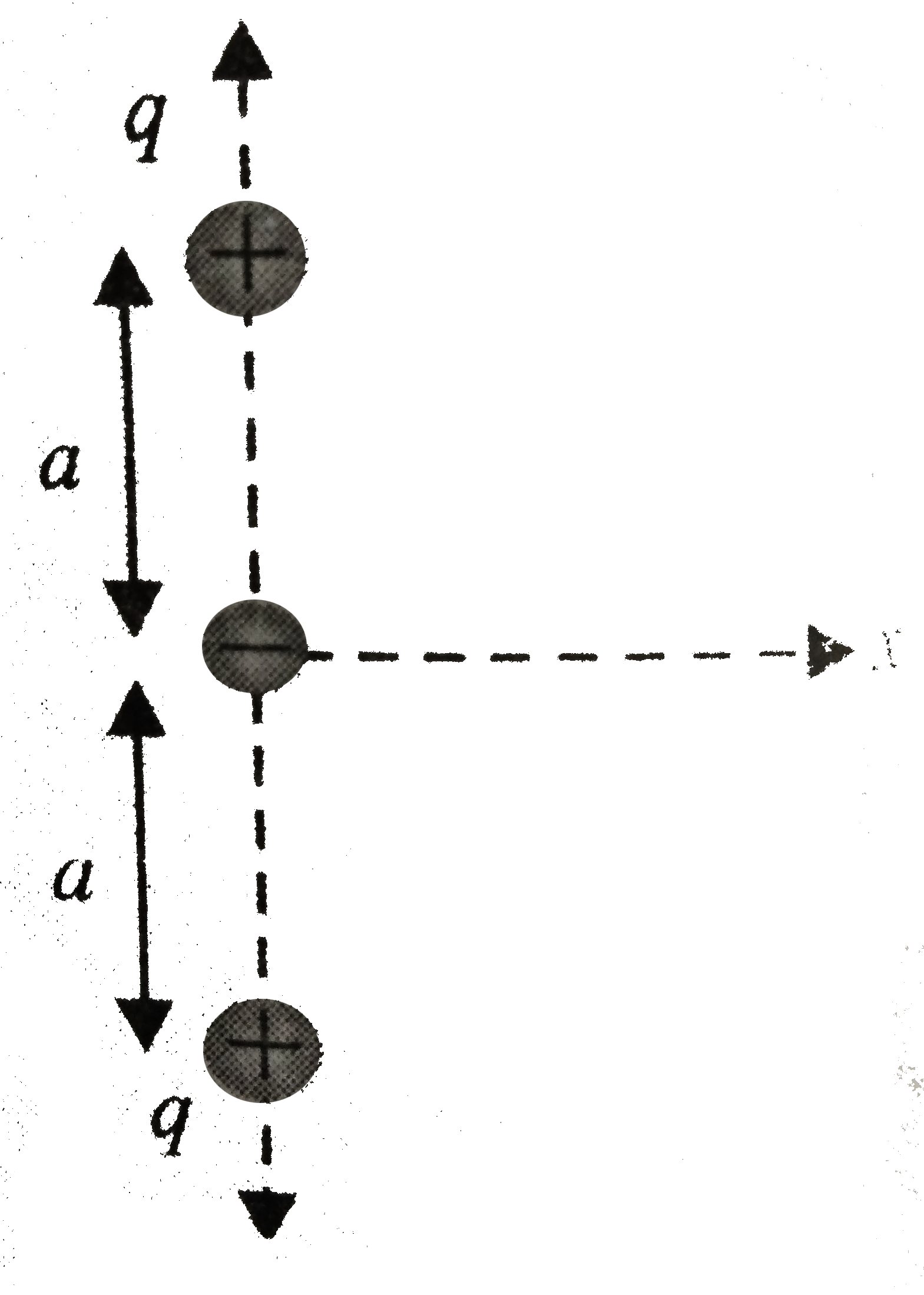
Two indentical point charges having magnitude q each are placed as shown if fig. If we place a negative cahrge (of magnitude -q and mass m)at the midpoint of charges and displaced along the x-axis, examine whether it will perform simpe harmonic motion. If yes then find the time period of oscillation of the particle.

Promotional Banner

Similar Questions

Explore conceptually related problems

Two points charges , each Q , are fixed at separation 2d . A charged particle having charge q and mass m is placed between them. (a) Now this charged particle is slightly displaced along the line joining the charges , slow that it will execute simple harmonic motion and find the time period of oscillation. (b) If charge q is negative and it is displaced slightly perpendicular to the line joining the charges , repeat the part (a) .

Two identical positive charges Q each are placed on the x axis at point (-a,0) and (a,0) A point charge of magnitude q is placed at the origin. For small displacement along x axis, the charge q executes simple harmonic motion if it is poitive and its time period is T_(1) . if the charge q is negative, it perform oscillations when displaced along y axis. in this case the time period of small oscillations is T_(2). find (T_(1))/(T_(2))

Two point charges each of magnitude +q are placed at a distance r from each other. Draw the lines of force in this case.

Positive charge Q is distributed uniformly over a circular ring of radius R. A particle having a mass m and a negative charge q, is placed on its axis at a distance x from the centre. Find the force on the particle. Assuming x ltltR, find the time period of oscillation of the particle if it is released from there.

Positive charge Q is distributed uniformly over a circular ring of radius R. A particle having a mass m and a negative charge q, is placed on its axis at a distance x from the centre. Find the force on the particle. Assuming x is very less than R, find the time period of oscillation of the particle if it is released from there.

Positive charge Q is distributed uniformly over a circular ring of radius R. A particle having a mass m and a negative charge q, is placed on its axis at a distance x from the centre. Find the force on the particle. Assuming x is very less than R, find the time period of oscillation of the particle if it is released from there.

Two identical point charges'of magnitude -q are fixed as shown in the figure below. A third charge +q is placed midway between the two charges at the point P. Suppose this charge is displaced a small distance from the point P in the directions indicated by the arrows, in which direction(s) will +q be stable with respect to the displacement?