

Home
Class 11
PHYSICS
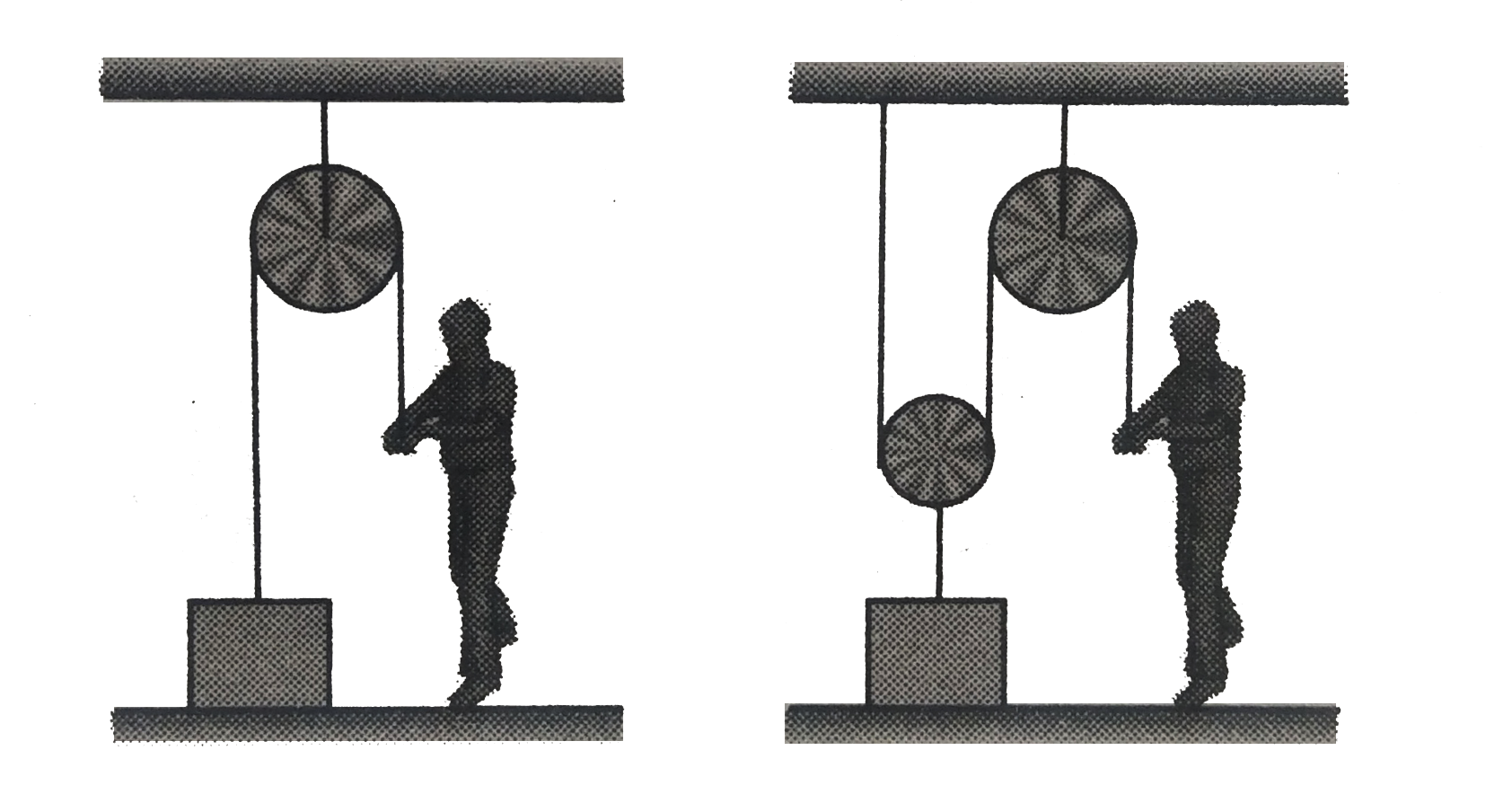
In fig., a person wants to rise a block ...

In fig., a person wants to rise a block lying on the ground to a height h. In both the cases, if the time required is same, then in which case he has to exert more force? Assuem pulleys and strigns light.

Promotional Banner

Similar Questions

Explore conceptually related problems

In the figure shown, a person wants to raise a block lying on the ground to a height h. in both the cases if time required is same then in which case he has to exert more force. Assume pulleys and strings light.

In the figure shown, a person wants to raise a block lying on the ground to a height h. in both the cases if time required is same then in which case he has to exert more force. Assume pulleys and strings light.

In the figure shown , a person wants to raise a block lying on the ground to a height h . In which case he has to exert more force. Assume pulleys and strings are light .

In the figure show , a person wants to raise a block lying on the ground to a height h . In which case he has to exert more force. Assume pulleys and strings are light .

In the figure show , a person wants raise a block lying on the ground to a height h . In which case he has to exert more force. Assume pulleys and strings are light .

The block has to be raised to a height L in the same time t. In which case force required is more ?

The pulley of radius R can rotate freely about its axle as shown in the figure. A thread is tightly wrapped around the pulley and its free end carries a block of mass m . When the block is at a height h above the ground the system is released (i.e., the pulley is made free to rotate & the block is allowed to fall) and at the same instant the axle is moved up keeping it horizontal all the time. When the block hits the floor the axle has gone up by a distance 2h . Find the angle by which the pulley must have rotated by this time.

A small block is shot into each of the four tracks as shown below. Each of the tracks rises to the same height. The speed with which the block enters the track is the same in all cases. At the highest point of the track, the normal reaction is maximum in