

Home
Class 12
PHYSICS
A voltmeter which can measure 2 V iscons...

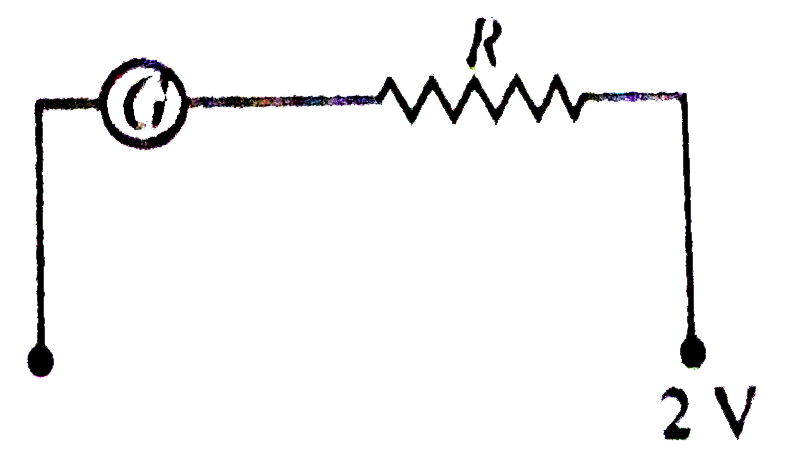
A voltmeter which can measure 2 V isconstructed by using a galvanometer of resistance `12 Omega` and that produces maximum deflection for the current of 2mA. Then the resistance R is

Promotional Banner

Similar Questions

Explore conceptually related problems

A multirange voltmeter can be constructed by using a galvanometer circuit as shown in Fig. EP 4.21. We want to construct a voltmeter that can measure 2V, 20V and 200 V using a galvanometer of resistance 10 Omega and that produces maximum deflection for current of 1 mA. find R_1 , R_2 and R_3 that have to be used.

A multirange voltmeter can be constructed by using a galvanometer circuit as shown in figure. We want to construct a voltmeter that can measure 2V, 20V and 200V using a galvanometer of resistance 10Omega and that produces maximum deflection for current of 1mA . Find R_1 , R_2 and R_3 that have to be used.

A multirange voltmeter can be constructed by using a galvanometer circuit as shown in figure. We want to construct a voltmeter that can measure 2V, 20V and 200V using a galvanometer of resistance 10Omega and that produces maximum deflection for current of 1mA . Find R_1 , R_2 and R_3 that have to be used.

A galvanometer with a coil of resistance 12 Omega shows a full scale deflection for a current of 2.5 mA. How can it be convereted into an ammeter of range 7.5A?

How can galvanometer be converted to a voltmeter ? Why is the series resistance greater that the galvanometer resistance ? A moving coil galvanometer of resistance 5Omega can measure a current of 15mA. What is the series resistance required if it is to measure 1.5 V ?

A galvanometer has coil resistance 30 Omega and full deflection current of 2mA. What resistance is needed to convert it into a voltmeter of 0.2V range.

A galvanometer of internal resistance 100 Omega has a full scale deflection current of 1mA. To convert it into a voltmeter of range 0-10V, the resistance to be connected is