

Home
Class 12
PHYSICS
In the figure- it is shown,the focal len...

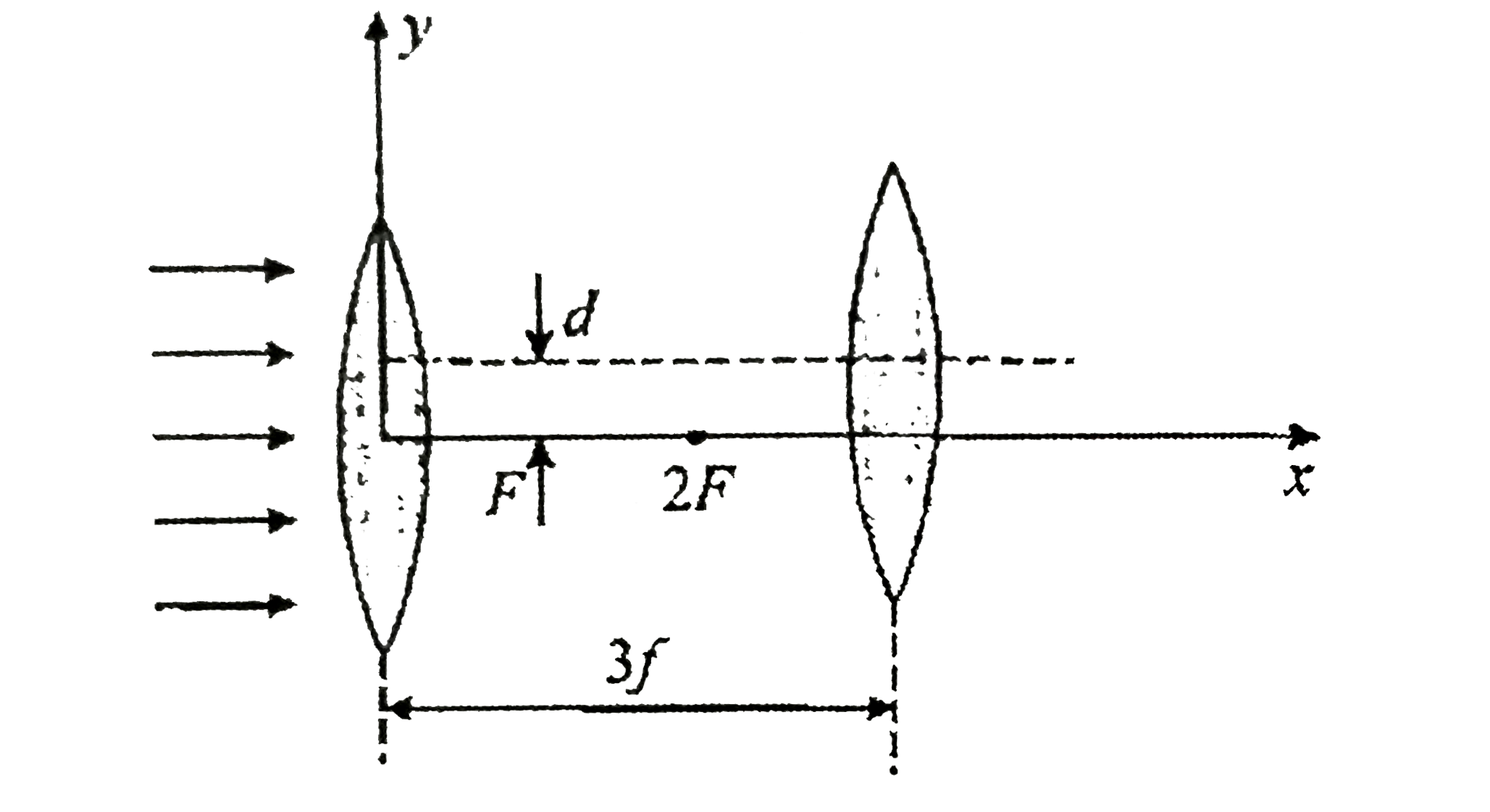
In the figure- it is shown,the focal length f of the two thin convex lenses is the same. They are separated by a horizontal distance 3f and their optical axes are displaced by a vertical separation `'d'(d lt lt f)` as shown. Taking the origin of coordinates O at the centre of the first lens , find the x and y coordinates of the point where aparallel beam of rays coming from the left finally gets focussed ?
((5f, 2d)]

Promotional Banner

Similar Questions

Explore conceptually related problems

the focal length of the two thin convex lenses is the same =f They are separated by a horizontal distance 3f and their optical axes are displaced by a vertical separation 'd'(dltltf) .Taking the origin of coordinates O at the centre of the first,lens ,find the xand y coordiates of the point where a parallel beamof rays coming from the left finally get focused?

Two thin convex lenses of focal lengths f_(1) and f_(2) are separated by a horizontal distance d (where dltf_(1) , dltf_(2) ) and their centres are displaced by a vertical separation triangle as shown in the fig. Taking the origin of coordinates O, at the centre of the first lens the x and y coordinates of the focal point of this lens system, for a parallel beam of rays coming form the left, are given by:

Two thin convex lenses of focal lengths f_(1) and f_(2) are separated by a horizontal distance d (where dltf_(1) , dltf_(2) ) and their centres are displaced by a vertical separation triangle as shown in the fig. Taking the origin of coordinates O, at the centre of the first lens the x and y coordinates of the focal point of this lens system, for a parallel beam of rays coming form the left, are given by:

Two thin convex lenses of focal lengths f_(1) and f_(2) are separated by a horizontal distance d (where dltf_(1) , dltf_(2) ) and their centres are displaced by a vertical separation triangle as shown in the fig. Taking the origin of coordinates O, at the centre of the first lens the x and y coordinates of the focal point of this lens system, for a parallel beam of rays coming form the left, are given by:

Two thin convex lenses of focal length f_(1) and f_(2) are separated by a horizontal distance 'd' where (dltf_(1) "and" dltf_(2)) and their optical centers are displaced vertically by x_(0) .Taking the origin at the centre of lens L_(1) consider the following cases when a parallel beam of paraxial rays are coming form left. x coordinate of the final image is

TTwo thin convex lenses of focal length f_(1) and f_(2) are separated by a horizontal distance 'd' where (dltf_(1) "and" dltf_(2)) and their optical centers are displaced vertically by x_(0) .Taking the origin at the centre of lens L_(1) consider the following cases when a parallel beam of paraxial rays are coming form left. Y coordinate of the final image is given by:

Two thin convex lenses of focal length f_(1) and f_(2) are separated by a horizontal distance 'd' where (dltf_(1) "and" dltf_(2)) and their optical centers are displaced vertically by x_(0) .Taking the origin at the centre of lens L_(1) consider the following cases when a parallel beam of paraxial rays are coming form left. for the lens1 L_(2) ,object distance is

Two thin convex lenses of focal lengths 4 cm and 8 cm are separated by a distance of 4 cm in air. The combination will have the focal length

Two thin convex lenses of focal lengths f_1 and f_2 are placed at a distance d between them. For the power of combination to be zero, the separation d should fee :