

Home
Class 11
PHYSICS
One mole of a mono atomic gas of molar m...

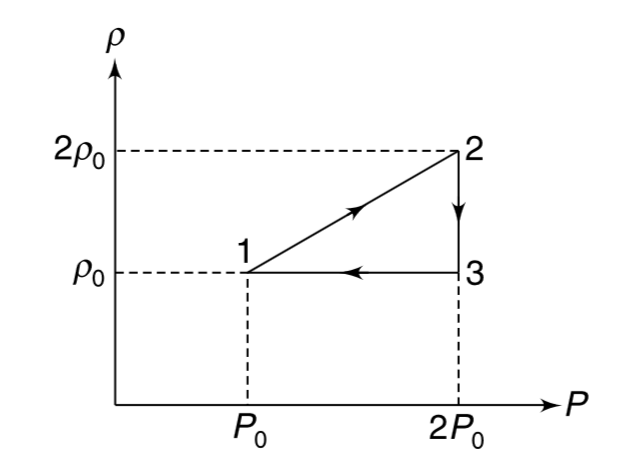
One mole of a mono atomic gas of molar mass M undergoes a cyclic process as shown in the figure. Here `rho` is density and P is pressure of the gas.
(a) Calculate the heat rejected by the gas in one complete cycle.
(b) Find the efficiency of the cycle.

Promotional Banner

Similar Questions

Explore conceptually related problems

The density (rho) versus pressure (p) graph of one mole of an ideal monoatomic gas undergoing a cyclic process is shown in figure. Molecular mass of gas is M. (a) Find work done in each process. (b) Find heat rejected by gas in one complete cycle. (c) Find the efficiency of the cycle.

One mole of a monatomic ideal gas undergoes a cyclic process as shown in the figure (where V is the volume and T is the temperature). Which of the statements below is (are) true?

One mole of a monatomic ideal gas undergoes a cyclic process as shown in the figure (where V is the volume and T is the temperature). Which of the statements below is (are) true ?

One mole of an ideal mono-atomic gas is taken round cyclic process ABCD as shown in figure below. Calculate

One mole of an ideal monoatomic gas undergoes a cyclic process as shown in figure. Then the change in the energy in expanding the gas from a to c along the path abc is:

n moles of a diatomic gas has undergone a cyclic process ABC as shown in figure. Temperature at A is T_(0). Find is heat rejected by the gas, if yes how much heat is rrejected ?

Two moles of a monatomic ideal gas undergo a cyclic process ABCDA as shown in figure. BCD is a semicircle. Find the efficiency of the cycle.

One mole of an ideal monoatomic gas undergoes a process as shown in the figure. Find the molar specific heat of the gas in the process. R is a gas constant.

In the cyclic process shown in the figure, the work done by the gas in one cycle is