

Home
Class 10
CHEMISTRY
The following diagram shows a part of t...

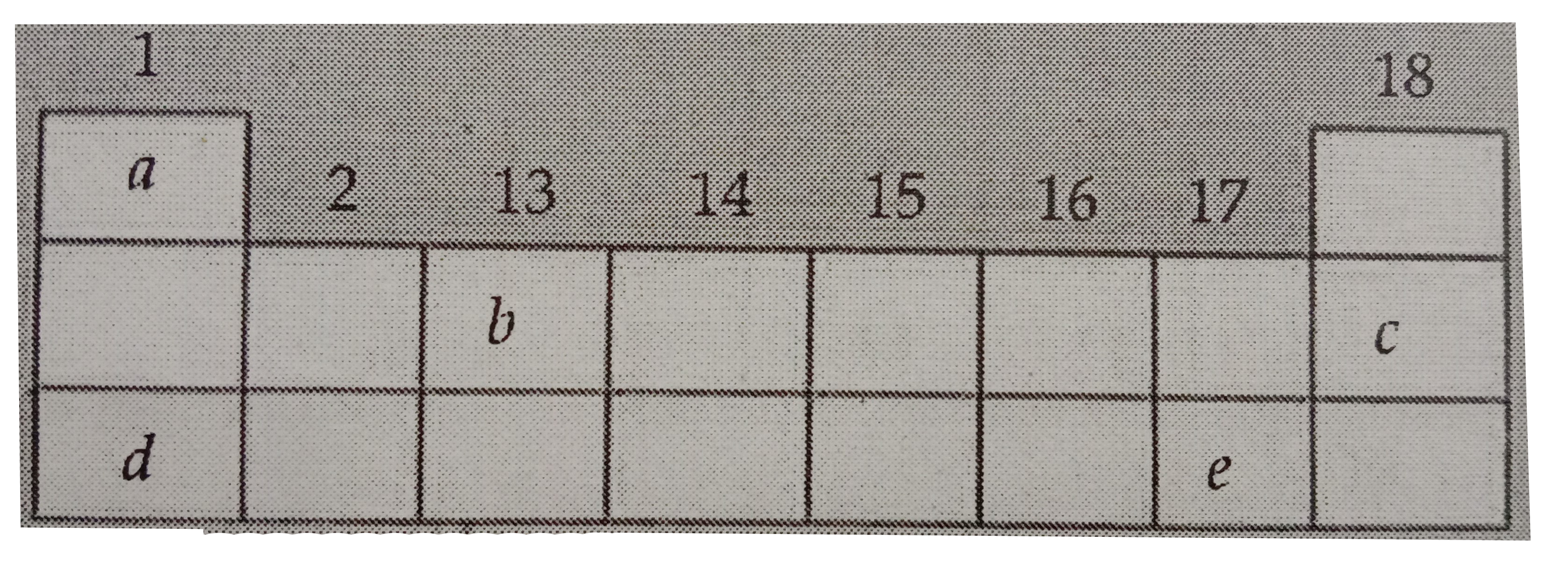
The following diagram shows a part of the periodic table containing first there periods in which five elements have been represented by the letters `a,b,c,d` and `e` (which are not their chemical symbols):

(i) Select the letter which represents an alkali metal.
(ii) Select the letter which represents a noble gas.
(iii) Select the letter which represents a halogen.
(iv) What type of bond is formed between `a` and `e`?
(v) What type of bond is formed between `d` and `e`?

Promotional Banner

Similar Questions

Explore conceptually related problems

In the following diagram for the first three periods of the periodic table, five elements have been represented by the letters a,b,c,d and e (which are not their chemical symbols): (i) Select the letter which represents a halogen. (ii) Select the letter which represents a noble gas. (iii) What type of bond is formed between a and b ? (iv) What type of bond is formed between c and b ? (v) Which element will form a divalent anion?

Select the option which represents labeled parts (A, B, C and D) correctly.

A to F are the structural formulae of some organic compound (i) give the letter which represent the family. (ii) Give the letters which donot represent hydrocarbons. (iii) How can 'C' be converted into 'A'?

This question refers to elements of the periodic table with atomic numbers from 3 to 18. In the table below, some elements are shown by letters, even though the letters are not the usual symbols of the elements. Which of these is an alkali metal

The letter 'D' in carbohydrates represents

The following diagram shows the Ts of dicot root, certain parts have been indicated by letters, Select the option in which these latters have been correctly matched with the parts which they indicate