Home
Class 12
PHYSICS
A secret agent pushes two mysterious cra...

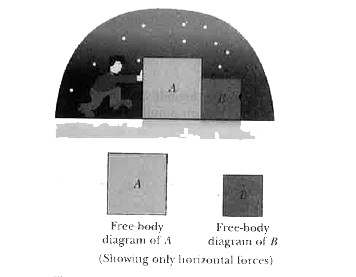
A secret agent pushes two mysterious crates across a frozen river in the dark of night. The crates slide friction-lessly. Their masses are 150 kg (A) and 50 kg (B). The agent's hands exert a 100 N force on A (see Fig. 5-19). How much force does A exert on B? If there is no friction, can either block's acceleration be zero? Therefore, can `sum vec(F)_("on A")=0`? Therefore, can the force exerted on A by B (which is equal in magnitude to that exerted on B by A) "balance" (be equal and opposite to) the force exerted by the agent?

Text Solution

Verified by Experts

With no friction, the unopposed force exerted by the agent makes both crates accelerate. If crate A is accelerating, the forces on A cannot be equal and opposite.
Calculations: (a) To find a force on block B, we apply Newton.s second law to B. Using a free-body diagram of B (left), we get
`sun F_("x on B")=F_("on B by A")=m_(B)alpha_("Bx")=m_(B)alpha_(B)." "(5-21)`
This leaves us with two unknowns, `F_("on B by A")` and `alpha_(B)`.
(b) However, if we apply the second law to block A as well (see free-body diagram of A at left), we get
`sun F_("x on A)=F_("on A by agent")-F_("on A by B")=m_(A)alpha_(Ax)=m_(A)alpha_(A)." "(5-22)`
However, we know that `F_("on A by B")=F_("on B by A")`. Also, `alpha_(A)=alpha_(B)` (label this common acceleration a). Thus, from Eqs. (5-21) and (5-22), we get
`F_("on B by A")=m_(B)alpha" "(5-23)`
and `" "F_("on A by agent")-F_("on B by A")=m_(A)alpha," "(5-24)`
which we can solve for the two unknowns `F_("on B by A")` and a. We use Eq. (5-23) to substitute for `F_("on B by A")` in Eq. (5-24):
`F_("on A by agent")-m_(B)alpha=m_(A)alpha`.
Then
`F_("on A by agent")=m_(B)alpha+m_(A)alpha=(m_(B)+m_(A))alpha`
and
`alpha=(F_("on A by agent"))/(m_(B)+m_(A))=(100" N")/(50" kg"+150" kg")=0.50" m"//"s"^(2)" "(5-25)`
Substituting this value and `m_(A)=50" kg"` into Eq. (5-23) gives us
`F_("on B by A")=(50" kg")(0.50" m"//"s"^(2))=25" N"`.
We have found that `F_("on B by A")` is one quarter of the force exerted by the hand on A. Likewise, `m_(B)` is one quarter of the combined mass `m_(A)+m_(B)` pushed by the hand. As you sould expect from Newton.s second law of motion, to impart the same acceleration to a mass one-fourth as great requires one fourth the force.
Promotional Banner

Topper's Solved these Questions

  • FORCE AND MOTION - I

    RESNICK AND HALLIDAY|Exercise CHECKPOINT|5 Videos
  • FORCE AND MOTION - I

    RESNICK AND HALLIDAY|Exercise PROBLEMS|52 Videos
  • FLUIDS

    RESNICK AND HALLIDAY|Exercise PRACTICE QUESTIONS (Integer Type )|5 Videos
  • FORCE AND MOTION-II

    RESNICK AND HALLIDAY|Exercise PRACTICE QUESTIONS (Integer Type)|1 Videos

Similar Questions

Explore conceptually related problems

Blocks A and B have masses of 2 kg and 3 kg. respectively. The ground is smooth. P is an external force of 10 N. The force exerted by B on A is

The elevator shown in figure is descending, with an acceleration of 2 m//s^(2) . The mass of block A is 0.5 kg. the force exerted by block A on block B is (mass of block B is 1 kg)

A boy of mass 50 kg standing on ground exerts a force of 500 N on the ground. The force exerted by the ground on the boy will be :

When F = 2n, the frictional force between 10 kg block 5 kg block is

Two forces are applied to a 5.0 kg crate, one is 6.0N to the north and the other is 8.0N to the west. The magnitude of the acceleration of the crate is :

The elevator shown in fig. is descending with an acceleration of 2 m//s^(2) . The mass of block A is 0.5 kg. The force exerted by the block A on the block B is

The elevator shown in fig. is descending with an acceleration of 2ms^(-2) . The mass of the block A=0.5kg . Find the force (in Newton) exerted by block A on block B.

P' and 'Q' horizontally push in the same direaction a 1200kg crate. 'P' pushes with force of 500 newton 'Q' pushes with a force of 300 newton If a frictional force provides 200 newton of resistance what is the acceleration of the crate. ?
