Home
Class 12
PHYSICS
In Fig. 5-27, a block attached to a chor...

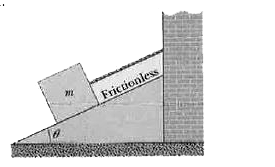
In Fig. 5-27, a block attached to a chord is resting on an inclined plane. Let the mass of the block be 8.5 kg and the angle `theta` be `30^(@)`.
(a) Find the tension in the cord and normal force acting on the block.
(b) If the cord is cut, find the magnitude of the resulting acceleration of the block.

Figure 5-27 A block attached to a chord resting on an incline.

Text Solution

Verified by Experts
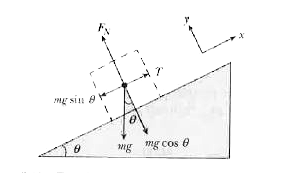
(1) We apply Newton.s second law to solve for the tension in the cord and the normal force on the block.
(2) The free-body diagram of the problem is shown in the Fig. 5-28. Since the acceleration of the block is zero, the components of Newton.s second law equation yield
`T-"mg "sin theta=0" "(5-39)`
`F_(N)="mg "cos theta=0," "(5-40)`
where T is the tension in the cord, and `F_(N)` is the normal force on the block.

Figure 5.28 Free body diagram of the given problem.
Calculation: Solving Eq. (5-39) for the tension in the string, we find
`T="mg "sin theta=(8.5" kg")(9.8" m"//"s"^(2))sin30^(@)`
`=42" N".`
We solve Eq. (5-40) above for the normal force `F_(N)`.
`F_(N)="mg "cos theta=(8.5" kg")(9.8" m"//"s"^(2))cos30^(@)`
`=72" N"`.
(b) If the cord is cut, find the magnitude of the resulting acceleration of the block.
Calculation: When the cord is cut, it no longer exerts a force on the block and the block accelerates. The x component of the second law becomes -mg `sin theta=ma`, so the acceleration becomes
`a=-g sin theta=-(9.8" m"//"s"^(2))sin 30^(@)`
`=-4.9" m"//"s"^(2)`.
The negative sign indicates the acceleration is down the plane. The magnitude of the acceleration is `4.9" m"//"s"^(2)`.
Note: The normal force `F_(N)` on the block must be equal to mg `cos theta` so that the block is in contact with the surface of the incline at all time. When the cord is cut, the block has an acceleration `a=-g sin theta`, which in the limit `theta to 90^(@)` becomes `-g`, as in the case of a free fall.
Promotional Banner

Topper's Solved these Questions

  • FORCE AND MOTION - I

    RESNICK AND HALLIDAY|Exercise CHECKPOINT|5 Videos
  • FORCE AND MOTION - I

    RESNICK AND HALLIDAY|Exercise PROBLEMS|52 Videos
  • FLUIDS

    RESNICK AND HALLIDAY|Exercise PRACTICE QUESTIONS (Integer Type )|5 Videos
  • FORCE AND MOTION-II

    RESNICK AND HALLIDAY|Exercise PRACTICE QUESTIONS (Integer Type)|1 Videos

Similar Questions

Explore conceptually related problems

A block of mass 5 kg is acted upon two perpendicular force 7 N and 24N . Find the magnitude and the direction of acceleration of the block.

A block of mass 2 kg is kept at rest on a smooth inclied plane as shown in (a) with the help of a string Find the tension in the string and reaction on the block if the string is cut, find the acceleration of the block neglecting friction.

Two forces act on a 4.5 kg block resting on a frictionless surface as shown in the given figure. What is the magnitude of the horizontal acceleration of the block ?

The figure shows a horizontal force vecF acting on a block of mass M on an inclined plane (angle theta ). What is the normal reaction N on the block?

A block of mass 0.1 kg is held against a wall by applying a horizontal force of 5 N on the block. If the coefficient of friction between the block and the wall is 0.5, then the magnitude of the frictional force acting on the block is

A force of 50N acts in the direction as shown in figure. The block of mass 5kg, resting on a smooth horizontal surface. Find out the acceleration of the block.

A block of mass 5 kg rests on a inclined plane at an angle of 30^(@) with the horizontal. If the block just begins to slide, then what is the coefficient of static friction between the block and the surface?

A block is placed on a rough horizontal plane. Three horizontalforces are applied on the block as shown in the figure. If the block is in equilibrium, find the friction force acting on the block.

A block of mass 0.1 is held against a wall applying a horizontal force of 5N on block. If the coefficient of friction between the block and the wall is 0.5, the magnitude of the frictional force acting on the block is:

