Home
Class 12
PHYSICS
Figure 5-34 shows three blocks attached ...

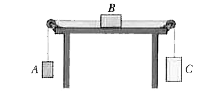
Figure 5-34 shows three blocks attached by cords that loop over frictionless pulleys. Block B lies on a friction-less table, the masses are `m_(A)=6.00` kg, `m_(B)=8.00` kg, and `m_(C)=10.0` kg. When the blocks are released, what is the tension in the cord at the right?

Figure 5-34 Three blocks attached over two pulleys by a cord.

Text Solution

Verified by Experts

First we analyze the entrie system with "clockwise" motion considered positive (that is, downward is positive for block C, rightward is positive for block B, and upward is positive for block A) and find acceleration. Then we analyze forces on block C only.
Calculation: The equation for the system is
`m_(C)g-m_(A)g=Ma" "("where M = mass of the system "=24.0 kg)`.
This yields an acceleration of
`a=g(m_(C)-m_(A))//M=1.63" m"//"s"^(2)`.
Next we analyze the forces just on block C : `m_(C)g-T=m_(C)a.`
Thus the tension is
`T=m_(C)g(2m_(A)+m_(B))//M=81.7" N".`
Promotional Banner

Topper's Solved these Questions

  • FORCE AND MOTION - I

    RESNICK AND HALLIDAY|Exercise CHECKPOINT|5 Videos
  • FORCE AND MOTION - I

    RESNICK AND HALLIDAY|Exercise PROBLEMS|52 Videos
  • FLUIDS

    RESNICK AND HALLIDAY|Exercise PRACTICE QUESTIONS (Integer Type )|5 Videos
  • FORCE AND MOTION-II

    RESNICK AND HALLIDAY|Exercise PRACTICE QUESTIONS (Integer Type)|1 Videos

Similar Questions

Explore conceptually related problems

In Fig. 5-31, three ballot boxes are connected by cords, one of which wraps over a pulley having negligible friction on its axle and negligible mass. The three masses are m_(A)=30.0 kg, m_(B)=40.0 kg, and m_(c)=10.0 kg. (a) When the assembly is released from rest, what is the tension in the cord connecting B and C? (b) When the assembly is released from rest, how far does A move in the first 0.250 s (assuming it does not reach the pulley)?

Figure 5-50 shows two blocks connected by a cord (of negligible mass) that passes over a frictionless pulley (also of negligible mass). The arrangement is known as Atwood's machine. One block has mass m_(1)=1.30 kg, the other has mass m_(2)=2.80 kg. What are (a) the magnitude of the blocks' acceleration and (b) the tension in the cord ?

Two blocks are connected by a cord passing over a small frictionless pulley and resting on frictionless planes as shown in the figure. The acceleration of the blocks is :

Two blocks are connected by a cord passing over a small frictionless pulley and resting on frictionless planes as shown in the figure The accleration of the blocks is-

Figure 5-20 shows a block S (the sliding block) with mass M = 3.3 kg. The block is free to move along a horizontal frictionless surface and connected, by a cord that wraps over a frictionless pulley, to a second block H (the hanging block), with mass m = 2.1 kg. The cord and pulley have negligible masses compared to the blocks (they are "massless"). The hanging block H falls as the sliding block S accelerates to the right. Find (a) the acceleration of block S, (b) the acceleration of block H, and ( c ) the tension in the cord. Figure 5.20 A block S of mass M is connected to a block H of mass m by a cord that wraps over a pulley.

Two 100 g blocks hang at the ends of a light flexible cord passing over a small frictionless pulley. A 40 g block rests on the block an right and removed after 2 sec. (a) How far will each block move in the first second after the 40 g block is removed? (b) What was the tension in the cord before the 40 g block was removed? (c) What was the tension in the cord supporting the pulley after the 40 g block was removed?

Pulleys shown in the system of the figure are massless and friction less. Threads are inextensible. Mass of block A, B and C are m_(1) kg,m_(2) =4kg and m_(3) = 2.75kg , respectively .Calculate acceleration of A block

In Fig. 5-27, a block attached to a chord is resting on an inclined plane. Let the mass of the block be 8.5 kg and the angle theta be 30^(@) . (a) Find the tension in the cord and normal force acting on the block. (b) If the cord is cut, find the magnitude of the resulting acceleration of the block. Figure 5-27 A block attached to a chord resting on an incline.

A block of mass m_(1)=3.70 kg on a frictionless plane inclined at angle 30.0^(@) is connected by a cord over a massless, frictionless pulley to a second block of mass m_(2)=2.30 kg (see Fig. 5-32). (a) What is the magnitude of the acceleration of each block? (b) What is the direction of the acceleration of the hanging block ? (c) What is the tension in the cord?

Two blocks of masses 3 kg and 6 kg are connected by a string as shown in the figure over a frictionless pulley. The acceleration of the system is
