Text Solution
Verified by Experts
The correct Answer is:



Topper's Solved these Questions
CURRENT AND RESISTANCE
RESNICK AND HALLIDAY|Exercise Problems|36 VideosCURRENT AND RESISTANCE
RESNICK AND HALLIDAY|Exercise Practice Questions (Single Corret Choice Type)|39 VideosCURRENT AND RESISTANCE
RESNICK AND HALLIDAY|Exercise Practice Questions (Integer Type)|3 VideosCIRCULAR MOTION
RESNICK AND HALLIDAY|Exercise CHECK POINTS|6 VideosELASTICITY
RESNICK AND HALLIDAY|Exercise PRACTICE QUESTIONS (Integer Type)|3 Videos
Similar Questions
Explore conceptually related problems
RESNICK AND HALLIDAY-CURRENT AND RESISTANCE-Checkpoints
- The figure here shows a portion of a circuit. What are the magnitude a...
Text Solution
|
- The figure shows conduction electrons moving leftward in a wire. Are t...
Text Solution
|
- The figure here shows three cylindrical copper conductors along with t...
Text Solution
|
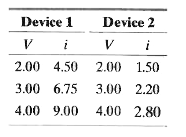
- The following tables gives the current i (in amperes) through two devi...
Text Solution
|
- Can you see how the two wires having different conductivities connecte...
Text Solution
|
- A potential difference V is connected across a device with resistance ...
Text Solution
|