Home
Class 12
PHYSICS
There are mainly two types of combinatio...

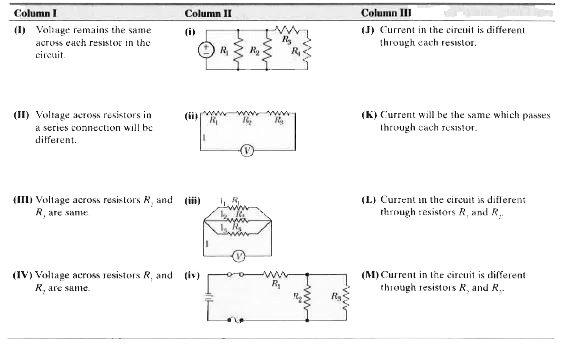
There are mainly two types of combinations of resistors in a circuit, series and parallel. In the given table, Column I shows voltages of different arrangements of resistors, Column II shows different arrangement of resistors and Column III shows currents of different arrangements of resistors.
What are the conditions when resistor is in the parallel network?

A

(I) (ii) (J)

B

(IV) (ii) (M)

C

(II) (ii) (J)

D

(I) (iii) (J)

Text Solution

Verified by Experts

The correct Answer is:

D
Promotional Banner

Topper's Solved these Questions

  • CURRENT AND RESISTANCE

    RESNICK AND HALLIDAY|Exercise Practice Questions (Integer Type)|3 Videos
  • CURRENT AND RESISTANCE

    RESNICK AND HALLIDAY|Exercise Practice Questions (Linked Comprehension)|5 Videos
  • CIRCULAR MOTION

    RESNICK AND HALLIDAY|Exercise CHECK POINTS|6 Videos
  • ELASTICITY

    RESNICK AND HALLIDAY|Exercise PRACTICE QUESTIONS (Integer Type)|3 Videos

Similar Questions

Explore conceptually related problems

Electrical current is the flow of charged particles. The electric current flows through a wire the same way as how water moves in a river. The electricity is nothing but the flow of electrons. There are two main combinations of resistors in circuit, that is series and parallel. In the given table, Column I shows different combinations of resistors, Column II shows voltages of different arrangements of resistors and Column III shows currents and voltage division needed or not in different arrangements of resistors. When does the voltage division problem arise?

Electrical current is the flow of charged particles. The electric current flows through a wire the same way as how water moves in a river. The electricity is nothing but the flow of electrons. There are two main combinations of resistors in circuit, that is series and parallel. In the given table, Column I shows different combinations of resistors, Column II shows voltages of different arrangements of resistors and Column III shows currents and voltage division needed or not in different arrangements of resistors. When there is no voltage division problem arise?

Electrical current is the flow of charged particles. The electric current flows through a wire the same way as how water moves in a river. The electricity is nothing but the flow of electrons. There are two main combinations of resistors in circuit, that is series and parallel. In the given table, Column I shows different combinations of resistors, Column II shows voltages of different arrangements of resistors and Column III shows currents and voltage division needed or not in different arrangements of resistors. When does the current division problem arise?

Interference is an important property of light. In the given table, Column I shows the properties of interfering waves, Column II shows the phase difference, and Column III shows the path difference between two interfering waves What are the conditions for destructive interference?

Interference is an important property of light. In the given table, Column I shows the properties of interfering waves, Column II shows the phase difference, and Column III shows the path difference between two interfering waves What are the conditions for constructive interference?

Interference is an important property of light. In the given table, Column I shows the properties of interfering waves, Column II shows the phase difference, and Column III shows the path difference between two interfering waves What are the conditions for sustained interference?

In the given table Column I shows the different values of masses of the body. Column II shows the different values of angular speed of the body and Column III shows the radius of circle in which the body moves. Which combination has 0.199N as the centrepetal force?

In the given table Column I shows the different values of masses of the body. Column II shows the different values of angular speed of the body and Column III shows the radius of circle in which the body moves. Which combination has 0.13N as the centrepetal force?
