Home
Class 12
PHYSICS
In the following figure shows the variat...

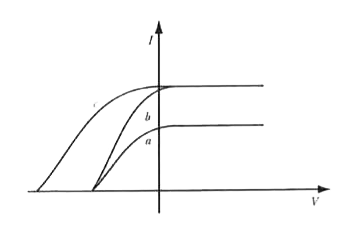
In the following figure shows the variation of photocurrent with potential of the collector plate for a photosensitive surface for three different radiations. Let `I_(a), I_(b) and I_(c)` be the intensities and `f_(a), f_(b) and f_(c)` be the frequencies for the curves a, b, and c, respectively.

A

`f_(a)=f_(b) and I_(a)= I_(b)`

B

`f_(a)=f_(c) and I_(a)= I_(c)`

C

`f_(a)=f_(b) and I_(a)lt I_(b)`

D

`f_(a)=f_(c) and I_(b)= I_(c)`

Text Solution

Verified by Experts

The correct Answer is:

C
Promotional Banner

Topper's Solved these Questions

  • PHOTONS AND MATTER WAVES

    RESNICK AND HALLIDAY|Exercise PRACTICE QUESTIONS (More than One Correct Choice Type)|5 Videos
  • PHOTONS AND MATTER WAVES

    RESNICK AND HALLIDAY|Exercise PRACTICE QUESTIONS (Link Comprehension)|17 Videos
  • PHOTONS AND MATTER WAVES

    RESNICK AND HALLIDAY|Exercise PROBLEMS|50 Videos
  • OSCILLATIONS

    RESNICK AND HALLIDAY|Exercise Practice Questions|57 Videos
  • RELATIVITY

    RESNICK AND HALLIDAY|Exercise PRACTICE QUESTIONS (Integer Type)|5 Videos

Similar Questions

Explore conceptually related problems

The fig. shows the variation of photon current with anode potential for a photo-senstive surface for three different radiation. Let I_(a), I_(b) and I_(c) be the intensities and f_(a), f_(b) and f_(c) be the frequency for the curves a,b and c respectively.

The figure shows the variation of photocurrent with anode potential for a photosensitve surface for three different radiations. Let l_a, l_b and l_c be the curves a, b and c, respectively (a) f_a = f_b and l_a != l_b (b) f_a = f_c and l_a = l_c (c ) f_a = f_b and l_a = l_b (d) f_b = f_c and l_b = l_c

From the following graph of photocurrent against collector plate potential for two different intensities of light I_1 and I_2 one can , conclude

From the following graph of photocurrent against collector plate potential, for two different intensities of light I_1 and I_2 one can conclude.

The Fig shows a plot of three curves a, b, c showing the variation of photocurrent versis collector plate potential for the different intensities I_1, I_2 and I_3 having frequencies v_1, v_2 and v_3 respectively, incident on a photosensitive surface. Point out the two curves for which the incident radiation have same frequency but different intensities.

The graph of Fig. shows the variation of photoelectric current with collector plate potential for different frequencies of incident radiations. (i) Which physical parameter is kept constant for the three curves? (ii) Which frequency (v_1,v_2 or v_3) is the highest?

If f is a bijection and g is the inverse of f ,then fog=I_(B and gof=I_(A) where I_(A) and I_(B) are ) the identively. respectively.

The following graph shows the variation of stopping potential with frequency for three different metals a, b and c . A light wave having wavelength 550 nm is falling on th metal surface a,b,c one by one. Which metal plate with generate photoelectric current?

RESNICK AND HALLIDAY-PHOTONS AND MATTER WAVES-PRACTICE QUESTIONS (Single Correct Choice Type)
  1. In the following figure gives the stopping voltage V versus the wavele...

    Text Solution

    |

  2. A non-monochromatic light is used in an experiment on photoelectric ef...

    Text Solution

    |

  3. In the following figure shows the variation of photocurrent with poten...

    Text Solution

    |

  4. In a photoelectric tube, the voltage applied is such that the photoele...

    Text Solution

    |

  5. An image of the sun is formed by a lens, of the focal length of 30 cm,...

    Text Solution

    |

  6. If a parallel beam of light having intensity I is incident normally on...

    Text Solution

    |

  7. The difference between the photons and other material particles that w...

    Text Solution

    |

  8. A beta particle, gamma ray, and alpha particle all have the same momen...

    Text Solution

    |

  9. If a proton and an electron have the same kinetic energy, which has th...

    Text Solution

    |

  10. The equation E=pc is valid

    Text Solution

    |

  11. A particle of mass 4m at rest decays into two particles of masses m an...

    Text Solution

    |

  12. Which of the following graph represent the variation of particle momen...

    Text Solution

    |

  13. The frequency of matter waves is expressed as

    Text Solution

    |

  14. Psi(x) is the wave function for a particle moving along the x axis. Th...

    Text Solution

    |

  15. The significance of |Psi|^(2)x is

    Text Solution

    |

  16. A free electron in motion along the x axis has a localized wave functi...

    Text Solution

    |

  17. The uncertainty in position of an electron in a certain state is 5 xx ...

    Text Solution

    |

  18. The reflection coefficient R for a certain barrier tunneling problem i...

    Text Solution

    |

  19. An electron with energy E is incident on a potential energy barrier of...

    Text Solution

    |

  20. An electron with energy E is incident upon a potential energy barrier ...

    Text Solution

    |
