Home
Class 12
PHYSICS
The table that follows shows some measur...

The table that follows shows some measurements of the decay rate of a sample of `.^(128)I`, a radio nuclide often used medically as a tracer to measure the rate at which iodine is absorbed by the thyroid gland.
`|{:("Time(min)",A (counts//s),"Time(min)",A(counts)//s,),(4,392.2,132,10.9,),(36,161.4,164,4.56,),(68,65.5,196,1.86,),(10,26.8,218,1.00,):}|`

The half life `t_(1//2)` for this radio nuclide.

Text Solution

Verified by Experts
The disintegration constant `lamda` determines the exponenetial rate at which the decay rate R decreases with time t (as indicated by Eq. 40 -17, `R=R_(0)e^(-lamda)` ). Therefore we should be able to determin `lamda` by plotting the measurements of R against the measurement times t. However, obtaining `lamda` from a plot of R versus t is difficult because R decreases exponentially with l, according to Eq. 40-17. A neat solution is to transform eq. 40 -17 into a linear function of t, so that we can easily find `lamda`. To do so we take the natural logarithms of both sides of Eq. 40 -17.
Calculations: We obtain
In `~r="In"(R_(0)e^(-lamdat))="In" R_(0)+"In"(e^(-lamdat))`
`="In" R_(0)-lamdat` (40-20)
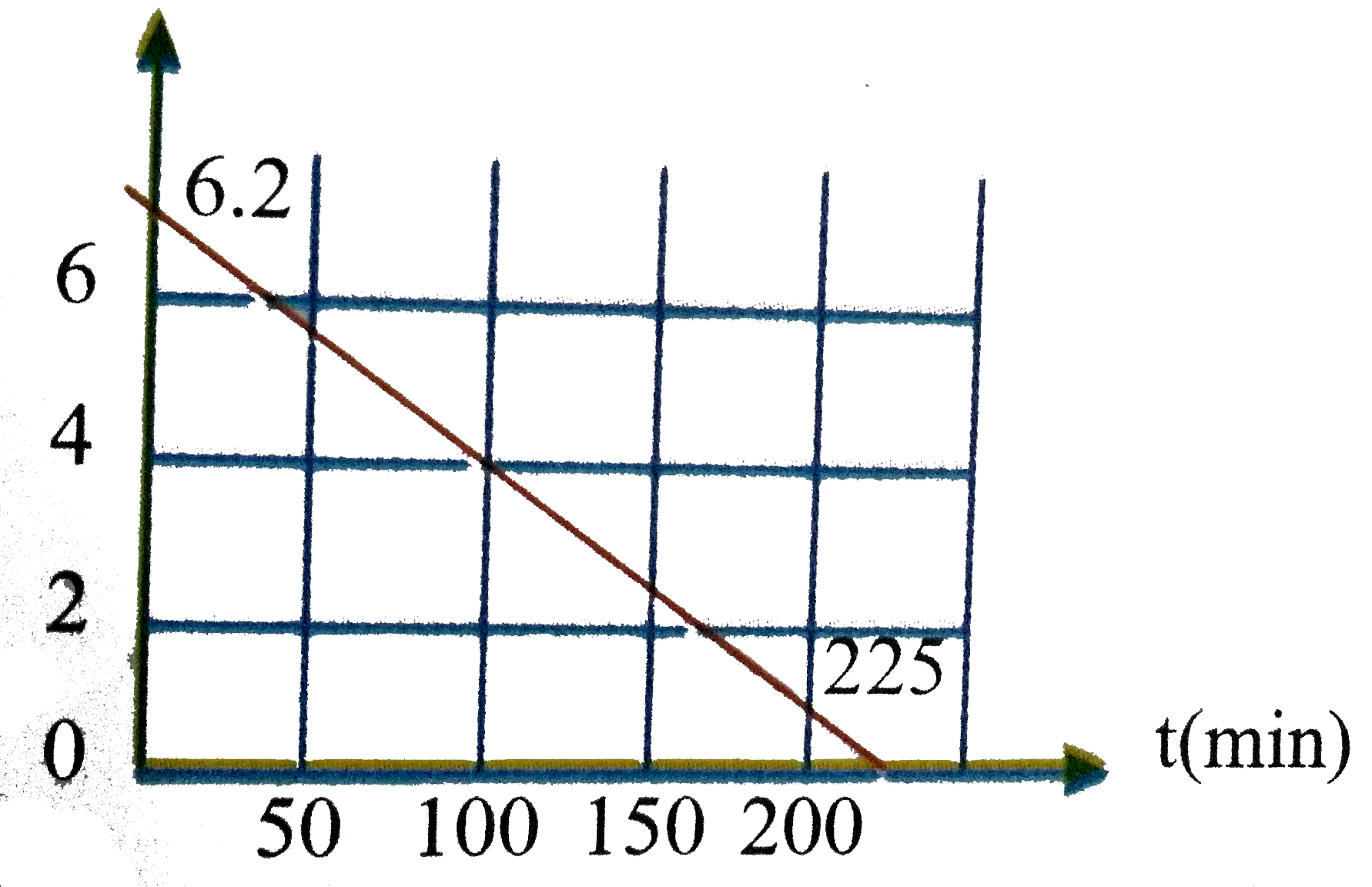
Because eq. 40 -20 9s of the form y=b+mx with b and m constants, itis a linear equation giving the quantity in R as a function of t. Thus, we plot In R (instead of R) versus t, we should get a straight line. Further, the slope of the line should be equal to `-lamda)`.
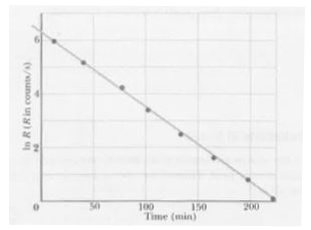
Figure 40 -11 shows a plot of In R versus time t for the given measurements. The slope of the straight line that fits through the plottd points is
slope `=(0-6.2)/(225"min"-0)=-0.276"min"^(-1)`
Thus `-lamda-0.0276"min"^(-1)`
or `lamda=0.0276"min"~~1.7h^(-1)`
The time for the decay rate R to decrease by 1/2 is related to the disintegration constant `lamda` via Eq. 40 -19 `(T_(1//2)=("In"2)//lamda)`. From the equation. We find
`T_(1//2)=("In"2)/(lamda)=("In"2)/(0.0276"min"^(-1))~~25` min.
Promotional Banner

Topper's Solved these Questions

  • THE NUCLEUS

    RESNICK AND HALLIDAY|Exercise CHECKPOINT|5 Videos
  • THE NUCLEUS

    RESNICK AND HALLIDAY|Exercise PROBLEMS|66 Videos
  • THE KINETIC THEORY OF GASES

    RESNICK AND HALLIDAY|Exercise PRACTICE QUESTIONS|72 Videos
  • UNITS AND MEASUREMENT

    RESNICK AND HALLIDAY|Exercise PRACTICE QUESTIONS (MATRIX-MATCH)|11 Videos

Similar Questions

Explore conceptually related problems

The half-life of a sample of a radioactive substance is 1 hour. If 8 xx 10^10 atoms are present at t = 0 , then the number of atoms decayed in the duration t = 2 hour to t = 4 hour will be

For an elementary, 2A+Bto3C , the rate of appearance of C at time 't' is 1*3xx10^(-4)"mol "L^(-1)s^(-1) . Calculate at this time (i) rate of the reaction (ii) rate of disappearance of A.

A first order reaction is found to have a rate constant, k = 4.2 xx 10^(-12) s^(-1) . Find the half-life of the reaction.

The half-life of a radioactive substance against alpha- decay is 1.2 xx 10^7 s . What is the decay rate for 4 xx 10^15 atoms of the substance ?

Cane sugar is gradualaly converted into dextrose and laevuloe by dilute acid. The rate of inversion is observed by measuring the polarisation angle, at various times, when the following results are obtained: {:("Time (min)",0,10,20,30,40,100,oo),("Angle",32.4,28.8,25.5,22.4,19.6,-6.1,-14.1):} Show that the reaction is of first order. Calculate the value of t, when the solution is optically inactive.

For a first order reactin, rate constant is given is log k = 14 - (1.2 xx 10^(4))/(T) , then what will be value of temperature if its half life period is 6.93 xx 10^(-3) min ?

For the elementary reaction 2A + B to 3C , if the rate of appearance of C at time 't' is 1.3 xx 10^(-4)mol L^(-1)s^(-1) , calculate at this time (i) rate of the reaction (ii) rate of disappearance of A.

