

Home
Class 11
PHYSICS
As shown in Fig. the two sides of a step...

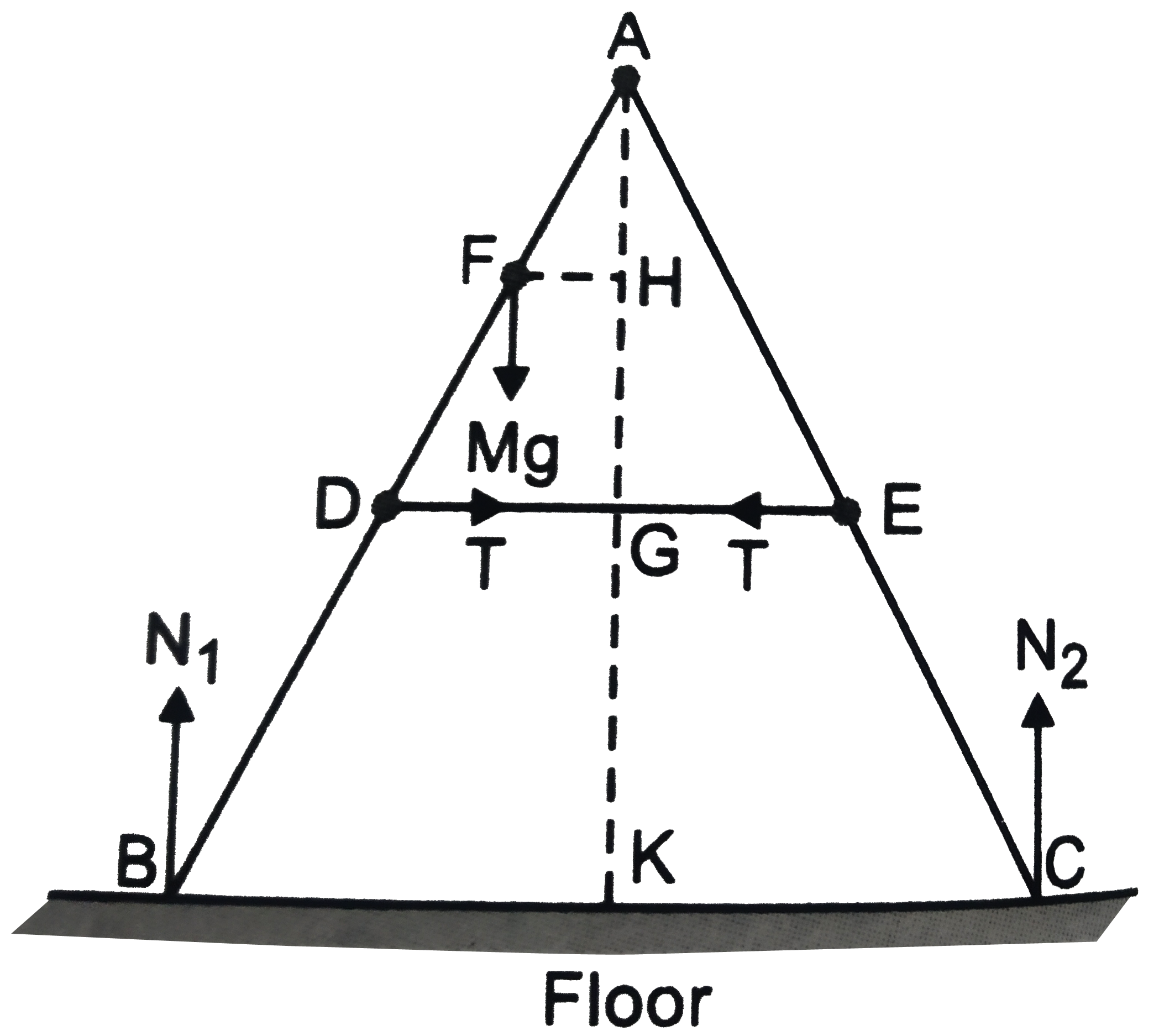
As shown in Fig. the two sides of a step ladder `BA` and `CA` are `1.6 m` long and hinged at `A`. A rope `DE, 0.5 m` is tied half way up. A weight `40 kg` is suspended from a point `F, 1.2 m` from B along the ladder` BA`. Assuming the floor to be fricionless and neglecting the weight of the ladder, find the tension in the rope and forces exerted by the floor on the ladder. (Take `g = 9.8 m//s^(2))`
(Hint. Consider the eqilibrium of each side of the ladder separately.)

Promotional Banner

Similar Questions

Explore conceptually related problems

As shown in Fig.7.40, the two sides of a step ladder BA and CA are 1.6 m long and hinged at A. A rope DE, 0.5 m is tied half way up. A weight 40 kg is suspended from a point F, 1.2 m from B along the ladder BA. Assuming the floor to be frictionless and neglecting the weight of the ladder, find the tension in the rope and forces exerted by the floor on the ladder. (Take g = 9.8 m//s^(2) )

As shown in the given figure. the two sides of a step ladder BA and CA are 1.6 m long and hinged at A.A rope DE, 0.5 m is tied half way up. A weight 40 kg is suspended from a point F, 1,2 m from B along the ladder BA. Assuming the floor to be frictionless and neglecting the weight of the ladder, find the tension in te rope and forces exerted by the floor on the ladder. (Take g = 9.8 ms^-2 ) (Hint: consider the equilibrium of each side of the ladder separately).

A 3m long ladder weighing 20 kg leans on a frictionless wall. Its feet rest on the floor 1 m from the wall as shown in Fig.7.27. Find the reaction forces of the wall and the floor.

A 3m long ladder weighing 20 kg leans on a frictionless wall. Its feet rest on the floor 1 m from the wall as shown in Fig.7.27. Find the reaction forces of the wall and the floor.