Home
Class 11
PHYSICS
A train whistling at constant frequency ...

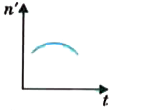
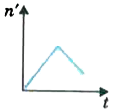
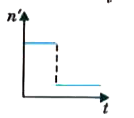
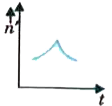
A train whistling at constant frequency is moving towards a station at a constant speed V. The train goes past a stationary observer on the station. The frequency `n^(')` of the sound as heard by the observer is plotted as a function of time t, figure. Identify the expected curve.

A

B

C

D

Text Solution

Verified by Experts

The correct Answer is:

C

When train is approaching a stationary observer, the apparent frequency observed is given by
`n'= (upsilon - upsilon_(0))/(upsilon - upsilon_(s)) n = ((upsilon)/(upsilon - V))n` = constant
Also, `n' gt n`
After crossing the stationary observer, the apparent frequency heard by observer is given by
`n' = (upsilon-upsilon_(0))/(upsilon - upsilon_(s)) n = ((upsilon)/(upsilon + V))n` = constant
Here `n' lt n`
The correct option is (c).
Promotional Banner

Topper's Solved these Questions

  • WAVES

    MODERN PUBLICATION|Exercise HIGH ORDER THINKING SKILLS & ADVANCED LEVEL|15 Videos
  • WAVES

    MODERN PUBLICATION|Exercise REVISION EXERCISES|107 Videos
  • WAVES

    MODERN PUBLICATION|Exercise NCERT ADDITIONAL EXERCISES|6 Videos
  • UNITS AND MEASUREMENT

    MODERN PUBLICATION|Exercise CHAPTER PRACTICE TEST|15 Videos
  • WORK, ENERGY AND POWER

    MODERN PUBLICATION|Exercise Chapter Practice Test|16 Videos

Similar Questions

Explore conceptually related problems

A railway engine whistling at a constant frequency moves with a constant speed. It goes past a stationary observer standing beside the railway track. The frequency (n) of the sound heard by the observer is plotted agains time (t) . Which of the following best represents the resulting curve?

A sound source, emitting sound of constant frequency, moves with a constant speed and crosses a stationary observer. The frequency (n) of sound heard by the observer is plotted against time (t). Which of the following graphs represents the correct variation :-

An engine whistling at a constant frequency n_0 and moving with a constant velocity goes past a stationary observer. As the engine crosses him, the frequency of the sound heard by him changes by a factor f. The actual difference in the frequencies of the sound heard by him before and after the engine crosses him is

A train is moving towards a stationary observer. Which of the following curve best represents the frequency recived by observer f aas afunction of time?

A source of sound is travelling towards a stationary observer. The frequency of sound heard by the observer is 25 % more than the actual frequency. If the speed of sound is v , that of the source is

If a source of frequency n moving with velocity v crosses a stationary observer, then the change in the frequency of sound heard by the observer will be (velocity of sound = V)

a bus is moving towards and stationary observer with speed 20 m/s blows a horn of frequency 200 Hz. the frequency of sound heard by the observer is approximately ( take speed of sound 320 m/s)

MODERN PUBLICATION-WAVES-NCERT EXEMPLAR PROBLEMS
  1. Equation of a plane progressive wave is given by y=0.6 sin 2pi(t-(x)/(...

    Text Solution

    |

  2. A string of mass 2.50kg is under a tension os 200N. The length of the ...

    Text Solution

    |

  3. A train whistling at constant frequency is moving towards a station at...

    Text Solution

    |

  4. A transverse harmonic wave on a string is descrbed by y(x, t) = 3.0 si...

    Text Solution

    |

  5. The displacement of a string is given by y(x,t)=0.06sin(2pix//3)cos(12...

    Text Solution

    |

  6. Speed of sound waves in a fluid depends

    Text Solution

    |

  7. During propagation of a plane progressive mechanical wave,

    Text Solution

    |

  8. The transverse displacement of a string (clamped at its both ends ) is...

    Text Solution

    |

  9. A train, standing in a station yard, blows a whistle of frequency 400H...

    Text Solution

    |

  10. Which of the following statements are true for a stationary wave ?

    Text Solution

    |

  11. A sonometer wire is vibrating is resonance with a tuning fork. Keeping...

    Text Solution

    |

  12. An organ pipe of length L open at both ends is found to vibrate in its...

    Text Solution

    |

  13. A tuning fork A, marked 512 Hz, produces 5 beats per second, when soun...

    Text Solution

    |

  14. The displacement of an elastic wave is given by the function y=3 sin o...

    Text Solution

    |

  15. A sitar wire is replaced by another wire of same length and material b...

    Text Solution

    |

  16. At what temperatures (i n ^(@)C) will the speed of sound in air be 3 t...

    Text Solution

    |

  17. When two waves of almost equal frequencies n(1) andn(2) reach at a po...

    Text Solution

    |

  18. A steel wire has a length of 12 m and a mass of 2.10 kg. What will be ...

    Text Solution

    |

  19. A pipe 20 cm long is closed at one end. Which harmonic mode of the pip...

    Text Solution

    |

  20. A train standing at the outer signal of a railway station blows a whis...

    Text Solution

    |
