

Home
Class 12
PHYSICS
A small, electrically charged bead can s...

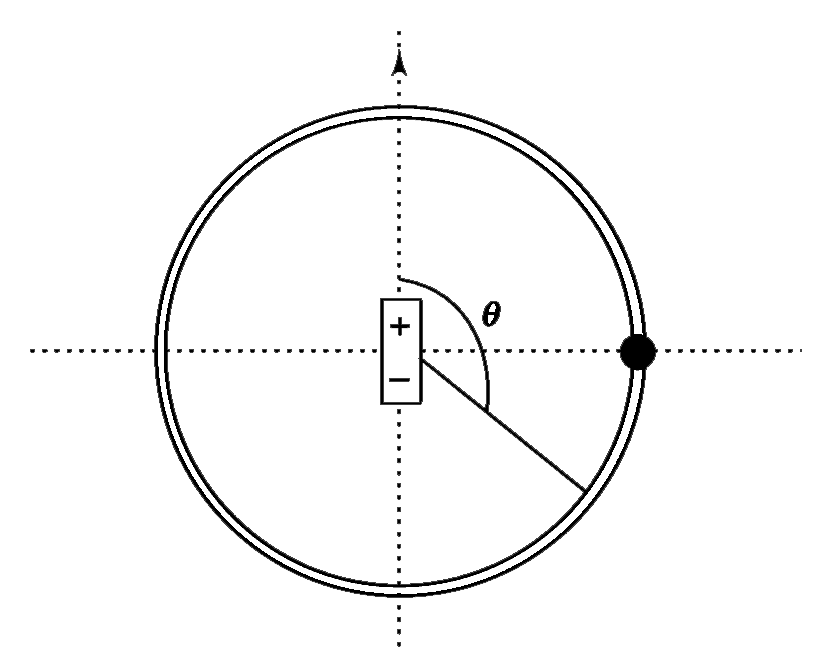
A small, electrically charged bead can slide on a circular, frictionless, thin, insulating ring. Charge on the bead is Q and its mass is m . A small electric dipole, having dipole moment P is fixed at the centre of the circle with the dipole’s axis lying in the plane of the circle. Initially, the bead is held on the perpendicular bisector of the dipole (see fig.) Ignore gravity and answer the following questions.
(a) Write the speed of the bead when it reaches the position `theta` shown in the figure. (b) Find the normal force exerted by the ring on the bead at position `theta`. (c) How does the bead move after it is released? Where will the bead first stop after being released? (d) How would the bead move in the absence of the ring?

Promotional Banner

Similar Questions

Explore conceptually related problems

Define electric dipole and electric dipole moment.

A small, electrically charged bead can slide on a circular, frictioless, insulating rod. A point - like electric dipole (vec(P)) is fixed at the centre of the circle with the dipole.s axis lying in the plane of the circle. Intially the bead is on the plane of symmetry of the dipole, as shown in the figure. The bead is slightly displaced along ring, tangentially with intial speed very close to zero. (Ignore the effect of gravity, assuming that the electric forces are much greater than the gravitational ones). The normal force exerted by rod on the bead is (q = angle between an radius vector of bead, (considering dipole as origin)

A small, electrically charged bead can slide on a circular, frictioless, insulating rod. A point - like electric dipole (vec(P)) is fixed at the centre of the circle with the dipole.s axis lying in the plane of the circle. Intially the bead is on the plane of symmetry of the dipole, as shown in the figure. The bead is slightly displaced along ring, tangentially with intial speed very close to zero. (Ignore the effect of gravity, assuming that the electric forces are much greater than the gravitational ones). How would the bead move in the absence of rod (intial motion is perpendicular to and negligibly small)

For a small dipole, (ii) Show that the electric potential vanishes at all points on the perpendicular bisector of the dipole.

A dipole of dipole moment P is kept at the centre of a ring of radius R and charge Q the dipole moment has direction along the ring due to the dipole is :

Show that the ratio of electric fields at equal distances on the axis and on the perpendicular bisector for a small dipole is 2 : 1.

What is the ratio of the intensity of the electric field at a particlular distance on the axis to that on the perpendicular bisector of a very small dipole ?