

Home
Class 11
PHYSICS
A container is partially filled with a l...


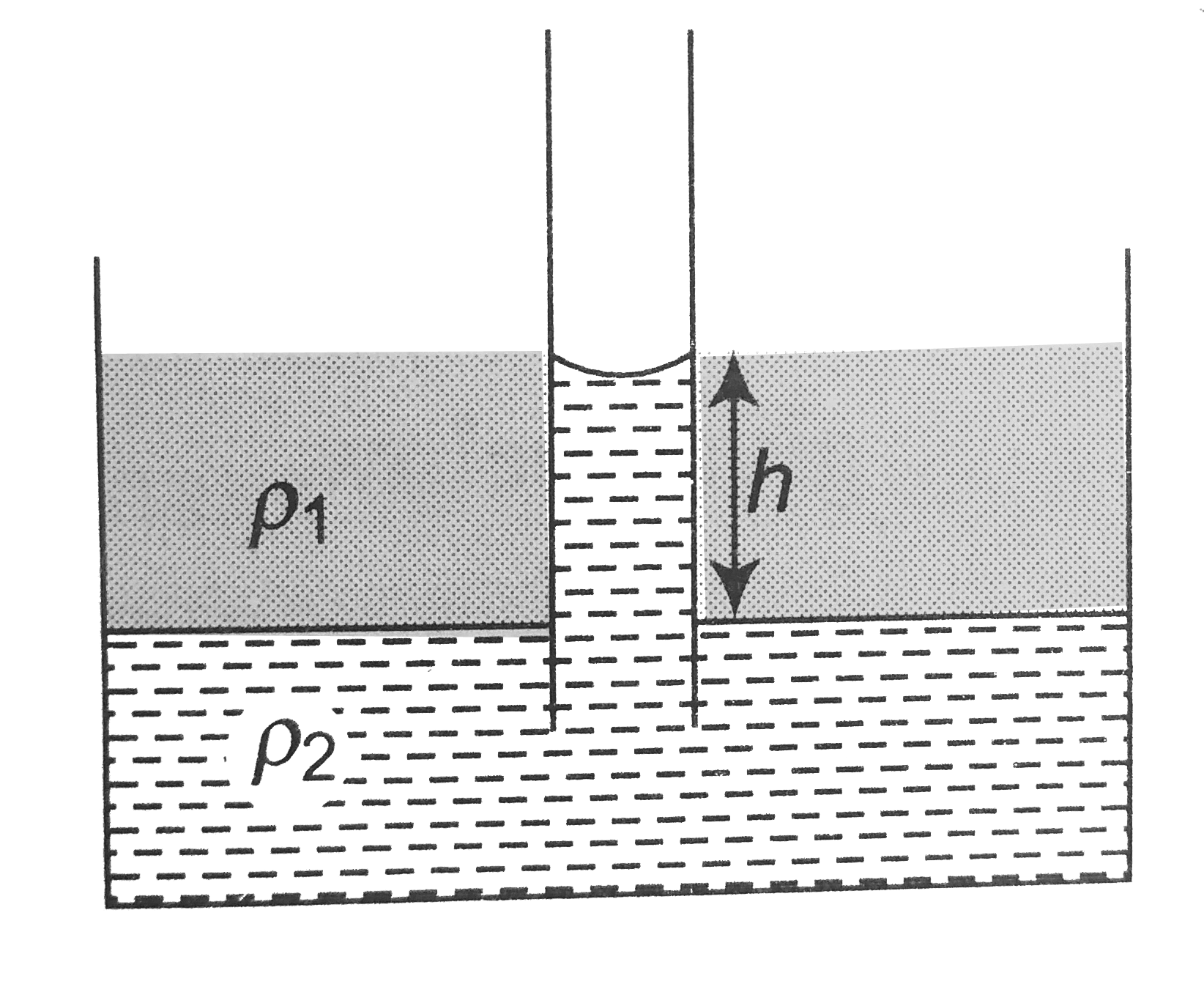
A container is partially filled with a liquid of density `rho_2` A capillary tube of radius r is vertically inserted in this liquid. Now another liquid of density `rho_1(rho_1ltrho_2)` is slowly poured in the container to a height h as shown. There is only denser liquid in the capillary tube. The rise of denser liquid in the capillary tube is also `h`. Assuming zero contact angle, the surface tension of heavier liquid is

Promotional Banner

Similar Questions

Explore conceptually related problems

The liquid in the capillary tube will rise if the angle of contact is

The liquid in the capillary tube will rise if the angle of contact is

A liquid rises in a capillary tube when the angle of contact is:

A liquid rises in a capillary tube when the angle of contact is:

A liquid rises in a capillary tube when the angle of contact is:

During capillary rise of a liquid in a capillary tube, the surface of contact that remains constant is of

Due to capillary action, a liquid will rise in the capillary tube if the angle of contact is

Due to capillary action, a liquid will rise in the capillary tube if the angle of contact is

(i) One end of a uniform glass capillary tube of radius r = 0.025 cm is immersed vertically in water to a depth h = 1cm . Contact angle is 0^(@) , surface tension of water is 7.5 × 10⁻² N//m , density of water is rho = 10^(3) kg//m^(3) and atmospheric pressure is P_(o) = 10^(5) N // m^(2) Find the excess pressure to be applied on the water in the capillary tube so that - (a) The water level in the tube becomes same as that in the vessel. (b) Is it possible to blow out an air bubble out of the tube by increasing the pressure? (ii) A container contains two immiscible liquids of density rho_(1) and rho_(2) (rho_(2) gt rho_(1)) . A capillary of radius r is inserted in the liquid so that its bottom reaches up to denser liquid and lighter liquid does not enter into the capillary. Denser liquid rises in capillary and attain height equal to h which is also equal to column length of lighter liquid. Assuming zero contact angle find surface tension of the heavier liquid.