Text Solution
Verified by Experts




Topper's Solved these Questions
CARBON AND ITS COMPOUNDS
VK GLOBAL PUBLICATION|Exercise VERY SHORT ANSWER QUESTIONS|33 VideosCARBON AND ITS COMPOUNDS
VK GLOBAL PUBLICATION|Exercise SHORT ANSWER QUESTIONS-I|24 VideosCARBON AND ITS COMPOUNDS
VK GLOBAL PUBLICATION|Exercise PROFICIENCY EXERCISE (Long Answer Questions)|6 VideosACIDS, BASES AND SALTS
VK GLOBAL PUBLICATION|Exercise PROFICIENCY EXERCISE ( Long Answer Questions (5 mark))|4 VideosCHEMICAL REACTIONS AND EQUATIONS
VK GLOBAL PUBLICATION|Exercise PROFICIENCY EXERCISE (LONG ANSWER QUESTIONS)|2 Videos
Similar Questions
Explore conceptually related problems
VK GLOBAL PUBLICATION-CARBON AND ITS COMPOUNDS-NCERT Exercises
- Ethane, with the molecular formula C(2)H(6) has
Text Solution
|
- Butanone is a four-carbon compound with the functional group
Text Solution
|
- While cooking, if the bottom of the vessel is getting blackened on the...
Text Solution
|
- Explain the nature of the covalent bond using the bond formation in CH...
Text Solution
|
- Draw the electron dot structures for: (a) ethanoic acid (b) H(2)...
Text Solution
|
- What is a homologous series ? Explain with an example.
Text Solution
|
- How can ethanol and ethanoic acid be differentiated on the basis of th...
Text Solution
|
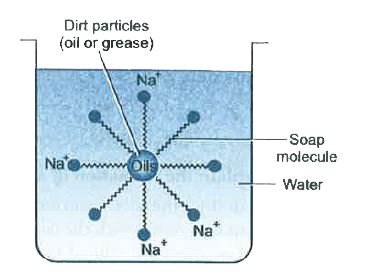
- Why does micelle formation take place when soap is added to water? Wil...
Text Solution
|
- Why are carbon and its compounds used as fuels for most applications?
Text Solution
|
- Explain the formation of scum when hard water is treated with soap.
Text Solution
|
- What change will you observe if you test soap with litmus paper (red a...
Text Solution
|
- What is hydrogenation? What is its industrial application?
Text Solution
|
- Which of the following hydrocarbons undergo addition reactions? C(2)...
Text Solution
|
- Give a test that can be used to differentiate chemically between butte...
Text Solution
|
- Explain the mechanism of the cleaning action of soaps.
Text Solution
|