

Home
Class 11
PHYSICS
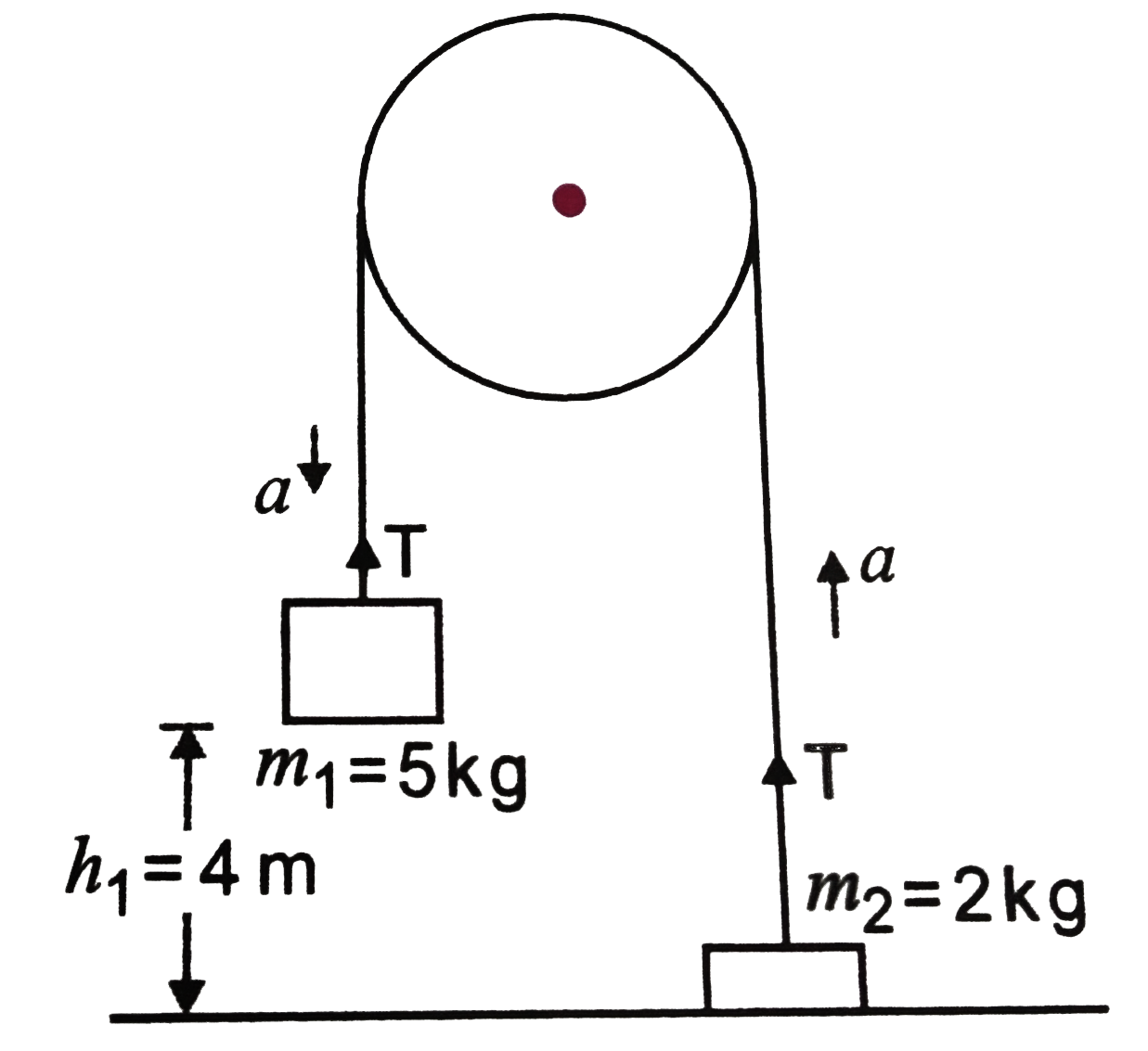
Two masses as shown in figure. Are relea...

Two masses as shown in figure. Are released from their positions. Calculate the velocity with which the mass of 5kg touches the surface if its initial heigth from the surface is 4m. Also, show that the gain in KE of the system is equal to loss in its P.E. Take `g=10ms^(-2)`.

Promotional Banner

Similar Questions

Explore conceptually related problems

The pendulum shown in the figure is kept horizontal. It is released from this positions. What is its velocity when it reaches the lowest position? (g=9.8ms^(-2))

How high must a body be lifted so that it gain P.E. equal to its KE while moving with a velocity of 30m//s ?Take g=10m//s^(2)

A raindrop of mass 1.00 g falling from a height of 1m hits the ground with a speed of 50 ms^(-1) Calculate (a) the loss of PE of the drop (b) the gain in KE of the drop ( c ) Is the gain in KE equal to loss of PE ? If not why ? Take, g =10 ms^(-2)

Two unequal masses are connected on two sides of a light and smooth pulley as shown in figure. The system is released from rest. The larger mass is stopped 1.0 second after the system is set into motion and then released immediately. The time elapsed before the string is tight again is: Take g=10m//s^(2)

A trolley of mass 20 kg is attached to a block of mass 4kg by massless string passing over a frictionless pulley as shown in the figure. If the coefficient of kinetic friction between trolley and the surface is 0.02, then the accderal ion of the trolley and block system is ("Take" g=10ms^(-2))

A trolley of mass 20 kg is attached to a block of mass 4kg by massless string passing over a frictionless pulley as shown in the figure. If the coefficient of kinetic friction between trolley and the surface is 0.02, then the accderal ion of the trolley and block system is ("Take" g=10ms^(-2))

Araindrop of mass 1 . 00 g falling from a height of 1 km hits the ground with a speed of 50 m s"^(-1) . Calculate (a) the loss of the drop . (b) the gain in K.E of the drop (c ) Is the gain in K.E equal to loss of P.E ? If not why ? Take g = 10 "ms"^(-2) .

A 1 kg mass on a floor is connected to a 2 kg mass by a string passing over a pulley. Obtain the speed of masses (after they are released), when the 2 kg mass just touches the floor. Establish that the gain in kinetic energy of the system equals the loss in its potential energy. The 2 kg mass is initially at a height of 3 m above the ground. Take g=9.8 ms^(-2) .