

Home
Class 12
PHYSICS
A block of mass m is stationary with res...

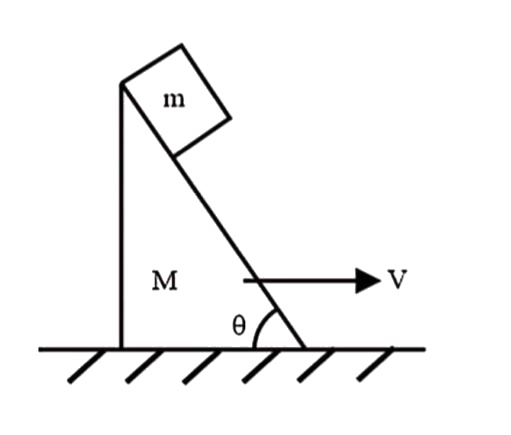
A block of mass m is stationary with respect to the wedge of mass M moving with uniform speed v on horizontal surface. Work done by friction force on the block in t seconds is

Promotional Banner

Similar Questions

Explore conceptually related problems

A block of mass m rests on a stationary wedge of mass M. The wedge can slide freely on a smooth horizontal surface as shown in figure. If the block starts from rest

A block of mass m rests on a stationary wedge of mass M. The wedge can slide freely on a smooth horizontal surface as shown in figure. If the block starts from rest

Block of mass m is stationary w.r.t. wedge. Normal force exerted by wedge on the block is

A block of mass m is kept over another block of mass 2 m and the system rests on a smooth horizontal surface. The coefficient of friction between the blocks is 0.50. Find the work done by the force of friction on the smaller block by the bigger block during a displacement d of the system, when a force mg is applied to the lower block.

A block of mass m is placed at the bottom of a massless smooth wedge which if placed on a horizontal surface. When we push the wedge with a constant force, the block moves up the wedge. Find the work done by the external agent when the block has a speed v and is reaches the top of the wedge.

A block of mass m is placed at the bottom of a massless smooth wedge which if placed on a horizontal surface. When we push the wedge with a constant force, the block moves up the wedge. Find the work done by the external agent when the block has a speed v and is reaches the top of the wedge.

A block of mass m is kept over another block of mass M and the system rests on a horizontal surface. A constant horizontal force F acting on the lower block produces an acceleration (F)/(2(m+M)) in the sytem. The two blocks always move together. Consider displacement d of the system. a. Find the work done by friction on bigger block. b. Find the coefficient of kinetic friction between the bigger block and the horizontal surface. c. Find the frictional acting on the smaller block. d. Find the work done by the force of friction on the smaller block by the bigger block. e. Find the work done by static friction on bigger block.

A block of mass m is kept over another block of mass M and the system rests on a horizontal surface. A constant horizontal force F acting on the lower block produces an acceleration (F)/(2(m+M)) in the sytem. The two blocks always move together. Consider displacement d of the system. a. Find the work done by friction on bigger block. b. Find the coefficient of kinetic friction between the bigger block and the horizontal surface. c. Find the frictional acting on the smaller block. d. Find the work done by the force of friction on the smaller block by the bigger block. e. Find the work done by static friction on bigger block.

A block of mass m is kept over another block of mass 2m and the system rests on a smooth horizontal surface. The coefficient of friction between the block is 0. 50 . Find the work done by the force of friction on the smaller block by the bigger block during a displacement the of the system when a force mg is applied to the lower block

A block of mass m is placed on another block of mass M which itself is lying on a horizontal surface .The coefficient of friction between two blocks is mu_(1) and that between the block of mass M and horizontal surfece is mu_(2) What maximum horizontal force can be applied to the lower block move without separation?