

Home
Class 12
MATHS
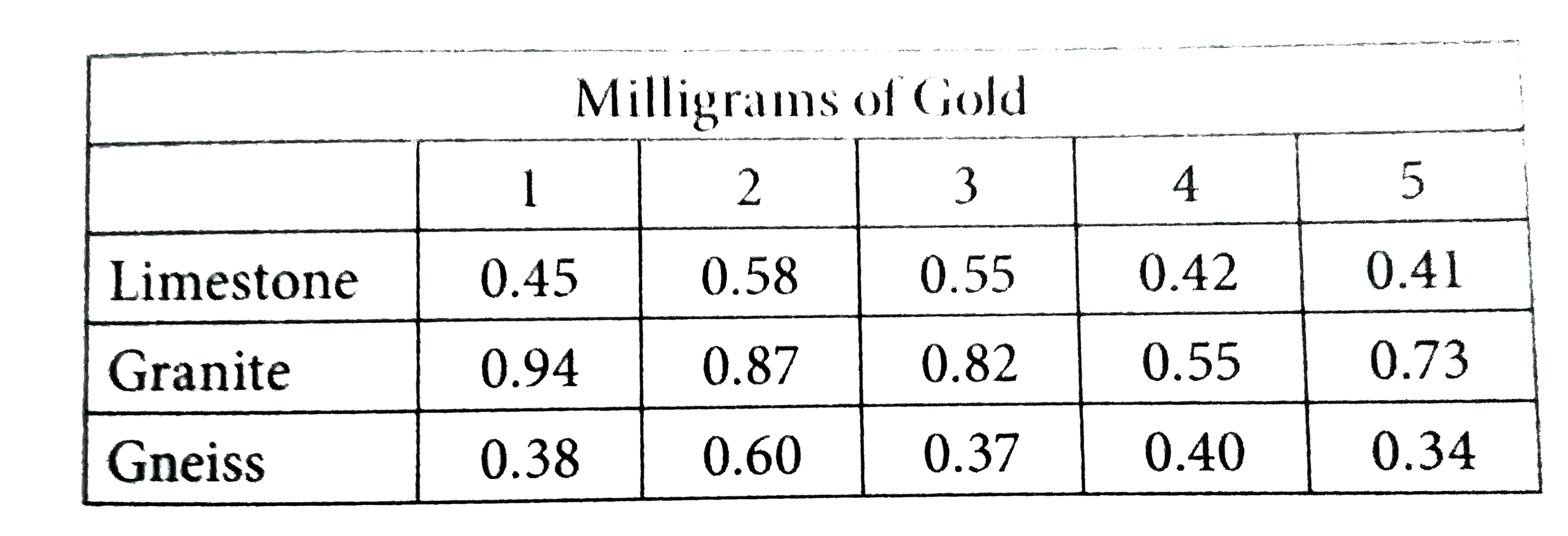
Five samples of each of three different ...


Five samples of each of three different rock types were collected on a hiking trip in Colorado. Each sample was analyzed for its gold content. The milligrams of gold found in each sample are presented in the table above. How much larger is the median of the amount of gold in the granite samples than that of the limestone samples?

Promotional Banner

Similar Questions

Explore conceptually related problems

Five samples of each of three different rock types were collected on a hiking trip in Colorado. Each sample was analyzed for its gold content. The milligrams of gold found in each sample are presented in the table above. What is the percent difference of the average gold content in the granite samples when compared to the average gold content of the gneiss samples?

Four samples of water [H_(2)O] are collected from different sources, Each sample on analysis was found to containsame percentage of oxygen. Which law of chemical combination is demonstrated by the above observation?

Collect samples of bees found in different crop fields and try to identify each of them.

(a) Four samples of carbon dioxide (CO_(2)) were prepared by using different methods. Each sample on analysis was found to contain 27.27% carbon by mass. Name the law which is in agreement with this observation. (b) Explain why the number of atoms in one mole of hydrogen gas is double the number of atoms in one mole of helium gas.

Simplest or empirical formula: Ascorbie acid (vitamin C ) a white crystalline solid, that is present in fruits and vegetables, curves scury and may help prevent the common cold. It is composed of 40.92%C, 4.58% H , and 54.50% O by mass. Determine its emprical formula. Strategy: Because one mole of atoms of any given element is 6.022xx10^(23) atoms, the ratio of the numbers of atoms the ratio of the numbers of atoms in any sample fo a compound is the same as the ratio fo motes of atoms is that compound. Thus, the energy is to, find the relative number of moles of each element in the compound and then use the numbers to establish the mole ratio of the elements which in turn give the subsrips in the empral formula. This calculation si carried out as follow: Step 1: Becuase the sum of all the percentages is 100% it is conventient to solve this type of problem by considerinf exactly 100g of the substance, which means 100.00g of ascoric acid contains 40.92g of C, 4.58g of H , and 54.50g of O Next we need to calculate the number of moles of atoms of each element in the compound. Step 2: We then obtain teh simplest whole number ratio between these number that gives that ratio of atoms in the sample and hence, the simplest or empirical formula for the compound.

A fair coin is tossed four xx,and people win Re 1 for each head and lose Rs 1.50 for each tail that turns up.From the sample space calculate how many different amounts of money you can have after four tosses and the probability' of having each of these amounts.

A fair coin is tossed four times, and people win Re 1 for each head and lose Rs 1.50 for each tail that turns up. From the sample space calculate how many different amounts of money you can have after four tosses and the probability' of having each of these amounts.

A fair coin is tossed four times and a person win R1 for each head and lose R1.50 for each tail that turns up. From the sample space calculate how many different amounts of money you can have after four tosses and the probability of having each of the amounts.

A fair coin is tossed four times, and a person wins Re. 1 for each head and loses Rs 1.50 for each tail that turns up. From the sample space. calculate how many different amounts of money you can have after four tosses and the probability of having each of the these amounts.