

Home
Class 12
PHYSICS
A photoelectric cell is connected to a s...


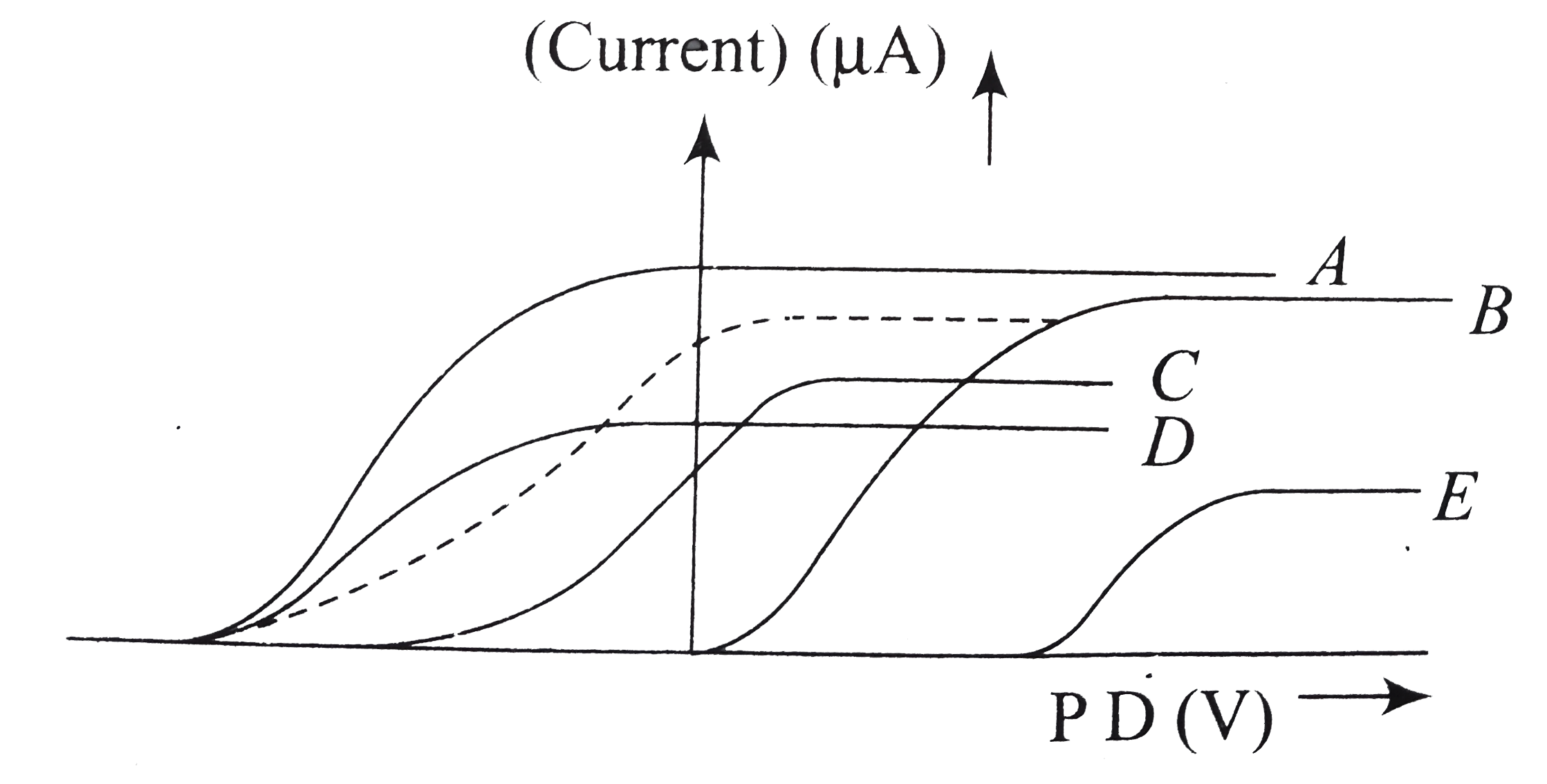
A photoelectric cell is connected to a source of variable potential difference, connected across it and the photoelectric current resulting `(muA)` is plotted against the applied potential difference (V). The graph in the broken line represents one for a given frequency and intensity of the incident radiation . If the frequency is increased and the intensity is reduced, which of the following graphs of unbroken line represents the new situation?

Promotional Banner

Similar Questions

Explore conceptually related problems

In a photoelectric experiment the relation between applied potential difference between cathode and anode V and the photoelectric current cathode and anode V and the photoelectric current l and was found to be shown in graph below. If planck's constant h=6.6xx10^(-34) Js, the frequency of incident radiation would e nearly (in s^(-1) )

In a photoelectric experiment the relation between applied potential difference between cathode and anode V and the photoelectric current cathode and anode V and the photoelectric current l and was found to be shown in graph below. If planck's constant h=6.6xx10^(-34) Js, the frequency of incident radiation would be nearly (in s^(-1) )

In a photoelectric effect experiment, the graph of stopping potential V versus reciprocal of wavelength obtained is shown in the figure. As the intensity of incident radiation is increased :

In a photoelectric effect experiment, the graph of stopping potential V versus reciprocal of wavelength obtained is shown in the figure. As the intensity of incident radiation is increased :

Which of the following graphs represents correctly the variations of 0.5 mv_("max")^(2) with the intensity of incident radiations of a constant frequency ?

In the following figure the curves have been drawn between the photoelectric current and the potential difference applied at the cathode with respect to anode at four different intensities, the stopping potential is represent by

The graph of Fig. shows the variation of photoelectric current (I) versus applied voltage (V) for the two different photosensitive materials for two different intensities of the incident radiation. Identify the pairs of curves that correspond to different materials but same intensity of incident radiation.

The graph of Fig. shows the variation of photoelectric current (I) versus applied voltage (V) for the two different photosensitive materials for two different intensities of the incident radiation. Identify the pairs of curves that correspond to different materials but same intensity of incident radiation.