

Home
Class 11
PHYSICS
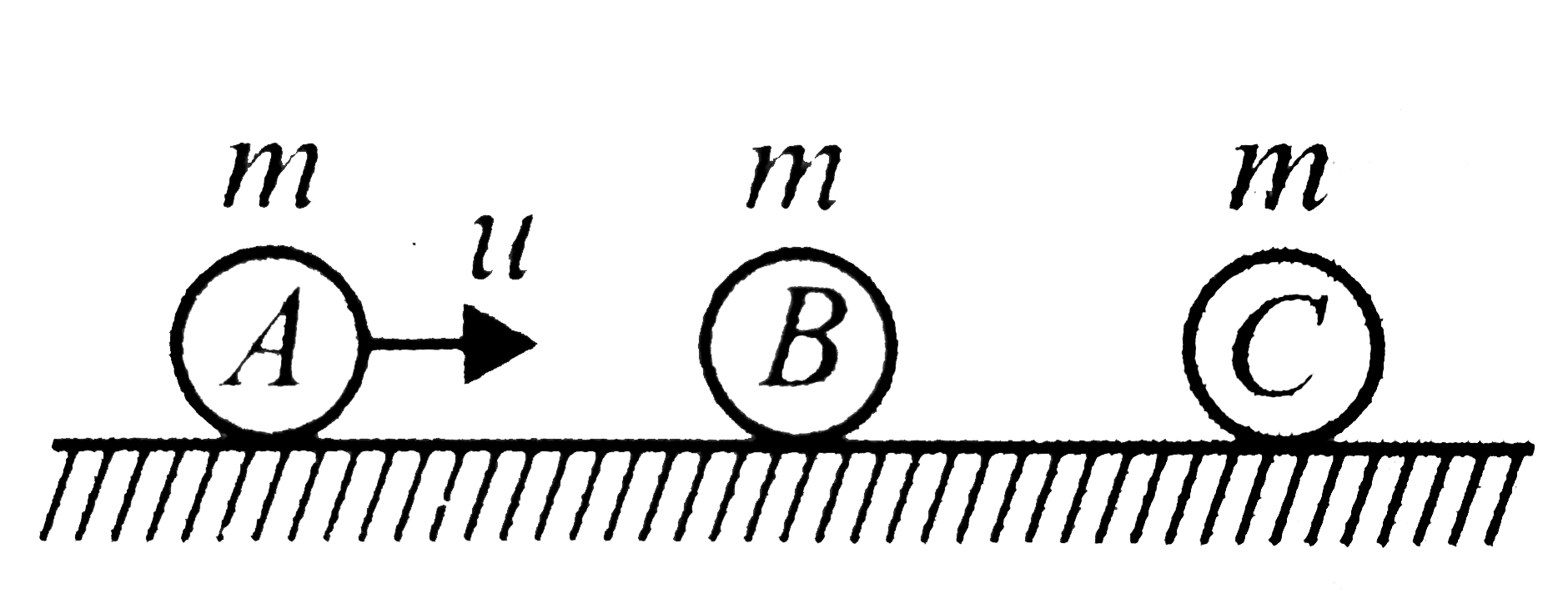
Three balls A, B and C of same mass m ar...

Three balls `A, B` and `C` of same mass `m` are placed on a frictionless horizontal plane in a straight line as shown. Ball `A` is moved with velocity `u` towards the middle ball `B`. If all the collisions are elastic, find the final velocities of all the balls.

Promotional Banner

Similar Questions

Explore conceptually related problems

Four identical balls A,B, C and D are placed in a line on frictionless horizontal surface. A and D are moed with the same speed u towards the middle as shown. Assuming elastic collisions, find the final velocities.

Four identical balls A,B, C and D are placed in a line on frictionless horizontal surface. A and D are moed with the same speed u towards the middle as shown. Assuming elastic collisions, find the final velocities.

A smooth hollow U shaped tube of mass 2m is lying at rest on a smooth horizontal table. Two small balls of mass m, moving with velocity u enter the tube simultaneously in symmetrical fashion. Assume all collisions to be elastic. Find the final velocity of the balls and the tube.

Two balls marked 1 and 2 of the same mass m and a third ball marked 3 of mass M are arranged over a smooth horizontal surface as shown in the figure. Ball 1 moves with a velocity v_(1) towards ball 2. All collisions are assumed to be elastic. If Mltm , the number of collisions between the balls will be.

Two balls marked 1 and 2 of the same mass m and a third ball marked 3 of mass M are arranged over a smooth horizontal surface as shown in the figure. Ball 1 moves with a velocity v_(1) towards ball 2. All collisions are assumed to be elastic. If Mltm , the number of collisions between the balls will be.

Two balls marked 1 and 2 of the same mass m and a third ball marked 3 of mass M are arranged over a smooth horizontal surface as shown in the figure. Ball 1 moves with a velocity v_(1) towards ball 2. All collisions are assumed to be elastic. If Mltm , the number of collisions between the balls will be.

Two balls marked 1 and 2 of the same mass m and a third ball marked 3 of mass M are arranged over a smooth horizontal surface as shown in the figure. Ball 1 moves with a velocity v_(1) towards ball 2. All collisions are assumed to be elastic. If Mltm , the number of collisions between the balls will be.