

Home
Class 11
PHYSICS
A light in extensible thread passes over...

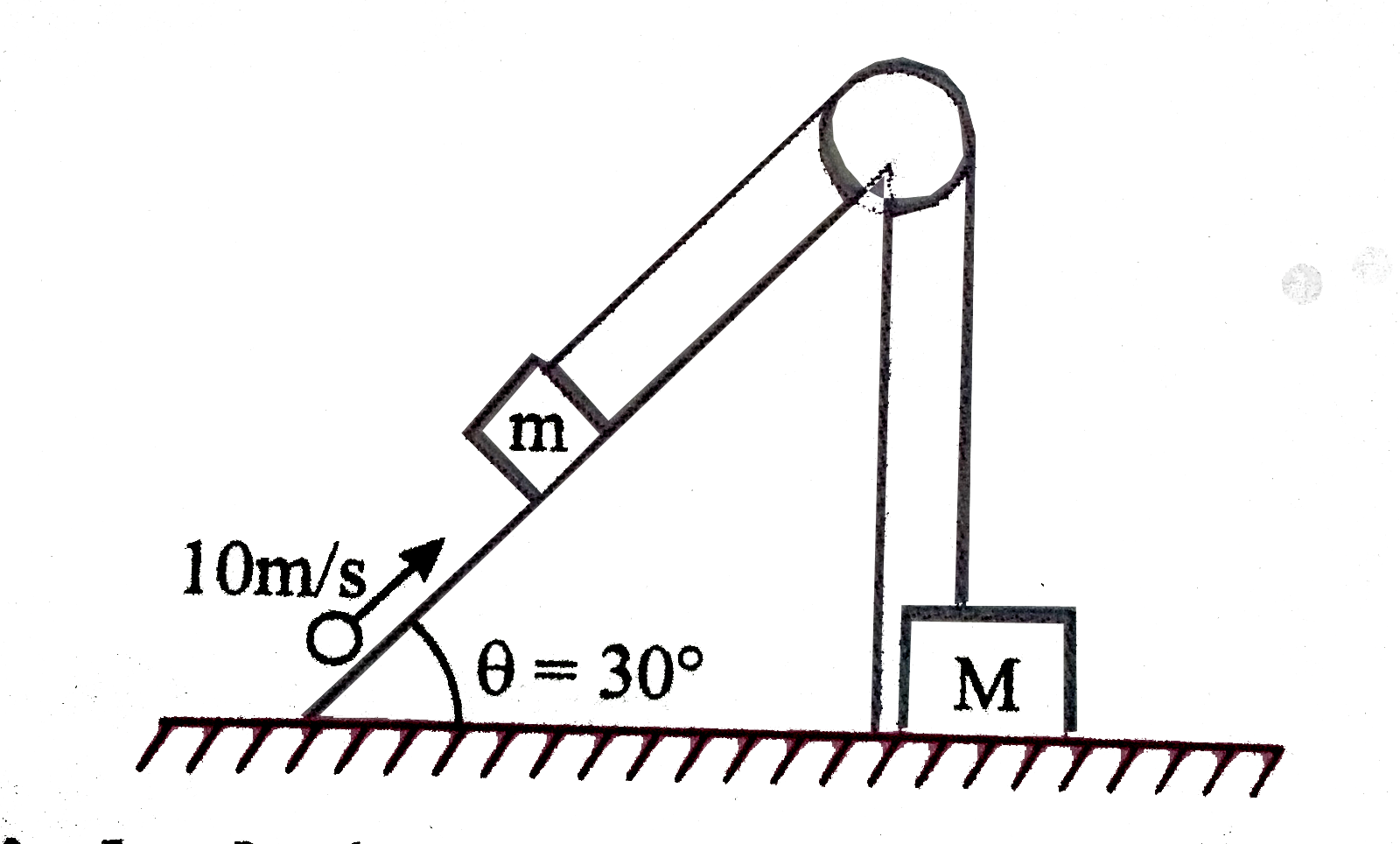
A light in extensible thread passes over a small frictionless pully. Two blocks of masses `m = kg` and `M = 3kg` respectively are attached with the thread as shown in the fig. The heavier block rests on a horizontal surface. A shell of mass `1 kg` moving upward with a velocity `10m//s` collides and sticks with the block of mass `'m'` as shown in the fig at `t = 0`. If the long inclined plane is smooth.

Find velocity of `(m+"shell")` just after collision.

Promotional Banner

Similar Questions

Explore conceptually related problems

A light in extensible thread passes over a small frictionless pully. Two blocks of masses m = kg and M = 3kg respectively are attached with the thread as shown in the fig. The heavier block rests on a horizontal surface. A shell of mass 1 kg moving upward with a velocity 10m//s collides and sticks with the block of mass 'm' as shown in the fig at t = 0 . If the long inclined plane is smooth. Find the maximum height ascended by 'M'

A light in extensible thread passes over a small frictionless pully. Two blocks of masses m = kg and M = 3kg respectively are attached with the thread as shown in the fig. The heavier block rests on a horizontal surface. A shell of mass 1 kg moving upward with a velocity 10m//s collides and sticks with the block of mass 'm' as shown in the fig at t = 0 . If the long inclined plane is smooth. Find the total time T at that instant of maximum height ascended by M

A light inelastic thread passes over a small frictionless pulley. Two blocks of masses m = 1 kg and M = 3 kg, respectively, are attached with the thread and heavy block rests on a surface. A particle P of mass 1 kg moving upward with a velocity of 10 ms^(-1) collides with the lighter block and sticks to it. The speed of the bigger block just after the string is taut will be [g = 10 ms^(-2)]

A light inelastic thread passes over a small frictionless pulley. Two blocks of masses m = 1 kg and M = 3 kg, respectively, are attached with the thread and heavy block rests on a surface. A particle P of mass 1 kg moving upward with a velocity of 10 ms^(-1) collides with the lighter block and sticks to it. The speed of the bigger block just after the string is taut will be [g = 10 ms^(-2)]

A block of mass m moving with a velocity v_(0) collides with a stationary block of mass M to which a spring of stiffness k is attached, as shown in Fig. Choose the correct alternative(s)

A block of mass m moving with a velocity v_(0) collides with a stationary block of mass M to which a spring of stiffness k is attached, as shown in Fig. Choose the correct alternative(s)

Two blocks of masses 1 kg and 2 kg are placed in contact on a smooth horizontal surface as shown in fig. A horizontal force of 6N is applied d(a) on a 1-kg block. Find the force of interaction of the blocks. .

Two blocks of masses 1 kg and 2 kg are placed in contact on a smooth horizontal surface as shown in fig. A horizontal force of 6N is applied d(a) on a 1-kg block. Find the force of interaction of the blocks. .