Home
Class 9
PHYSICS
In an experiment to trace the path of ra...

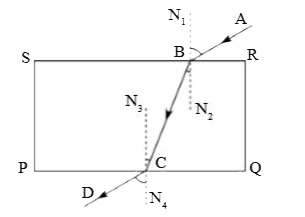
In an experiment to trace the path of ray through a glass slab, Shiva traced as shown in the figure. The teacher asked to identify the emergent ray. Which of the following would Shiva identify.

A

AB

B

BC

C

CD

D

`N_(1)N_(2)`

Text Solution

Verified by Experts

Promotional Banner

Topper's Solved these Questions

  • REFRACTION OF LIGHT AT PLANE SURFACES

    NCERT BANGLISH|Exercise THINK AND DISCUSS|2 Videos
  • REFRACTION OF LIGHT AT PLANE SURFACES

    NCERT BANGLISH|Exercise II. Application of concepts|3 Videos
  • MOTION

    NCERT BANGLISH|Exercise THINK AND DISCUSS|14 Videos
  • SOUND

    NCERT BANGLISH|Exercise Let us Improve our learning (Suggested Projects)|1 Videos

Similar Questions

Explore conceptually related problems

A ray of light is incident on a right-angled isosceles prism parallel to its base as shown in the figure. Refractive index of the material of the prism is sqrt(2) . Then which of the following statement (s) is // are true?

There are some experiment in which the outcomes cannot be identified discretely. For example, an ellipse of eccentricity 2sqrt(2)//3 is inscribed in a circle and a point within the circle is chosen at random. Now, we want to find the probability that this point lies outside the ellipse. Then, the point must lie in the shaded region shown in Figure. Let the radius of the circle be a and length of minor axis of the ellipse be 2b. Given that 1 - (b^(2))/(a^(2)) = (8)/(9) or (b^(2))/(a^(2)) = (1)/(9) Then, the area of circle serves as sample space and area of the shaded region represents the area for favorable cases. Then, required probability is p= ("Area of shaded region")/("Area of circle") =(pia^(2) - piab)/(pia^(2)) = 1 - (b)/(a) = 1 - (1)/(3) = (2)/(3) Now, answer the following questions. Two persons A and B agree to meet at a place between 5 and 6 pm. The first one to arrive waits for 20 min and then leave. If the time of their arrival be independant and at random, then the probability that A and B meet is

Show that for refraction of light through a parallel glass slab, the incident ray and the emergent ray are parallel to each other. Or, With the help of a diagram show how in case of a rectangular glass slab, when light is refracted by the two parallel faces of the slab, deviation between angle of incidence and angle of refractive is zero.

A glass slab consists of thin uniform layers of progressively decreasing refractive indices RI (see figure) such that the Rl of any layer is mu - m Deltamu . Here mu and Delta mu denote the Rl of 0^(th) layer and the difference in RI between any two consecutive layers, respectively. The integer m = 0,1,2,3... denotes the numbers of the successive layers. A ray of light from the 0^(th) layer enters the 1^(st) layer at an angle of incidence of 30^@ . After undergoing the m^(th) refraction, the ray emerges parallel to the interface. If mu = 1.5 and Delta mu = 0.015, the value of m is

