

Home
Class 11
PHYSICS
The potential energy function for a part...

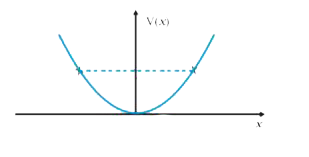
The potential energy function for a particle executing linear simple harmonic motion is given by `V(x)= kx^(2)"/"2`, where k is the force constant of the oscillator. For `k= 0.5 Nm^(1)`, the graph of V(x) versus x is shown in Fig. 6. 12. Show that a particle of total energy 1 J moving under this potential must 'turn back' when it reaches `x= pm 2m`.

Promotional Banner

Topper's Solved these Questions

  • WORK, ENERGY AND POWER

    NCERT BANGLISH|Exercise EXERCISES (ADDITIONAL EXERCISES)|6 Videos
  • WORK, ENERGY AND POWER

    NCERT BANGLISH|Exercise EXERCISES (ADDITIONAL EXERCISES)|6 Videos
  • WAVES

    NCERT BANGLISH|Exercise Exercises|26 Videos

Similar Questions

Explore conceptually related problems

The potential energy of a spring pendulum, with a mass m connected to it, is given by V=1/2kx^(2) (where x = displacement from the position of equilibrium and k = a constant). How does the applied force on the mass vary with displacement?

The displacement x of a particle in rectilinear motion at time t is represented as x^(2) = at^(2) +2bt+c , where a ,b, and c are constants. Show that the acceleration of this particle varies (1)/(x^(3)) .

The potential energy of a particle is given by the formula U= 100 -5x+100x^2 , U and x are in SI units. If mas of the particle is 0.1 kg then magnitude of its acceleration .

Potential energy of a particle is 1/2momega^(2)x^(2) , where m and omega are constants. Prove that the motion of the particle is simple harmonic.

The potential energy of a particle of mass 0.02 kg moving along x -axis is given by V = Ax(x - 4) J where x is in metres and A is a constant. Which of the following is/are correct statement (s)? (A) The particle is acted upon by a constant force. (B) The particle executes simple harmonic motion. (C) The speed of the particle is maximum at x = 2 m. (D) The period of oscillation of the particle is pi/5 sec.

A particle of mass m is located in a one dimensional potential field where potential energy is given by V(x) = A(1- cos Px) , where A and P are constant . The period of small oscillations of the particle is

NCERT BANGLISH-WORK, ENERGY AND POWER-EXERCISES
  1. A body of mass 2 kg initially at rest moves under the action of an app...

    Text Solution

    |

  2. Given in Fig. are examples of some potential energy functions in one ...

    Text Solution

    |

  3. The potential energy function for a particle executing linear simple h...

    Text Solution

    |

  4. Answer the following : Comets move around the sun in highly elliptic...

    Text Solution

    |

  5. Answer the following : An artificial satellite orbitting the earth i...

    Text Solution

    |

  6. Answer the following : In Fig.6.13. (i) the man walks 2m carrying a ...

    Text Solution

    |

  7. Underline the correct alternative : When a conservative force does p...

    Text Solution

    |

  8. Underline the correct alternative : Work done by a body against fric...

    Text Solution

    |

  9. Underline the correct alternative : The rate of change of total mome...

    Text Solution

    |

  10. Underline the correct alternative : In an inelastic collision of two...

    Text Solution

    |

  11. State if each of the following statements is true or false. Give reaso...

    Text Solution

    |

  12. State if each of the following statements is true or false. Give reaso...

    Text Solution

    |

  13. State if each of the following statements is true or false. Give reaso...

    Text Solution

    |

  14. Answer carefully, with reasons : In an elastic collision of two bill...

    Text Solution

    |

  15. Answer carefully, with reasons : Is the total linear momentum conser...

    Text Solution

    |

  16. Answer carefully, with reasons : What are the answers to (a) and (b)...

    Text Solution

    |

  17. Answer carefully, with reasons : If the potential energy of two bill...

    Text Solution

    |

  18. A body is initially at rest. It undergoes one-dimensional motion with ...

    Text Solution

    |

  19. A body is moving unidirectionally under the influence of a source of c...

    Text Solution

    |

  20. A body constrained to move along the z-axis of a coordinate system is ...

    Text Solution

    |