

Home
Class 11
PHYSICS
A ring of mass m=10kg can slide through ...

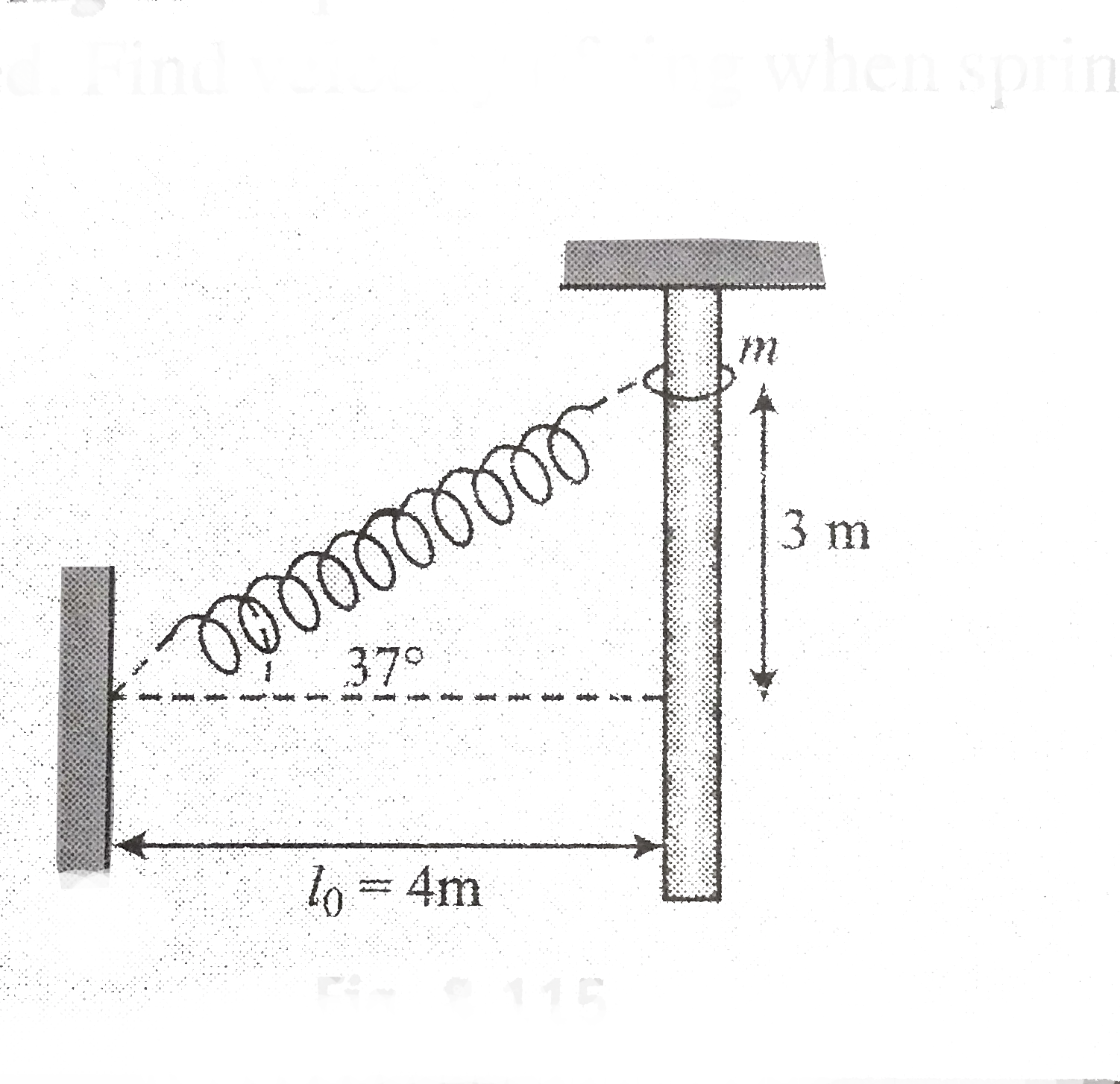
A ring of mass `m=10kg` can slide through a vertical rod with friction. It is connected with a spring of force constant `k=100Nm^-1`. The relaxed length of spring is `4m`. The ring is displaced `3m` as shown in the figure and released. Find velocity of ring when spring becomes horizontal.

Promotional Banner

Similar Questions

Explore conceptually related problems

A ring of mass m can slide over a smooth vertical rod as shown in figure. The ring is connected to a spring of force constant k = 4 mg//R , where 2R is the natural length of the spring . The other end of spring is fixed to the ground at a horizontal distance 2R from base of the rod . If the mass is released at a height 1.5 J then the velocity of the ring as it reaches the ground is

A ring of mass m can slide over a smooth vertical rod as shown in figure. The ring is connected to a spring of force constant k = 4 mg//R , where 2R is the natural length of the spring . The other end of spring is fixed to the ground at a horizontal distance 2R from base of the rod . If the mass is released at a height 1.5 J then the velocity of the ring as it reaches the ground is

A ring of mass m can slide over a smooth vertical rod. The ring is connected to a spring of force constant K=(4mg)/R where 2R is the natural length of the spring. The other end spring is fixed to the ground at a horizontal distance 2R from the base of the rod. the mass is released at a height of 1.5 R from ground.

A ring of mass m can slide over a smooth vertical rod. The ring is connected to a spring of force constant K=(4mg)/R where 2R is the natural length of the spring. The other end spring is fixed to the ground at a horizontal distance 2R from the base of the rod. the mass is released at a height of 1.5 R from ground.

A ring of mass m can slide over a smooth vertical rod. The ring is connected to a spring of force constant K=(4mg)/R where 2R is the natural length of the spring. The other end spring is fixed to the ground at a horizontal distance 2R from the base of the rod. the mass is released at a height of 1.5 R from ground.

On end of a light spring of natural length d and spring constant k is fixed on a rigid wall and the other is attached to a smooth ring of mass m which can slide without friction on a vertical rod fixed at a distance d from the wall. Initially the spring makes an angle of 37^@ with the horizontal. as shown in figure. When the system is released from rest, find the speed of the ring when the spring becomes horizontal. (sin 37^@=3/5) .

On end of a light spring of natural length d and spring constant k is fixed on a rigid wall and the other is attached to a smooth ring of mass m which can slide without friction on a vertical rod fixed at a distance d from the wall. Initially the spring makes an angle of 37^@ with the horizontal. as shown in figure. When the system is released from rest, find the speed of the ring when the spring becomes horizontal. (sin 37^@=3/5) .

One end of a light spring of natural length d and spring constant k is fixed on a rigid wall and the other is attached to a smooth ring of mass m which can slide without friction on a vertical rod fixed at a distance d from the wall. Initially the spring makes an angle of 37^(@) with the horizontal as shown in fig. When the system is released from rest, find the speed of the ring when the spring becomes horizontal. [ sin 37^(@) = 3/5]

One end of a light spring of natural length d and spring constant k is fixed on a rigid wall and the other is attached to a smooth ring of mass m which can slide without friction on a vertical rod fixed at a distance d from the wall. Initially the spring makes an angle of 37^(@) with the horizontal as shown in fig. When the system is released from rest, find the speed of the ring when the spring becomes horizontal. [ sin 37^(@) = 3/5]