

Home
Class 11
PHYSICS
In the arrangement shown in figure, mA =...

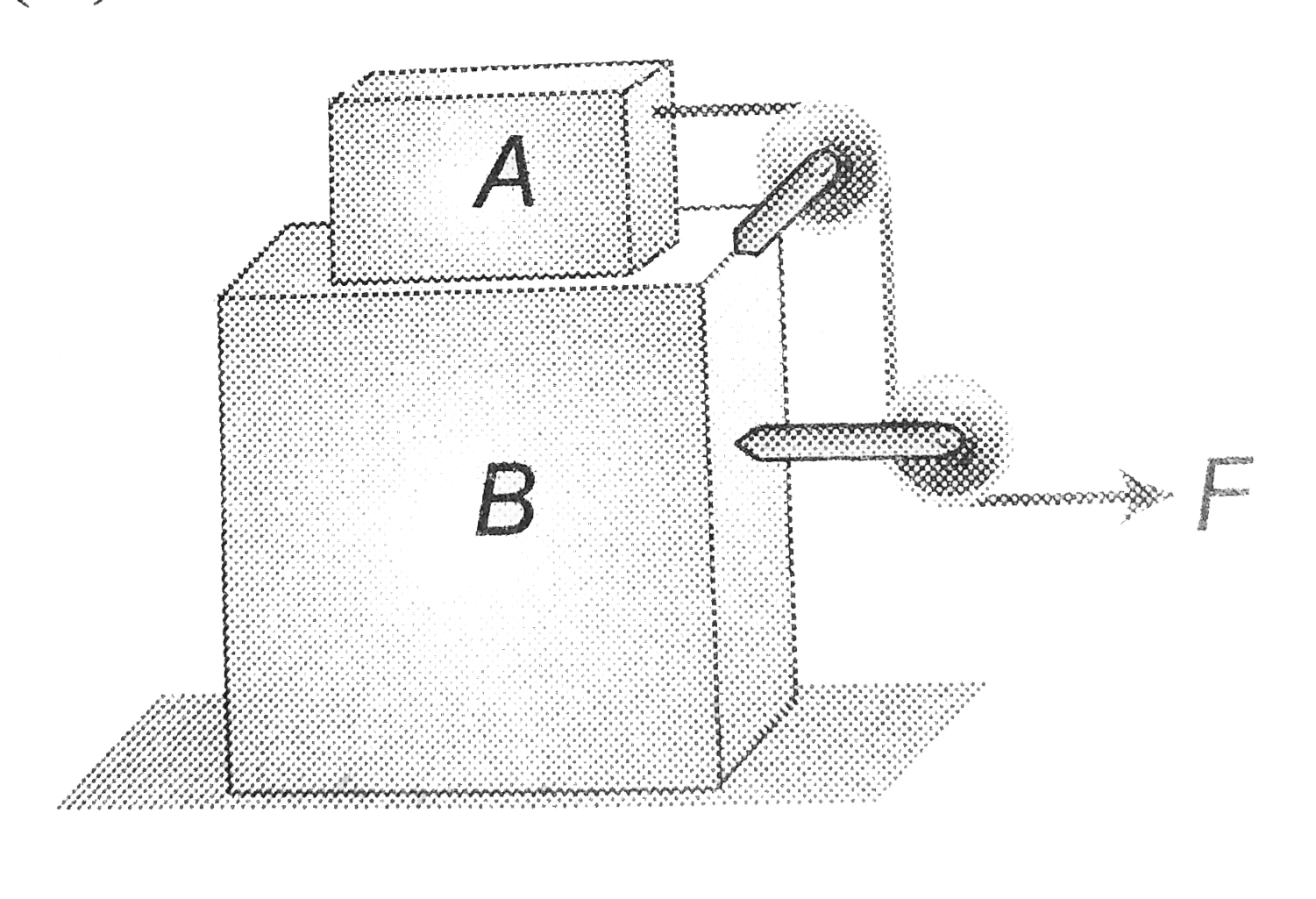
In the arrangement shown in figure, m_A = m_B = 2kg. String is massless and pulley is frictionless. Block B is resting on a smooth horizontal surface, while friction coefficient beteen block A and B is `mu=0.5` . the Maximum horizontal force F that can be applied so that block A does not slip over block B is.

Promotional Banner

Similar Questions

Explore conceptually related problems

In the arrangement shown in figure m_(A)=m_(B) =2 kg . String is massless and pulley is frictionless. Block B is resting on a smooth horizontal surface, while friction coefficient between blocks A and B is mu=0.5 . What maximum horizontal force F can be applied so that block A does not slip over the block B? (g=10 m//s^(2))

Two block A and B of masses 5 kg. and 3 kg. respectively rest on smooth horizontal surface with B over A. The coefficient of friction between A and B. 0.5 the maximum horizontal force that can be applied to A so that there will be motion of A and B without separation is :-

Two block A and B of masses 5 kg. and 3 kg. respectively rest on smooth horizontal surface with B over A. The coefficient of friction between A and B. 0.5 the maximum horizontal force that can be applied to A so that there will be motion of A and B without separation is :-

A cubical block of side .L. rests on a rough horizontal surface with coefficient of friction mu . A horizontal force F is applied on the block as shown in figure. The minimum force required to topple the block is

In the arrangement shown in figure the wall is smooth and friction coefficient between the blocks is mu = 0.1 . A horizontal force F = 1000 N is applied on the 2kg block. The wrong statement is :

A bar of mass m is placed on a triangular block of mass M as shown in figure The friction coefficient between the two surface is mu and ground is smooth find the minimum and maximum horizontal force F required to be applied on block so that the bar will not slip on the inclined surface of block

A bar of mass m is placed on a triangular block of mass M as shown in figure The friction coefficient between the two surface is mu and ground is smooth find the minimum and maximum horizontal force F required to be applied on block so that the bar will not slip on the inclined surface of block

The coefficient of static friction between the two blocks shown in figure is mu and the table is smooth. What maximum horizontal forced F can be applied to he block of mass M so that the block move together?

The coefficient of static friction between the two blocks shown in figure is mu and the table is smooth. What maximum horizontal forced F can be applied to he block of mass M so that the block move together?

The coefficient of static friction between the two blocks shown in figure is mu and the table is smooth. What maximum horizontal forced F can be applied to he block of mass M so that the block move together?