Home
Class 12
MATHS
Let z1 and z2 be the root of the equatio...

Let `z_1 and z_2` be the root of the equation `z^2+pz+q=0` where the coefficient p and q may be complex numbers. Let A and B represent `z_1 and z_2` in the complex plane. If `/_AOB=alpha!=0 and 0 and OA=OB, where O` is the origin prove that `p^2=4qcos^2 (alpha/2)`

Text Solution

Verified by Experts
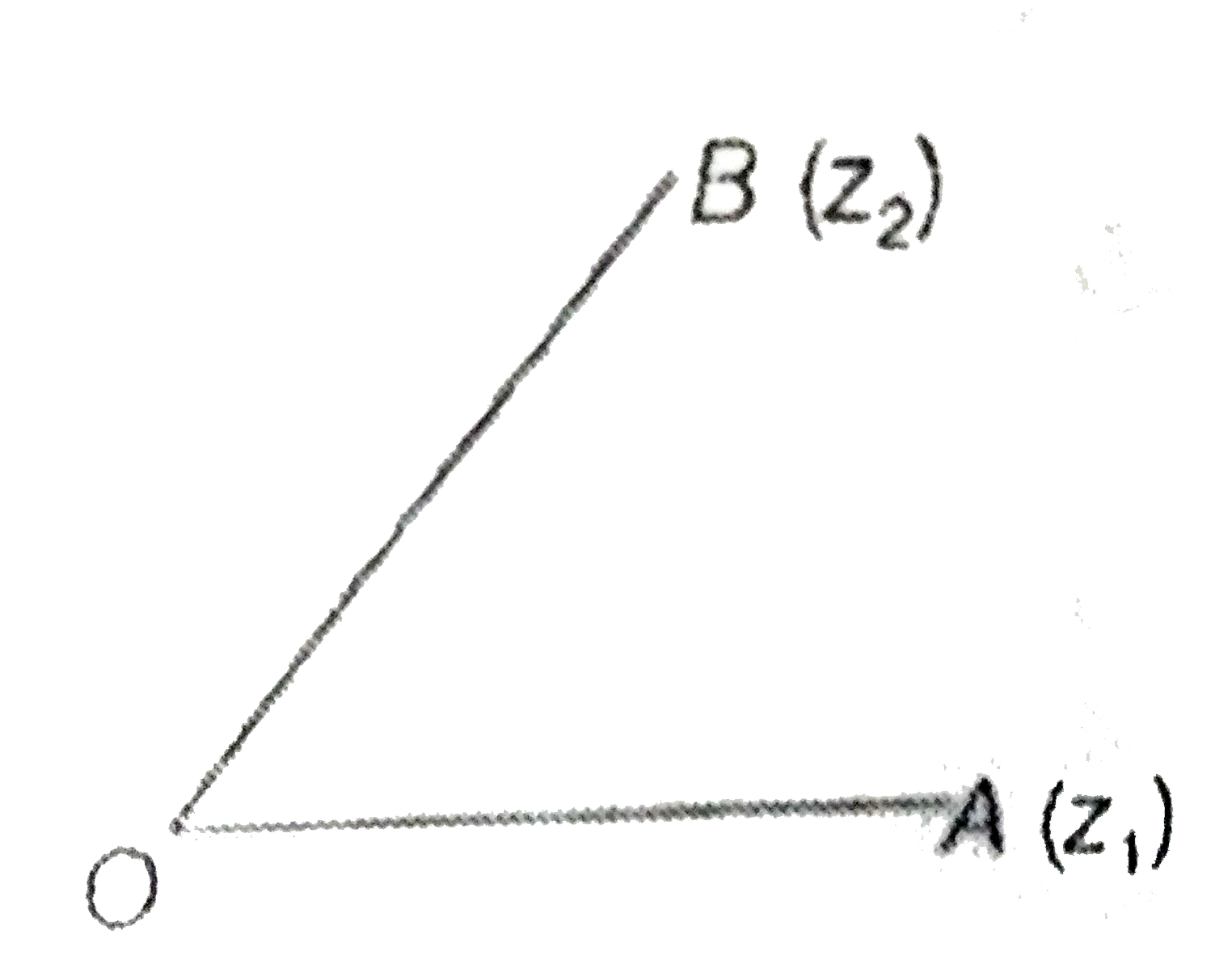
Since `z_1 +z_2 =- and z_1z_2 = q`
Now `z_1/z_2=|z_1|/|z_2|(cos alpha + I sin alpha )`
`rArr z_1/z_2 =(cos alpha + I sin alpha )/(1)`
`[ because |z_1| = |z_2|]`
Applying componendo and dividendo, we get
`(z_1+z_2)/(z_1-z_2)=(cosalpha+ i sin alpha + 1)/(cos alpha + i sin alpha-1)`
`=(2 cos^2(alpha//2)+2 i sin(alpha//2)cos(alpha//2))/(-2 sin^2(alpha//2)+2 isin(alpha//2)cos (alpha//2))`
`=(2 cos (alpha//2)[cos(alpha//2)+ i sin (alpha//2)])/(2i sin(alpha//2)[cos (alpha//2)+sin(alpha//2)])`
`=(cot (alpha //2))/(i)= - i cot alpha//2 rArr (-p)/(z_1 - z_2)=-i cot (alpha //2)`
On squaring both sides , we get `p^2/(z_1-z_2)^2=-i cot (alpha//2)`
`rArr " " p^2/((z_1+z_2)^2-4z_1z_2)=- cot^2 (alpha//2)`
`rArr p^2/(p^2 -4q)=- cot ^2(alpha//2)`
`rArr p^2= - p^2cot^2(alpha//2)+4q cot^2(alpha//2)`
`rArr p^2(1+cot^2 alpha//2)=4q cot^2 (alpha//2)`
`p^2 cosec^2 (alpha //2)= 4q cot^2 (alpha// 2)`
`rArr p^2 = 4q cos^2 alpha//2`
Promotional Banner

Topper's Solved these Questions

  • COMPLEX NUMBERS

    IIT JEE PREVIOUS YEAR|Exercise TOPIC 4 ROTATION OF A COMPLEX NUMBER (INTERGER ANSWER TYPE QUESTION )|1 Videos
  • COMPLEX NUMBERS

    IIT JEE PREVIOUS YEAR|Exercise TOPIC 5 DE-MOIVRES THEOREM,CUBE ROOTS AND nth ROOTS OF UNITY ( OBJECTIVE QUESTIONS I)(ONLY ONE CORRECT OPTION)|12 Videos
  • COMPLEX NUMBERS

    IIT JEE PREVIOUS YEAR|Exercise TOPIC 4 ROTATION OF A COMPLEX NUMBER (FILL IN THE BLANKS )|3 Videos
  • CIRCLE

    IIT JEE PREVIOUS YEAR|Exercise Topic 5 Integer Answer type Question|1 Videos
  • DEFINITE INTEGRATION

    IIT JEE PREVIOUS YEAR|Exercise LIMITS AS THE SUM|6 Videos

Similar Questions

Explore conceptually related problems

Let z_1a n dz_2 b be toots of the equation z^2+p z+q=0, where he coefficients pa n dq may be complex numbers. Let Aa n dB represent z_1a n dz_2 in the complex plane, respectively. If /_A O B=theta!=0a n dO A=O B ,w h e r eO is the origin, prove that p^2=4q"cos"^2(theta//2)dot

z_(1) and z_(2) are the roots of the equaiton z^(2) -az + b=0 where |z_(1)|=|z_(2)|=1 and a,b are nonzero complex numbers, then

Let z_(1) and z_(2) be the roots of the equation z^(2)+pz+q=0 . Suppose z_(1) and z_(2) are represented by points A and B in the Argand plane such that angleAOB=alpha , where O is the origin. Statement-1: If OA=OB, then p^(2)=4q cos^(2)alpha/2 Statement-2: If affix of a point P in the Argand plane is z, then ze^(ia) is represented by a point Q such that anglePOQ =alpha and OP=OQ .

Let z_1 and z_2 be the roots of the equation 3z^2 + 3z + b=0 . If the origin, together with the points represented by z_1 and z_2 form an equilateral triangle then find the value of b.

Number of solutions of the equation z^(3)+(3(bar(z))^(2))/(|z|)=0 where z is a complex number is

Solve the equation z^(2)+|z|=0, where z is a complex number.

Let z_1 and z_2 be the roots of z^2+pz+q =0. Then the points represented by z_1,z_2 the origin form an equilateral triangle if p^2 =3q.

Let a , b , c be distinct complex numbers with |a|=|b|=|c|=1 and z_(1) , z_(2) be the roots of the equation az^(2)+bz+c=0 with |z_(1)|=1 . Let P and Q represent the complex numbers z_(1) and z_(2) in the Argand plane with /_POQ=theta , o^(@) lt 180^(@) (where O being the origin).Then

