Text Solution
Verified by Experts
The correct Answer is:
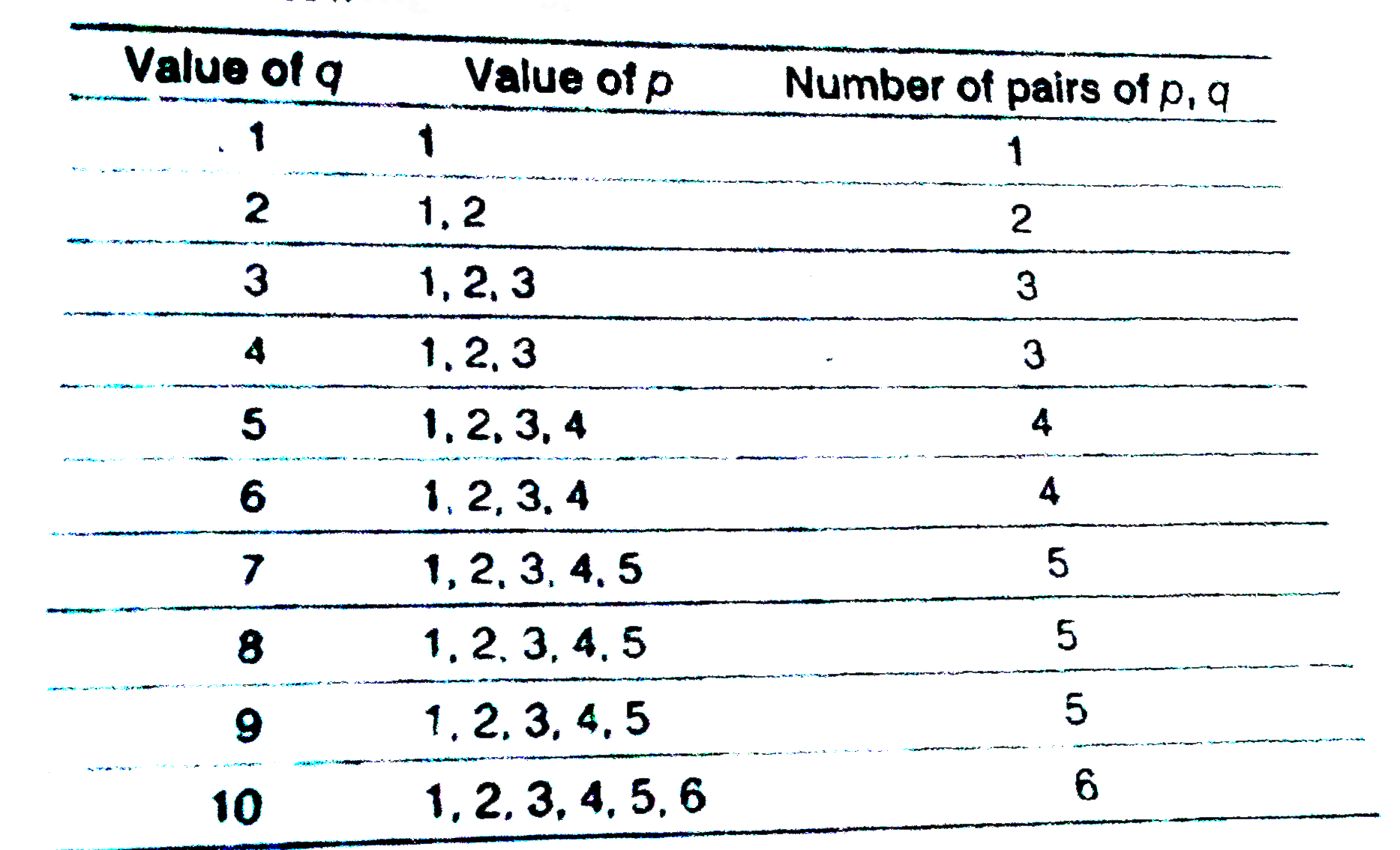



Topper's Solved these Questions
PROBABILITY
IIT JEE PREVIOUS YEAR|Exercise TOPIC 2 ADDITION AND SUBTRACTION LAW OF PROBABILITY OBJECTIVE QUESTIONS I (ONLY ONE CORRECT OPTION )|8 VideosPROBABILITY
IIT JEE PREVIOUS YEAR|Exercise TOPIC 2 ADDITION AND SUBTRACTION LAW OF PROBABILITY OBJECTIVE QUESTION II (ONE OR MORE THAN ONE CORRECT OPTION )|1 VideosPROBABILITY
IIT JEE PREVIOUS YEAR|Exercise TOPIC 1 CLASSICAL PROBABLITY OBJECTIVE QUESTIONS (TRUE /FALSE )|1 VideosPERMUTATIONS AND COMBINATIONS
IIT JEE PREVIOUS YEAR|Exercise Dearrangement and Number of Divisors (Fill in the Blank )|1 VideosRELATIONS AND FUNCTIONS
IIT JEE PREVIOUS YEAR|Exercise All Questions|1 Videos
Similar Questions
Explore conceptually related problems
IIT JEE PREVIOUS YEAR-PROBABILITY-TOPIC 1 CLASSICAL PROBABLITY OBJECTIVE QUESTIONS (ANALYTICAL AND DESCRIPTIVE QUESTIONS )
- An unbiased dike, with faces numbered 1,2,3,4,5,6, is thrown n time...
Text Solution
|
- If pa n dq are chosen randomly from the set {1,2,3,4,5,6,7,8,9, 10} wi...
Text Solution
|
- In how many ways, can three girls can three girls and nine boys be ...
Text Solution
|
- A box contains 2 fifty paise coins, 5 twenty five paise coins and a ce...
Text Solution
|
- Six boys and six girls sit in a row randomly. Find the probability tha...
Text Solution
|