

Home
Class 11
PHYSICS
If both spring consists k(1) and k(2) ar...

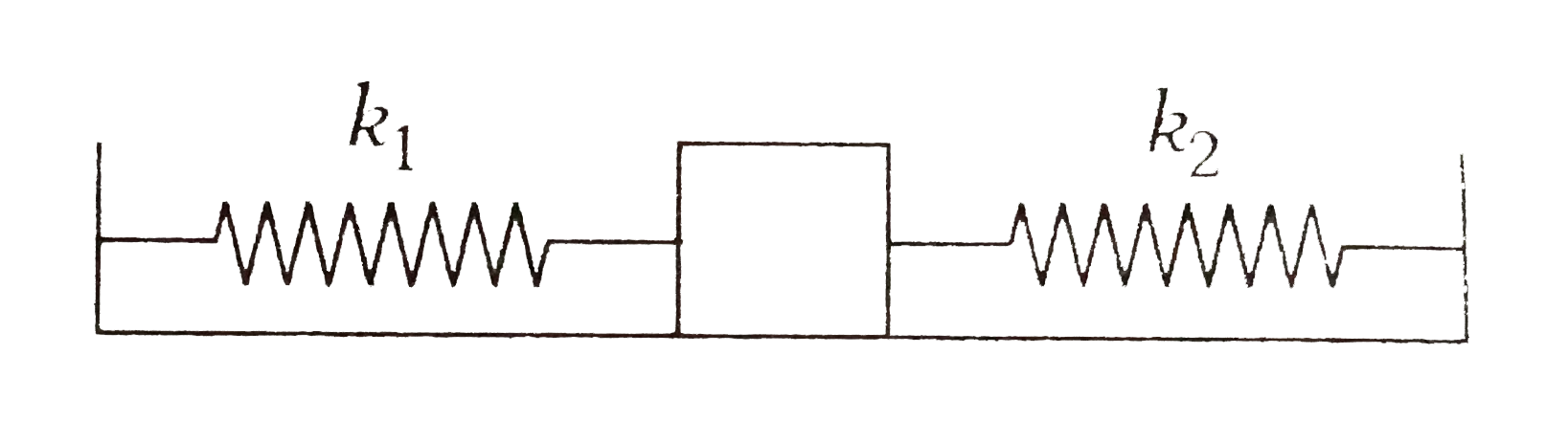
If both spring consists `k_(1)` and `k_(2)` are increased to `4k_(1)` and `4k_(2)` respectively, what will be the new frequency , if f was the original frequency ?

Promotional Banner

Similar Questions

Explore conceptually related problems

If both spring constant k_1 and k_2 are increased to 4k_1 and 4k_2 respectively, then new frequency in terms of original frequency f is :

Two identical massless springs A and B consist spring constant k_(A) and k_(B) respectively. Then :

Two identical massless springs A and B consist spring constant k_(A) and k_(B) respectively. Then :

Two springs of force constants k_(1) and k_(2) , are connected to a mass m as shown. The frequency of oscillation of the mass is f . If both k_(1) and k_(2) are made four times their original values, the frequency of oscillation becomes

Two springs of force constants k_(1) and k_(2) , are connected to a mass m as shown. The frequency of oscillation of the mass is f . If both k_(1) and k_(2) are made four times their original values, the frequency of oscillation becomes

Two springs of force constants k_(1) and k_(2) , are connected to a mass m as shown. The frequency of oscillation of the mass is f . If both k_(1) and k_(2) are made four times their original values, the frequency of oscillation becomes

Two springs, of force constants k_(1) and k_(2) , are connected to a mass ma as shown. The frequency of oscillation of mass is f . If both k_(1) and k_(2) are made four times their original values, the frequency of oscillation becomes

Two spring of spring constants k_(1) and k_(2) ar joined and are connected to a mass m as shown in the figure. Calculate the frequency of oscillation of mass m.

Two springs of force constants K_(1) " and " K_(2) are connected to a mass m as shown I the figure. If both K_(1) " and " K_(2) are made four times their original values, the frequency of oscillation becomes,