A
B
C
D
Text Solution
Verified by Experts
The correct Answer is:



Topper's Solved these Questions
AROMATIC COMPOUNDS AND ALKYL AND ARYL HALIDES
CENGAGE CHEMISTRY|Exercise Exercises Single Correct Answer Type|26 VideosAROMATIC COMPOUNDS AND ALKYL AND ARYL HALIDES
CENGAGE CHEMISTRY|Exercise Exercises Assertion-Resoning Type|1 VideosAROMATIC COMPOUNDS AND ALKYL AND ARYL HALIDES
CENGAGE CHEMISTRY|Exercise Exercises Multiple Correct Answers Type|12 VideosAPPENDIX INORGANIC VOLUME 2
CENGAGE CHEMISTRY|Exercise Short Answer Type|179 VideosBIOMOLECULES
CENGAGE CHEMISTRY|Exercise Exercises Archives (Analytical And Descriptive)|8 Videos
Similar Questions
Explore conceptually related problems
CENGAGE CHEMISTRY-AROMATIC COMPOUNDS AND ALKYL AND ARYL HALIDES -Exercises Single Correct
- Which is the most effective ion in an SN^(2) displacement on methyl br...
Text Solution
|
- Of the following four groups are m- directing when present on a benzen...
Text Solution
|
- The chemistry of benzene is characterised by which fo the following t...
Text Solution
|
- A reaction involving an aromatic nucleas is usually initiated by:
Text Solution
|
- Which of the following deactivates the aromatic nucleas?
Text Solution
|
- The experimentakkt determind rate equiaction for the alkaline hydeoly...
Text Solution
|
- Which of the follwing undergoes nitration most readily?
Text Solution
|
- Which of the follwing reaction s is not sterospecific?
Text Solution
|
- Which of the following on reaction with acetylene (Ch-=CH) produce gas...
Text Solution
|
- Which is least reactive towards nucleophilic substitution (S(N^(2)))
Text Solution
|
- Fluorobenzene (C(6)H(5)F) can be synthesized in the laboratory .
Text Solution
|
- CH(3)Br +Nu^(Theta) rarr CH(3)-Nu +Br^(Theta) The decreasing order o...
Text Solution
|
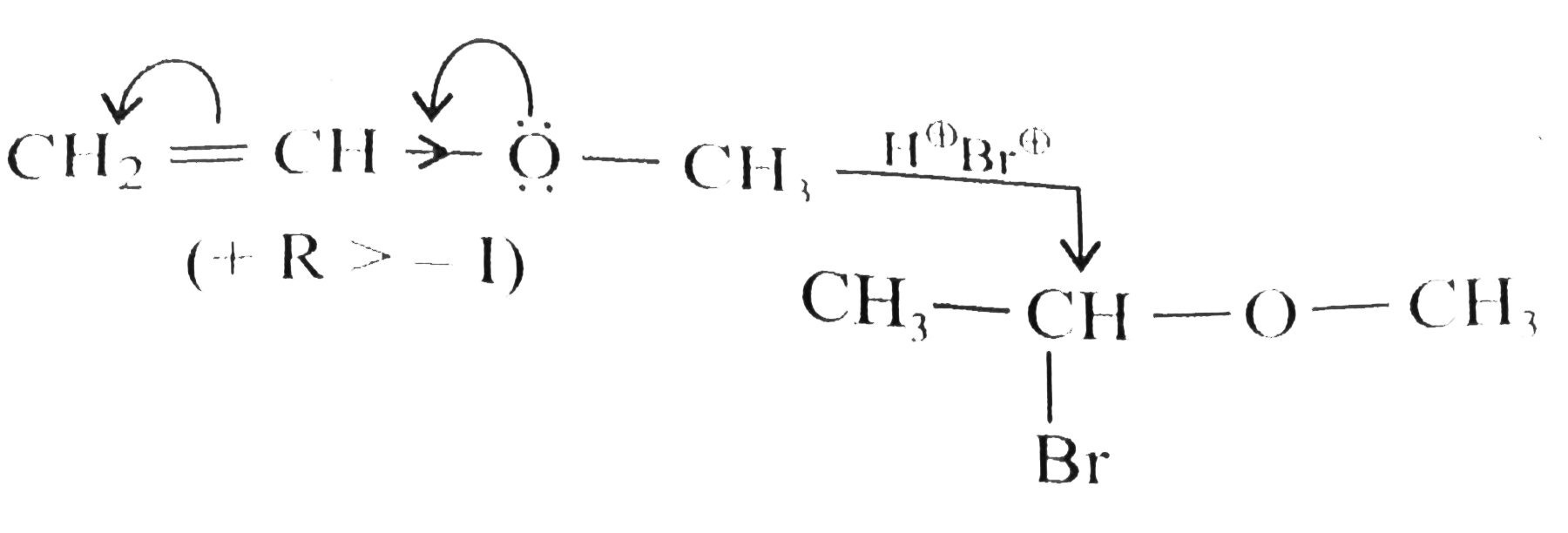
- HBr reacts with CH(2)=CH-OCH(3) under anhydrous conditions at room tem...
Text Solution
|
- The halogen compound which most readily undergoes nucleophilic substit...
Text Solution
|
- The correct decreasing order of SN^(1) reactivity of the folliwng is:...
Text Solution
|
- Which of the follwing has the highest boiling point?
Text Solution
|
- Which of the following sequence of reaction (reagents) can be used for...
Text Solution
|
- The decreasing order of dipole moment of the folliwng is: I. CH(3)Cl...
Text Solution
|
- Bottles containing C(6)H(5)I and C(6)H(5)-CH(2)I lost their original l...
Text Solution
|
- One mole of 1,2-dibromopropane on treatment with X moles of NaNH(2) fo...
Text Solution
|