

Home
Class 11
PHYSICS
The system shown in fig is in equilibriu...

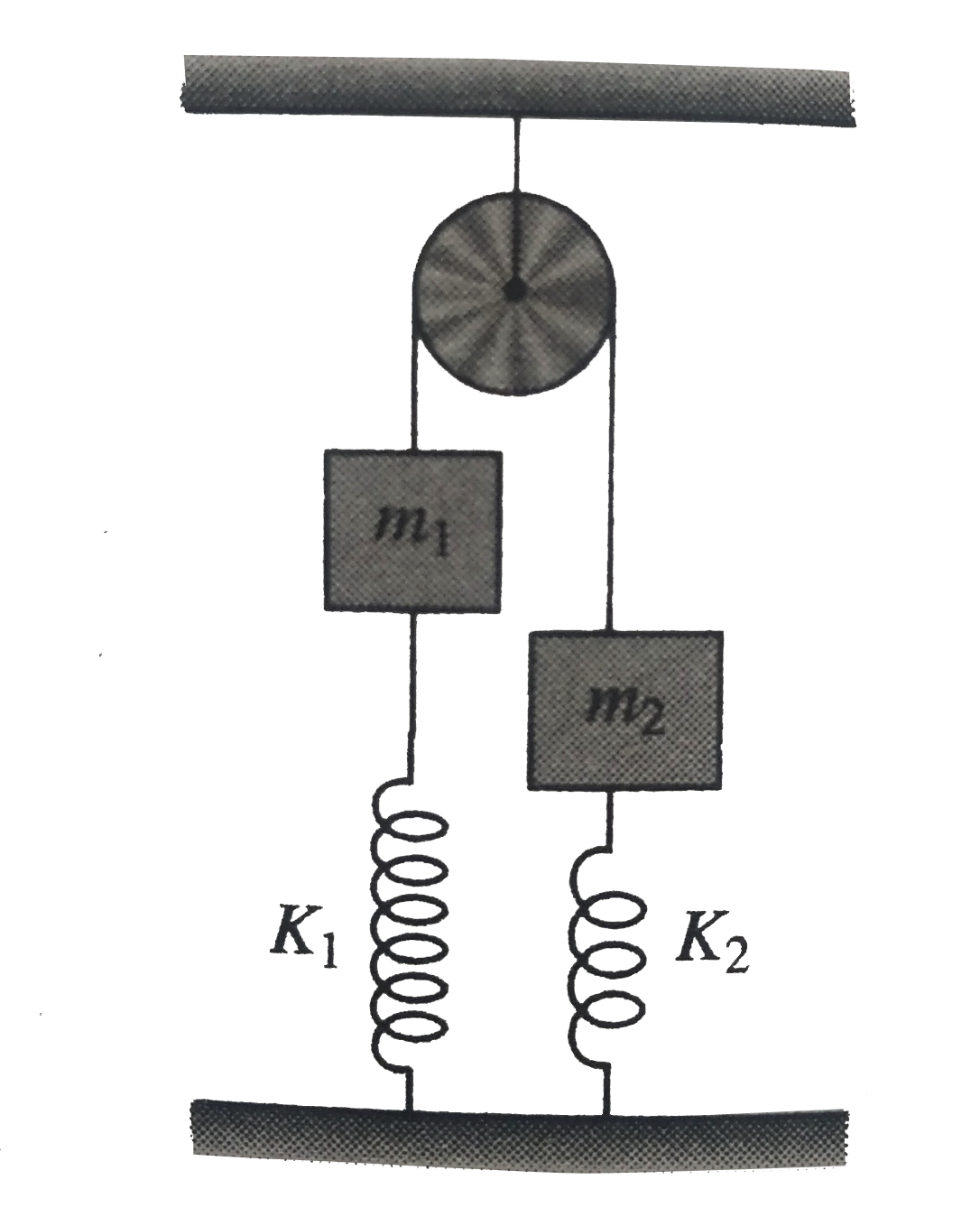
The system shown in fig is in equilibrium . Masses `m_(1) and m_(2)` are 2kg and 8kg, Respectively. Spring constants `k_(1) and k_(2)` ro `50Nm^(-1) and 70Nm^(-1)`, respectively. If the compression in second spring is 0.5m. What is the compression in first spring?

Promotional Banner

Similar Questions

Explore conceptually related problems

The system shown in fig is in equilibrium . Masses m_(1) and m_(2) are 2kg and 8kg, Respectively. Spring constants k_(1) and k_(2) are 50Nm^(-1) and 70Nm^(-1) , respectively. If the compression in second spring is 0.5m. What is the compression in first spring?

The spring constant of the spring shown in the figure is 250Nm^(-1) . Find the maximum compression of the spring?

Two spring of spring constants k_(1) and k_(2) ar joined and are connected to a mass m as shown in the figure. Calculate the frequency of oscillation of mass m.

Two blocks of masses 1 kg and 3 kg are moving with velocities 2 m//s and 1 m//s , respectively , as shown. If the spring constant is 75 N//m , the maximum compression of the spring is

A body of mass 2 kg is dropped from a height of 40 cm on a spring cushion of spring constant 1960 N*m^(-1) . What will be the compression of the spring ?

A mass M is suspended by two springs of force constants K_(1) and K_(2) respectively as shown in the diagram. The total elongation (stretch) of the two springs is

Two blocks m_1 and m_2 of masses 2kg and 5kg, respectively, are moving on a smooth plane along a straight line in the same direction, with velocities 10 m*s^(-1) and 3 m*s^(-1) respectively. The block m_2 is situated ahead of the block m_1 . An ideal spring (k=1120 N*m^(-1) ) is attached to the back of the block m_2 . Find the compression of the spring when m_1 collides with m_2 .

Consider two springs whose force constants are 1Nm^(-1) and 2N m^(-1) which are connected in series. Calculate the effective spring constant (k_(s)) and comment on k_(s) .

In an elevator a system is arranged as shown in figure. Initially elevator is at rest and the system is in equilibrium with middle spring unstretched. When the elevator accelerated upwards, it was found that for the new equilibrium position (with respect to lift), the further extension i the top spring is 1.5 times that of the further compression in the bottom spring, irrespective of the value of acceleration (a) Find the value of (m_1)/(m_2) in terms of spring constants for this happen. (b) if k_1=k_2=k_3=500(N)/(m) and m_1=2 kg and acceleration of the elevator is 2.5(m)/(s^2) , find the tension in the middle spring in the final equilibrium with respect to lift.