

Home
Class 12
PHYSICS
In the shown figure inside a fixed hollo...

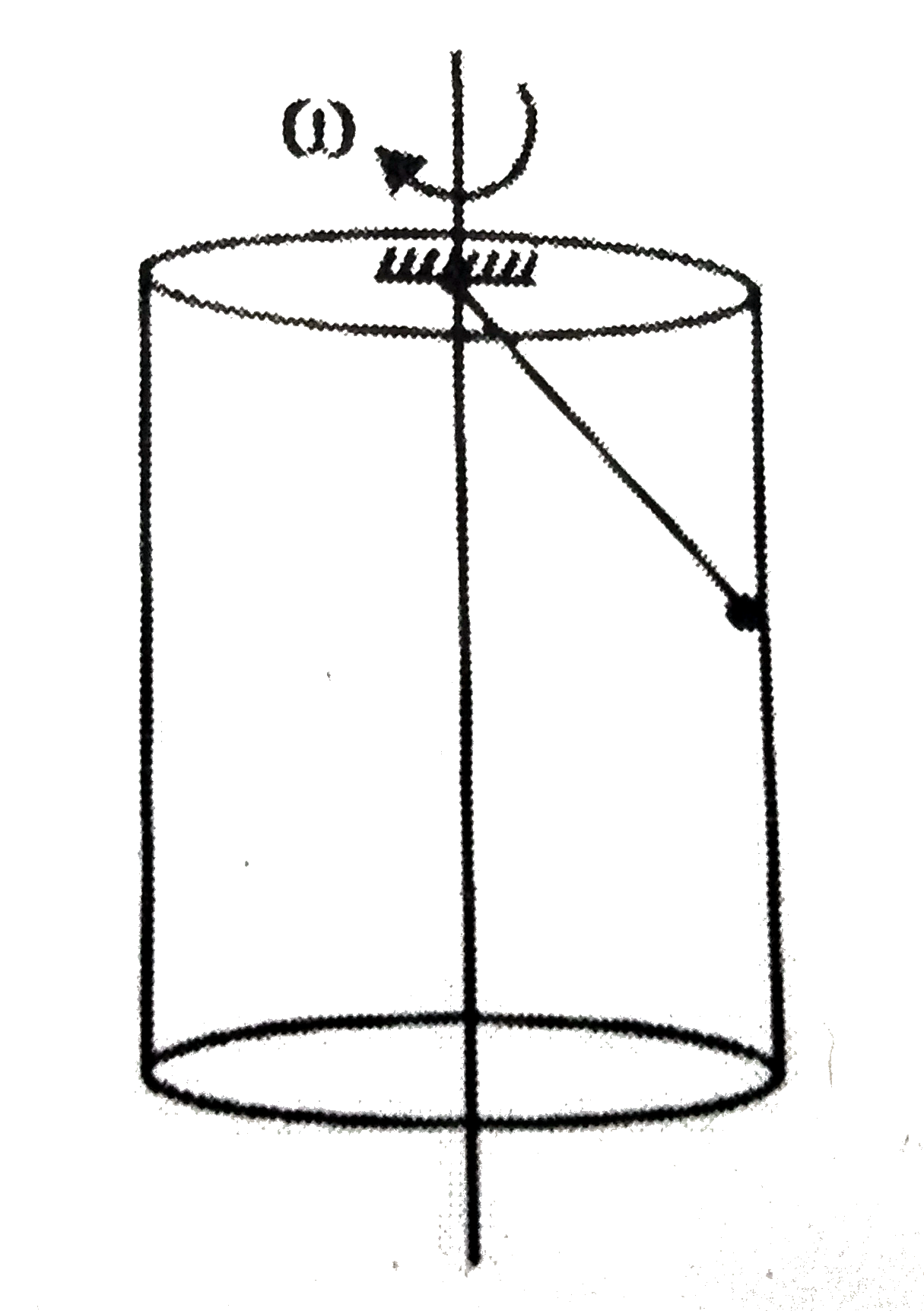
In the shown figure inside a fixed hollow cylinder with vetical axis a pendulumm is rotating in a conical path with its axis same as that of the cylinder with uniform angular velocity. Radius of culinder is 30cm, length of string is 50cm and mass of bob is 400gm. The bob makes contact with the inner fricitonless wall of the cylinder while moving

Promotional Banner

Similar Questions

Explore conceptually related problems

Let the moment of inertia of a hollow cylinder of length 30 cm (inner radius 10 cm and outer radius 20 cm ), about its axis be I. the radius of a thin cylinder of the same about its axis is also I is :

Let the moment of inertia of a hollow cylinder of length 30 cm (inner radius 10 cm and outer radius 20 cm ), about its axis be I. the radius of a thin cylinder of the same about its axis is also I is :

A solid cylinder of mass 2 kg and radius 0.2m is rotating about its own axis without friction with angular velocity 3 rads/s. A particle of mass 0.5 kg and moving with a velocity 5 m/s strikes the cylinder and sticks to it as shown in figure. The angular momentum of the cylinder before collision will be?

A solid cylinder of mass 2 kg and radius 0.2m is rotating about its own axis without friction with angular velocity 3 rads/s. A particle of mass 0.5 kg and moving with a velocity 5 m/s strikes the cylinder and sticks to it as shown in figure. The angular momentum of the cylinder before collision will be?

A hollow cylinder of radius r is rotating about its own vertical axis. Both ends of the cylinder are open. A piece of stone of mass m remains fixed on the inner side of the cylinder. What should be the minimum velocity of rotation of the cylinder so that the stone remains fixed on the surface of the cylinder without falling down? Coefficient of static friction between the wall of the cylinder and the stone = mu , acceleration due to gravity = g. Also, prove that this velocity is independent of the mass of the stone.

The axis of the uniform cylinder in figure is fixed. The cylinder is initially at rest. The block of mass M is initially moving to the friction and with speed v_(1) . It passes over the cylinder to the dashed position. When it first makes contact with the cylinder, it slips on the cylinder, but the friciton is large enough so that slipping ceases before M loses contacts wtih the cylinder. the cylinder has a radius R and a rotaitonal intertia I If omega is final angular velocity of the cylinder, then

The axis of the uniform cylinder in figure is fixed. The cylinder is initially at rest. The block of mass M is initially moving to the friction and with speed v_(1) . It passes over the cylinder to the dashed position. When it first makes contact with the cylinder, it slips on the cylinder, but the friciton is large enough so that slipping ceases before M loses contacts wtih the cylinder. the cylinder has a radius R and a rotaitonal intertia I For the entire process the quantitiy (ies) which will remain conserved for the (cylinder+block) system is/ are (anuglar momentum is considered about the cylinder axis)