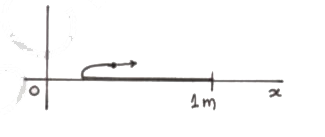
As shown in figure, a mat is being pulled with a coonstant speed of `v = 1m//s,` so that the mass of the part of the mat is continuously increasing. Hence here the mass is a variable.
The time required for bringing the entire mat in motion is given by
`Delta t =("distance covered by the end")/("speed")`
`= (2m)/(1m//s) =2s`
(Distance covered by the end =1m + 1m =2m)
From Newton.s second law of motion,
`F _(n et) = (Delta p)/(Delta t) = (Delta (mv))/(Delta t)`
Here v is constnat, so we get
`F _( n et) =v (Deltam)/(Delta t)`
Where `Deltam` is the cahrge of mass in `Delta t` time.
THge charge of mass in 2s is equal to entire mass of mat.
` F _(n et) = ((1m //s) x (1kg))/(2s)`
`=1/2N`
In the horizontal direction only one force is acting. Hence the required force is `1//2N`


