Home
Class 9
PHYSICS
In an experiment to trace the path of ra...

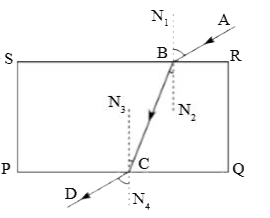
In an experiment to trace the path of ray through a glass slab, Shiva traced as shown in the figure. The teacher askedidenfity the emergy ray. Which of the following would Shiva indentify.

A

AB

B

BC

C

CD

D

`N_(1),N_(2)`

Text Solution

Verified by Experts

Promotional Banner

Topper's Solved these Questions

  • REFRACTION OF LIGHT AT PLANE SURFACES

    NCERT TAMIL|Exercise THINK AND DISCUSS|2 Videos
  • REFRACTION OF LIGHT AT PLANE SURFACES

    NCERT TAMIL|Exercise III. Higher Order Thinking Questions|3 Videos
  • MOTION

    NCERT TAMIL|Exercise THINK AND DISCUSS|14 Videos
  • SOUND

    NCERT TAMIL|Exercise Problems|4 Videos

Similar Questions

Explore conceptually related problems

In an experiment to trace the path of a ray of light passing through a rectangular glass slab, four students tabulated their observations as given below. Which student is correct.

a.Figure shows a cross-section of a 'light pipe' made of glass fibre of refractive index 1.68 The outer converting of the pipe is made of a material of refractive index 1.44. What is the range of the angles of the incident rays with the axis of the pipe for which total reflections insides the pipe take place as shown in the figure. b.What is the answer if there is no outer converting of the pipe ?

After tracing the path of a ray of light through a glass prism, a student marked the angle of indicence (angle i) , angle of emergence (angle e) and the angle of deviation (angleD) as shown in the diagram. The correctly marked angles are :

Figure shows a transparent hemisphere of radius 3.0 cm made of a material of refractive index 2.0. (a) A narrow beam of parallel rays is incident on the hemisphere as shown in the figure. Are the rays totally reflected at the plane surface ? (b) Find the image formed by the refraction at the first surface. (c) Find the image formed by the reflection or by the refraction at the plane surface. (d) Trace qualitatively the final rays as they come out of the hemisphere.

A beam of light passing from one transparent medium to another obliquely, undergoes an abrupt change in direction. This phenomenon is known as refraction of light. a. Name the law which satisfies during this refraction. b. Draw the figure which shows refraction through a parallel sided glass slab. (Ray passing from air ) c. Using the figure obtaind in (b). Show that the incident ray and the emergent ray are parallel to each other.

Read the passage and Answer the following question: In, vacuum the velocity of light radiation with different wavelength is the same. But in a material medium, the velocity of different colour radiations is not the same and they travel with different paths. Due to this, the refractive index of the medium is different for different colours. If white beam of light is incident on a glass prism, the angle of refraction for different colours is different. When Sunlight is incident on a refracting surface, then it gets split into seven coloured spectrum and emerges out. The splitting of light into its component colours is called dispersion. Sir Isaac Newton was the first to use a glass prism to obtain the spectrum of Sunlight. A glass prism is transparent medium bounded by two plane surfaces inclined at an angle. When white light is dispersed into seven colours by a prism, different colours of light bend through different angles with respect to incident ray. Out of these seven colours, red light bends the least, while violet light bends the most. So, the rays of each colour emerge along different paths and becomes distinct. Hence, we get spectrum of seven - different colours. Q. How do emergent rays appear ?

Read the passage and Answer the following question: In, vacuum the velocity of light radiation with different wavelength is the same. But in a material medium, the velocity of different colour radiations is not the same and they travel with different paths. Due to this, the refractive index of the medium is different for different colours. If white beam of light is incident on a glass prism, the angle of refraction for different colours is different. When Sunlight is incident on a refracting surface, then it gets split into seven coloured spectrum and emerges out. The splitting of light into its component colours is called dispersion. Sir Isaac Newton was the first to use a glass prism to obtain the spectrum of Sunlight. A glass prism is transparent medium bounded by two plane surfaces inclined at an angle. When white light is dispersed into seven colours by a prism, different colours of light bend through different angles with respect to incident ray. Out of these seven colours, red light bends the least, while violet light bends the most. So, the rays of each colour emerge along different paths and becomes distinct. Hence, we get spectrum of seven - different colours. Q. Which light deviates the least and which one deviates the most ?

