

Home
Class 9
PHYSICS
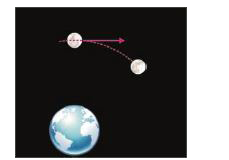
In figure 7, we see that the moon 'falls...

In figure 7, we see that the moon 'falls' around earth rather than straight into it. If the magnitude of velocity were zero, how would it move?

Promotional Banner

Topper's Solved these Questions

  • GRAVITATION

    NCERT TAMIL|Exercise Let us Improve our learning (Reflections on concepts)|12 Videos
  • GRAVITATION

    NCERT TAMIL|Exercise Let us Improve our learning (Application of concepts)|20 Videos
  • GRAVITATION

    NCERT TAMIL|Exercise Let us Improve our learning (Multiple choice questions) (Suggested projects)|4 Videos
  • FLOATING BODIES

    NCERT TAMIL|Exercise MULTIPLE CHOICE QUESTIONS|6 Videos
  • HEAT

    NCERT TAMIL|Exercise Multiple choice questions (Suggested Projects)|4 Videos

Similar Questions

Explore conceptually related problems

An artificial satellite is moving in a circular or bit around the earth with a speed equal to half the magnitude of escape velocity from the earth (i) determine the height of the satellite above the earth's surface.

An artificial satellite is moving in a circular or bit around the earth with a speed equal to half the magnitude of escape velocity from the earth (ii) If the satellite is stopped suddenly in its orbit or allowed to fall freely on the earth, find the speed with which it hits the surface of the earth take g = 9.8 ms^(-2) , radius of the earth = 6400 km.

a. Magnetic field lines show the direction (at every point) along which a small magnetised needle aligns (at the point) Do the magnetic field also represent the lines of force one a moving charged particle at every point ? b. Magnetic field lines can be entirely confined within the core of a toroid , but not within a straight solenoid. Why ? c. If magnetic monopoles existed, how would the Gauss ' law of magnetism be modified ? d. Does a bar magnet exert a torque on itself due to its own field ? Does one element of a current - carrying wire exert a force on another element of the same wire ? e.Magnetic field arises due to charges in motion . Can a system have magnetic moments eventhough its charge is zero ?

Weightlessness in space: Space travellers as well as objects in the spacecraft appear to be floating. Why does this happen? Though the spacecradft is at a height from the surface of the earth the value of g there is not zero. In the space station the value of g is only 11% less than its value on the surface of the earth. Thus, the height of a spacecraft is not the reason for their weightlessness. Their weightlessness is caused by their being in the state of free fall. Though the spacecraft is not falling on the earth because of its velocity along the orbit, the only force acting on it is the gravitational force of the earth and therefore it is in a free fall state. As the velocity of free fall does not depend on the properties of an object, the velocity of free falls is the same for the spacecraft, the travellers and the objects in the craft. Thus, if a traveller releases an object from her hand, it will remain stationary with respect to her and will appear to be weightless. Is the value of g zero in the space station?

Weightlessness in space: Space travellers as well as objects in the spacecraft appear to be floating. Why does this happen? Though the spacecradft is at a height from the surface of the earth the value of g there is not zero. In the space station the value of g is only 11% less than its value on the surface of the earth. Thus, the height of a spacecraft is not the reason for their weightlessness. Their weightlessness is caused by their being in the state of free fall. Though the spacecraft is not falling on the earth because of its velocity along the orbit, the only force acting on it is the gravitational force of the earth and therefore it is in a free fall state. As the velocity of free fall does not depend on the properties of an object, the velocity of free falls is the same for the spacecraft, the travellers and the objects in the craft. Thus, if a traveller releases an object from her hand, it will remain stationary with respect to her and will appear to be weightless. Why doesn't the spacecraft fall towards the Earth?

Weightlessness in space: Space travellers as well as objects in the spacecraft appear to be floating. Why does this happen? Though the spacecradft is at a height from the surface of the earth the value of g there is not zero. In the space station the value of g is only 11% less than its value on the surface of the earth. Thus, the height of a spacecraft is not the reason for their weightlessness. Their weightlessness is caused by their being in the state of free fall. Though the spacecraft is not falling on the earth because of its velocity along the orbit, the only force acting on it is the gravitational force of the earth and therefore it is in a free fall state. As the velocity of free fall does not depend on the properties of an object, the velocity of free falls is the same for the spacecraft, the travellers and the objects in the craft. Thus, if a traveller releases an object from her hand, it will remain stationary with respect to her and will appear to be weightless. Why is weightlessness caused in a spacecraft?

Weightlessness in space: Space travellers as well as objects in the spacecraft appear to be floating. Why does this happen? Though the spacecradft is at a height from the surface of the earth the value of g there is not zero. In the space station the value of g is only 11% less than its value on the surface of the earth. Thus, the height of a spacecraft is not the reason for their weightlessness. Their weightlessness is caused by their being in the state of free fall. Though the spacecraft is not falling on the earth because of its velocity along the orbit, the only force acting on it is the gravitational force of the earth and therefore it is in a free fall state. As the velocity of free fall does not depend on the properties of an object, the velocity of free falls is the same for the spacecraft, the travellers and the objects in the craft. Thus, if a traveller releases an object from her hand, it will remain stationary with respect to her and will appear to be weightless. If a traveller releases an object from her hand in the spacecraft, what will happen?

Take a small stone. Hold it in your hand. We know that the force gravity due to the earth acts on each and every object. When we were holding the stone in our hand, the stone was experiencing this force, but it was balanced by a force that we were applying on it in the opposite direction. As a result, the stone remained at rest. Once we release the stone from our hands the only force that acts on it is the gravitational force of the earth and the stone falls down under its influence. Whenever an object moves under the influence of the force of gravity alone, it is said to be falling freely. Thus the released stone is in a free fall. In free fall, the initial velocity of the object is zero and goes on increasing due to acceleration due to gravity of the earth. During free fall, the frictional force due to air opposes the motion of the object and buoyant force also acts on the object. Thus, true free fall is possible only in vacuum. For a freely falling object, the velocity on reaching the earth and the time taken for it can be calculated by using Newton's equations of motion. For free fall the initial velocity u=0 and the acceleration a=g . Thus, we can write the equations as v="gt",s=1/2"gt"^(2),v^(2)=2gs For calculating the motion of an object thrown upwards, acceleration is negative, i.e. in a direction opposite to the velocity and is taken to be -g. The magnitude of g is the same but the velocity of the object decreases due to -ve acceleration. The moon and the artificial satellites are moving only under the influence of the gravitational field of the earth. Thus they are in free fall. What is the initial velocity and what is the effect of gravitational acceleration on the object in free fall?

Take a small stone. Hold it in your hand. We know that the force gravity due to the earth acts on each and every object. When we were holding the stone in our hand, the stone was experiencing this force, but it was balanced by a force that we were applying on it in the opposite direction. As a result, the stone remained at rest. Once we release the stone from our hands the only force that acts on it is the gravitational force of the earth and the stone falls down under its influence. Whenever an object moves under the influence of the force of gravity alone, it is said to be falling freely. Thus the released stone is in a free fall. In free fall, the initial velocity of the object is zero and goes on increasing due to acceleration due to gravity of the earth. During free fall, the frictional force due to air opposes the motion of the object and a buoyant force also acts on the object. Thus, true free fall is possible only in vacuum. For a freely falling object, the velocity on reaching the earth and the time taken for it can be calculated by using Newton's equations of motion. For free fall the initial velocity u=0 and the acceleration a=g . Thus, we can write the equations as v="gt",s=1/2"gt"^(2),v^(2)=2gs For calculating the motion of an object thrown upwards, acceleration is negative, i.e. in a direction opposite to the velocity and is taken to be -g. The magnitude of g is the same but the velocity of the object decreases due to -ve acceleration. The moon and the artificial satellites are moving only under the influence of the gravitational field of the earth. Thus they are in free fall. Which force acts on the stone in free fall after you release it?

Take a small stone. Hold it in your hand. We know that the force gravity due to the earth acts on each and every object. When we were holding the stone in our hand, the stone was experiencing this force, but it was balanced by a force that we were applying onn it in the opposite direction. As a result, the stone remained at rest. Once we release the stone from our hands the only force that acts onit is the gravitational force of the earth and the stone falls down under its influence. Whenever an object moves under the influence of the force of gravity alone, it is said to be falling freely. Thus the released stone is in a free fall. In free fall, the initial velocity of the object is zero and goes on increasing due to acceleration due to gravity of the earth. During free fall, the frictional force due to air opposes the motion of the object anda buoyant force also acts on the object. Thus, true free fall is posible only in vacuum. For a freely falling object, the velocity on reachign the earth and the time taken for it can be calculated by using Newton's eqwuations of motion. For free fall the initial velocity u=0 and the acceleration a=g . Thus, we can write the equations as v="gt",s=1/2"gt"^(2),v^(2)=2gs For calculating the motion of an object thrown upwards, acceleration is negative, i.e. in a direction opposite ot the velocity and is taken to be -g. The magnitude of g is the same but the velocity of the object decreases due to -ve acceleration. The moon and the artificial satellites are moving only under the influence of the gravitational field of the earth. Thus they are in free fall. What is free fall?

NCERT TAMIL-GRAVITATION-Think and discuss
  1. Where does the centre of gravity of a sphere and triangular lamina lie...

    Text Solution

    |

  2. Can an object have more than one centre of gravity?

    Text Solution

    |

  3. Why doesn't the leaning tower of Pisa topple over?

    Text Solution

    |

  4. Why must you bend forward when carrying a heavy load on your back?

    Text Solution

    |

  5. Can an object move along a curved path if no force acts on it?

    Text Solution

    |

  6. As a car speeds up when rounding a curve, does its centripetal acceler...

    Text Solution

    |

  7. Calculate the tension in a string that whirls a 2 kg - toy in a horizo...

    Text Solution

    |

  8. In figure 7, we see that the moon 'falls' around earth rather than str...

    Text Solution

    |

  9. According to the equation for gravitational force, what happens to the...

    Text Solution

    |

  10. If there is an attractive force between all objects, why do we not fee...

    Text Solution

    |

  11. Is the force of gravity stronger on a piece of iron than on a piece of...

    Text Solution

    |

  12. An apple falls because of the gravitational attraction of earth. Wha...

    Text Solution

    |

  13. Give an example for the motion of an object of zero speed and with non...

    Text Solution

    |

  14. Two stones are thrown into air with speeds 20 m/s, 40m/s respectively?...

    Text Solution

    |

  15. When is your weight equal to mg?

    Text Solution

    |

  16. Give example of when your weight is zero?

    Text Solution

    |

  17. Where does the centre of gravity of a sphere and triangular lamina lie...

    Text Solution

    |

  18. Can an object have more than one centre of gravity?

    Text Solution

    |

  19. Why doesn't the leaning tower of Pisa topple over?

    Text Solution

    |

  20. Why must you bend forward when carrying a heavy load on your back?

    Text Solution

    |