

Home
Class 11
PHYSICS
Consider the decay of a free neutron at ...

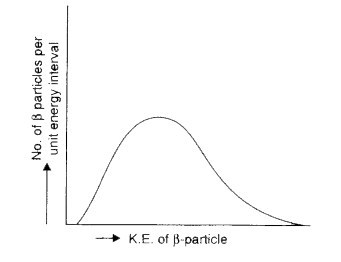
Consider the decay of a free neutron at rest: n`top+e^(-)` Show that the tow-body dacay of this type must necessarily give an electron of fixed energy and, therefore, cannot for the observed continous energy distribution in the `beta`-decay of a neutron or a nucleus.

Promotional Banner

Topper's Solved these Questions

  • WORK, ENERGY AND POWER

    NCERT TAMIL|Exercise EXAMPLE|36 Videos
  • WORK, ENERGY AND POWER

    NCERT TAMIL|Exercise EXERCISE - MULTIPLE CHOICE QUESTIONS|15 Videos
  • WORK, ENERGY AND POWER

    NCERT TAMIL|Exercise EXERCISES|46 Videos
  • WAVES

    NCERT TAMIL|Exercise EVALUATION(IV. NUMERICAL PROBLEMS)|7 Videos

Similar Questions

Explore conceptually related problems

A free neutron beta-decays to a proton weth a half-life of 14 minutes .(a)What is the decay constant ?(b)Find the energy liberated in the process.

Consider the beta decay ^198 Au rarr ^198 Hg ** + Beta^(-1) + vec v . where ^198 Hg^** represents a mercury nucleus in an excited state at energy 1.088 MeV above the ground state. What can be the maximum kinetic energy of the electron emitted? The atomic mass of ^198 Au is 197.968233 u and that of ^198 Hg is 197.966760 u .

Show that the minimum energy needed to sepatate a proton from a nucleus with Z protons and N neutrons is Delta E=(M_z-1+M_H-M_(Z,N)c^(2)) where M_(Z,N)= mass of an atom with Z protons and N neutrons in the nucleus and M_H= mass of a hydrogen atom. this energy is known as proton-separation energy.

Consider the case of bombardment of ""^(235)U nucleus with a thermal neutron. The fission products are ""^(95)Moand""^(139)La and two neutrons. Calculate the energy released. (Rest masses of the nuclides : ""^(235)U=235.0439u,""_(0)^(1)n=1.0087u,""^(95)Mo=94.9058u,""^(139)La=138.9061u Take 1 u = 931MeV).