In figure, a block `A` of mass `2kg` is moving to the right with a speed `5m//s` on a horizontal frictionless surface. Another block `B` of mass `3kg` a massless spring of spring constant `222N//m` attached to it, is moving to the left on the same surface and with a speed `2m//s` . Let us take the direction to the right as the positive `X-` direction. At some instant, block `A` collides with the spring attached to block `B`. At some other instant , the spring has maximum compression and then, finally, blocks move with their final velocities. Assuming that `(i)` the spring force is conservative and so there is no conversion of kinetic energy to internal energy and `(ii)`, no sound is made when block `A` hits the spring, answer the following questions.
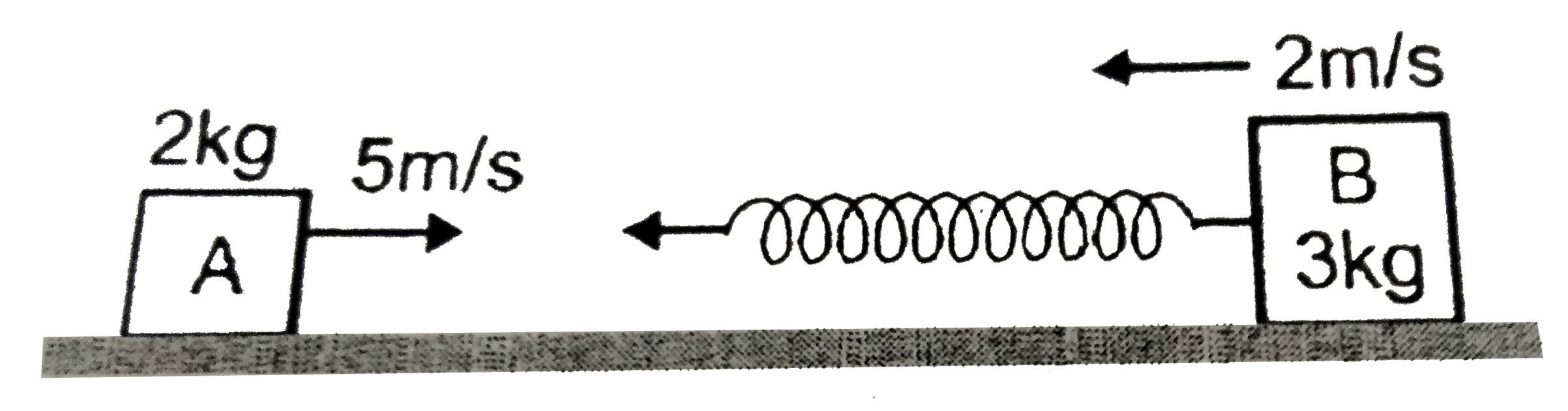
Final velocity of centre of mass of the system of blocks `A` and `B` will be `:`
In figure, a block `A` of mass `2kg` is moving to the right with a speed `5m//s` on a horizontal frictionless surface. Another block `B` of mass `3kg` a massless spring of spring constant `222N//m` attached to it, is moving to the left on the same surface and with a speed `2m//s` . Let us take the direction to the right as the positive `X-` direction. At some instant, block `A` collides with the spring attached to block `B`. At some other instant , the spring has maximum compression and then, finally, blocks move with their final velocities. Assuming that `(i)` the spring force is conservative and so there is no conversion of kinetic energy to internal energy and `(ii)`, no sound is made when block `A` hits the spring, answer the following questions.
Final velocity of centre of mass of the system of blocks `A` and `B` will be `:`
Final velocity of centre of mass of the system of blocks `A` and `B` will be `:`



Similar Questions
Explore conceptually related problems
In figure, a block A of mass 2kg is moving to the right with a speed 5m//s on a horizontal frictionless surface. Another block B of mass 3kg a massless spring of spring constant 222N//m attached to it, is moving to the left on the same surface and with a speed 2m//s . Let us take the direction to the right as the positive X- direction. At some instant, block A collides with the spring attached to block B . At some other instant , the spring has maximum compression and then, finally, blocks move with their final velocities. Assuming that (i) the spring force is conservative and so there is no conversion of kinetic energy to internal energy and (ii) , no sound is made when block A hits the spring, answer the following questions. Find velocity of block A will be :
In figure, a block A of mass 2kg is moving to the right with a speed 5m//s on a horizontal frictionless surface. Another block B of mass 3kg a massless spring of spring constant 222N//m attached to it, is moving to the left on the same surface and with a speed 2m//s . Let us take the direction to the right as the positive X- direction. At some instant, block A collides with the spring attached to block B . At some other instant , the spring has maximum compression and then, finally, blocks move with their final velocities. Assuming that (i) the spring force is conservative and so there is no conversion of kinetic energy to internal energy and (ii) , no sound is made when block A hits the spring, answer the following questions. Velocity of centre of mass of the system of blocks A and B , before collision is :
In figure, a block A of mass 2kg is moving to the right with a speed 5m//s on a horizontal frictionless surface. Another block B of mass 3kg a massless spring of spring constant 222N//m attached to it, is moving to the left on the same surface and with a speed 2m//s . Let us take the direction to the right as the positive X- direction. At some instant, block A collides with the spring attached to block B . At some other instant , the spring has maximum compression and then, finally, blocks move with their final velocities. Assuming that (i) the spring force is conservative and so there is no conversion of kinetic energy to internal energy and (ii) , no sound is made when block A hits the spring, answer the following questions. Velocity of centre of mass of the system of blocks A and B , before collision is :
In figure, a block A of mass 2kg is moving to the right with a speed 5m//s on a horizontal frictionless surface. Another block B of mass 3kg a massless spring of spring constant 222N//m attached to it, is moving to the left on the same surface and with a speed 2m//s . Let us take the direction to the right as the positive X- direction. At some instant, block A collides with the spring attached to block B . At some other instant , the spring has maximum compression and then, finally, blocks move with their final velocities. Assuming that (i) the spring force is conservative and so there is no conversion of kinetic energy to internal energy and (ii) , no sound is made when block A hits the spring, answer the following questions. In previous question, at the given instant, compression will be nearly :
In figure, a block A of mass 2kg is moving to the right with a speed 5m//s on a horizontal frictionless surface. Another block B of mass 3kg a massless spring of spring constant 222N//m attached to it, is moving to the left on the same surface and with a speed 2m//s . Let us take the direction to the right as the positive X- direction. At some instant, block A collides with the spring attached to block B . At some other instant , the spring has maximum compression and then, finally, blocks move with their final velocities. Assuming that (i) the spring force is conservative and so there is no conversion of kinetic energy to internal energy and (ii) , no sound is made when block A hits the spring, answer the following questions. In the collision process, while the spring is getting compressed :
In figure, a block A of mass 2kg is moving to the right with a speed 5m//s on a horizontal frictionless surface. Another block B of mass 3kg a massless spring of spring constant 222N//m attached to it, is moving to the left on the same surface and with a speed 2m//s . Let us take the direction to the right as the positive X- direction. At some instant, block A collides with the spring attached to block B . At some other instant , the spring has maximum compression and then, finally, blocks move with their final velocities. Assuming that (i) the spring force is conservative and so there is no conversion of kinetic energy to internal energy and (ii) , no sound is made when block A hits the spring, answer the following questions. In the collision process, while the spring is getting compressed :
In figure, a block A of mass 2kg is moving to the right with a speed 5m//s on a horizontal frictionless surface. Another block B of mass 3kg a massless spring of spring constant 222N//m attached to it, is moving to the left on the same surface and with a speed 2m//s . Let us take the direction to the right as the positive X- direction. At some instant, block A collides with the spring attached to block B . At some other instant , the spring has maximum compression and then, finally, blocks move with their final velocities. Assuming that (i) the spring force is conservative and so there is no conversion of kinetic energy to internal energy and (ii) , no sound is made when block A hits the spring, answer the following questions. Maximum compression of the spring in the collision will be nearly
In figure, a block A of mass 2kg is moving to the right with a speed 5m//s on a horizontal frictionless surface. Another block B of mass 3kg a massless spring of spring constant 222N//m attached to it, is moving to the left on the same surface and with a speed 2m//s . Let us take the direction to the right as the positive X- direction. At some instant, block A collides with the spring attached to block B . At some other instant , the spring has maximum compression and then, finally, blocks move with their final velocities. Assuming that (i) the spring force is conservative and so there is no conversion of kinetic energy to internal energy and (ii) , no sound is made when block A hits the spring, answer the following questions. Maximum compression of the spring in the collision will be nearly
In figure, a block A of mass 2kg is moving to the right with a speed 5m//s on a horizontal frictionless surface. Another block B of mass 3kg a massless spring of spring constant 222N//m attached to it, is moving to the left on the same surface and with a speed 2m//s . Let us take the direction to the right as the positive X- direction. At some instant, block A collides with the spring attached to block B . At some other instant , the spring has maximum compression and then, finally, blocks move with their final velocities. Assuming that (i) the spring force is conservative and so there is no conversion of kinetic energy to internal energy and (ii) , no sound is made when block A hits the spring, answer the following questions. STATEMENT -1: The net momentum of a system of two moving particles is zero. Then a particular instant of time, the net angular momentum of system of given two particle is same about any point. STATEMENT -2: If net momentum of a system of two moving particle is zero, then angular mometum of system of given two particles is zero about any point.
In figure, a block A of mass 2kg is moving to the right with a speed 5m//s on a horizontal frictionless surface. Another block B of mass 3kg a massless spring of spring constant 222N//m attached to it, is moving to the left on the same surface and with a speed 2m//s . Let us take the direction to the right as the positive X- direction. At some instant, block A collides with the spring attached to block B . At some other instant , the spring has maximum compression and then, finally, blocks move with their final velocities. Assuming that (i) the spring force is conservative and so there is no conversion of kinetic energy to internal energy and (ii) , no sound is made when block A hits the spring, answer the following questions. When the blocks are yet to attain their final velocities, in this situation at any instant when block A is moving with a velocity 4 hat(i) m//s , velocity of block B will then be :
Recommended Questions
- In figure, a block A of mass 2kg is moving to the right with a speed 5...
Text Solution
|
- A block of mass m moves with a speed v towards the right block which i...
Text Solution
|
- In figure, a block A of mass 2kg is moving to the right with a speed 5...
Text Solution
|
- In figure, a block A of mass 2kg is moving to the right with a speed 5...
Text Solution
|
- In figure, a block A of mass 2kg is moving to the right with a speed 5...
Text Solution
|
- In figure, a block A of mass 2kg is moving to the right with a speed 5...
Text Solution
|
- In figure, a block A of mass 2kg is moving to the right with a speed 5...
Text Solution
|
- In figure, a block A of mass 2kg is moving to the right with a speed 5...
Text Solution
|
- In figure, a block A of mass 2kg is moving to the right with a speed 5...
Text Solution
|