

Home
Class 12
PHYSICS
A rod length L and mass M is placed alon...

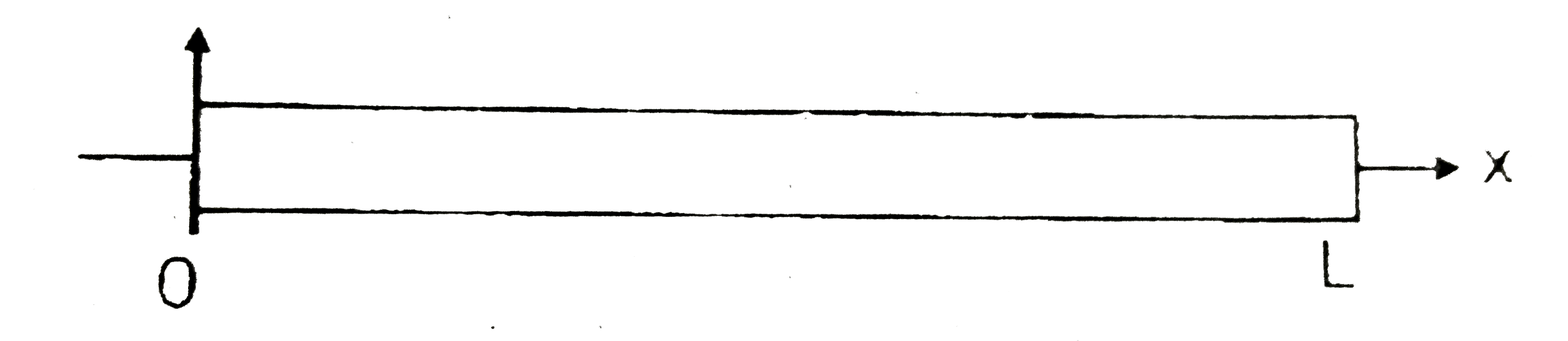
A rod length `L` and mass `M` is placed along the `x`-axis with one end at the origin, as shown in the figure above. The rod has linear mass density `lamda=(2M)/(L^(2))x,` where `x` is the distance from the origin. Which of the following gives the `x`-coordinate of the rod's center of mass?

Promotional Banner

Similar Questions

Explore conceptually related problems

Find centre of mass of given rod of linear mass density lambda=(a+b(x/l)^2) , x is distance from one of its end. Length of the rod is l .

Find centre of mass of given rod of linear mass density lambda=(a+b(x/l)^2) , x is distance from one of its end. Length of the rod is l .

A non–uniform thin rod of length L is placed along x-axis as such its one of ends at the origin. The linear mass density of rod is lambda=lambda_(0)x . The distance of centre of mass of rod from the origin is :

A non–uniform thin rod of length L is placed along x-axis as such its one of ends at the origin. The linear mass density of rod is lambda=lambda_(0)x . The distance of centre of mass of rod from the origin is :

The linear density of a thin rod of length 1m lies as lambda = (1+2x) , where x is the distance from its one end. Find the distance of its center of mass from this end.

The linear density of a thin rod of length 1m lies as lambda = (1+2x) , where x is the distance from its one end. Find the distance of its center of mass from this end.

Find coordinates of mass center of a non-uniform rod of length L whose linear mass density lambda varies as lambda=a+bx, where x is the distance from the lighter end.

Find coordinates of mass center of a non-uniform rod of length L whose linear mass density lambda varies as lambda=a+bx, where x is the distance from the lighter end.

Find coordinates of mass center of a non-uniform rod of length L whose linear mass density lambda varies as lambda=a+bx, where x is the distance from the lighter end.