

Home
Class 12
PHYSICS
An infinite no of bricks are placed one ...

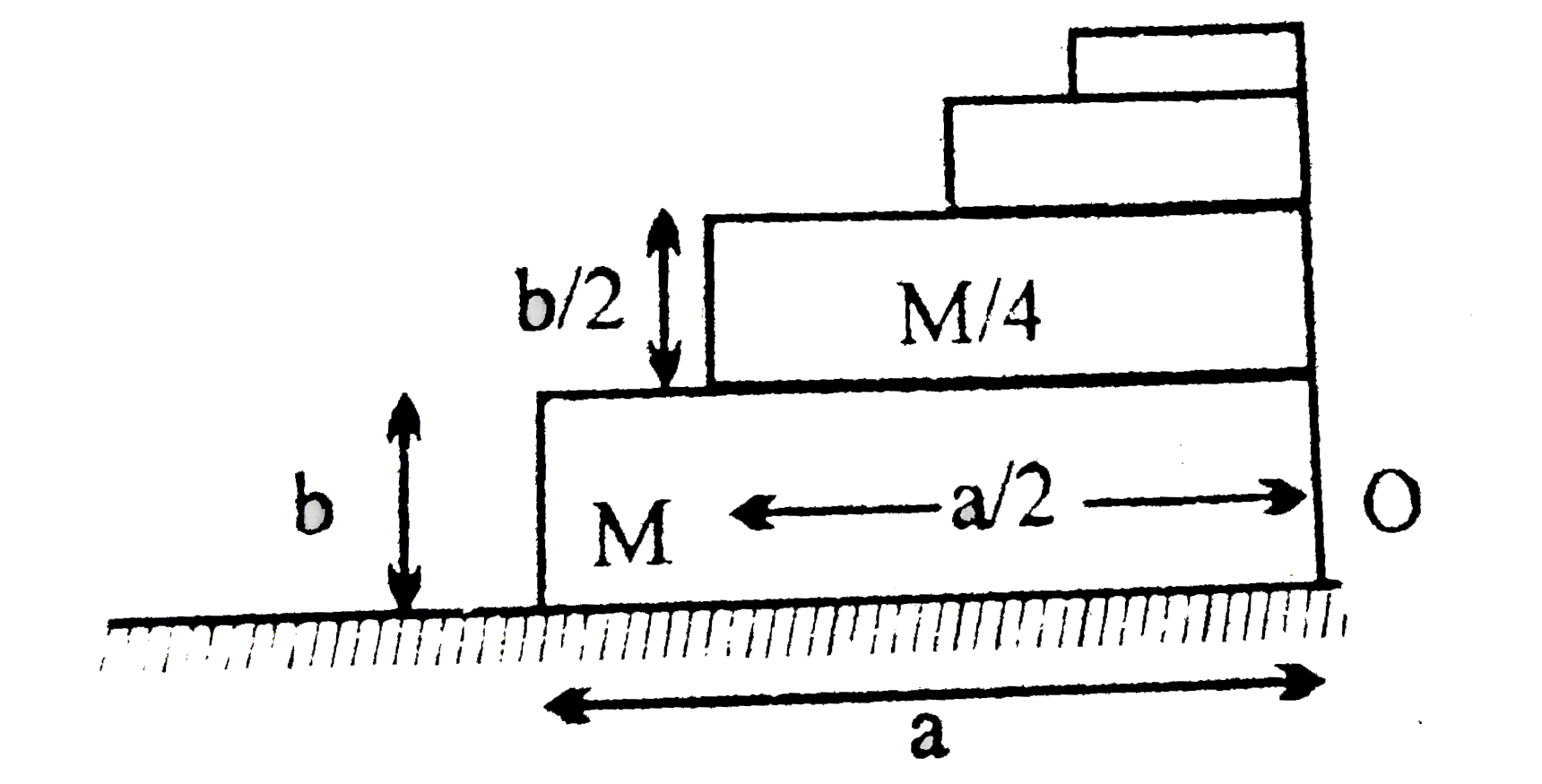
An infinite no of bricks are placed one over the other as shown in the figure. Each succeeding brick having half the length and breadth of its precceeding brick and the mass of each succeeding bricks `1//4^(th)` of the preceding one, take 'O' as the origin, the centre of mass of the system of bricks is at

Promotional Banner

Similar Questions

Explore conceptually related problems

Infinite number of bricks are placed one over the other as shown in the figure. Each succeeding brick having half the length and breadth of its preceding brick and the mass of each succeeding bricks being (1//4)^(th) of the preceding one. Taking 'O' as the origin, the x coordinate of centre of mass of the system of bricks is at

Infinite number of bricks are placed one over the other as shown in the figure. Each succeeding brick having half the length and breadth of its preceding brick and the mass of each succeeding bricks being (1//4)^(th) of the preceding one. Taking 'O' as the origin, the x coordinate of centre of mass of the system of bricks is at

Find the x coordinate of the centre of mass of the bricks shown in figure :

Find the x coordinate of the centre of mass of the bricks shown in figure :

Find the x coordinate of the centre of mass of the bricks shown in figure :

Three bricks each of length L and mass M are arranged as shown from the wall. The distance of the centre of mass of the system from the wall is

Two identical bricks of length L are piled one on top of the other on a table as shown in the figure the maximum distance S the top brick can overhand the table with the system still balanced is:

Two identical bricks of length L are piled one on top of the other on a table as shown in the figure the maximum distance S the top brick can overhand the table with the system still balanced is:

Two uniform thin rods each of length L and mass m are joined as shown in the figure. Find the distance of centre of mass the system from point O