

Home
Class 11
PHYSICS
There is a step of height h on an inclin...

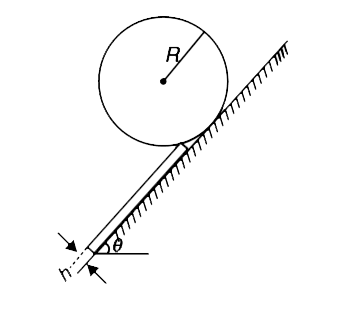
There is a step of height `h` on an incline plane. The step prevents a ball of radius R from rolling down.
(a) If the inclination `(theta)` of the incline is increased gradually, at what value of `theta` the ball will just manage to climb the step?

(b) Does the gravitational potential energy of the ball increases or decreases as it climbs the step ?

Promotional Banner

Similar Questions

Explore conceptually related problems

There is a step of height h on an incline plane. The step prevents a ball of radius R from rolling down. If the inclination (theta) to the incline is increased gradualluy, at some value of theta the ball will just manage to climb the step then value of theta is.

There is a step of height h on an incline plane. The step prevents a ball of radius R from rolling down. If the inclination (theta) to the incline is increased gradualluy, at some value of theta the ball will just manage to climb the step then value of theta is.

A disc of radius R is rolling down an inclined plane whose angle of inclination is theta Its acceleration would be

A disc of radius R is rolling down an inclined plane whose angle of inclination is theta Its acceleration would be

A solid cylinder is rolling down a rough inclined plane of inclination theta . Then

A solid cylinder is rolling down a rough inclined plane of inclination theta . Then

A block with a square base measuring axxa and height h, is placed on an inclined plane. The coefficient of friction is mu . The angle of inclination (theta) of the plane is gradually increased. The block will

A block with a square base measuring axxa and height h, is placed on an inclined plane. The coefficient of friction is mu . The angle of inclination (theta) of the plane is gradually increased. The block will

A spherical shell of radius R is rolling down an incline of inclination theta without slipping. Find minimum value of coefficient of friction.