Home
Class 11
PHYSICS
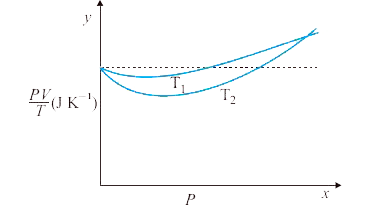
Figure Show plot of PV//T versus P for 1...

Figure Show plot of `PV//T` versus P for `1.00xx10^(-3)` kg of oxygen gas at two different temperatures.

(a) What does the dotted plot signify?
(b) Which is true: `T_(1) gt T_(2)` or `T_(1) lt T_(2)`?
(c) What is the value of `PV//T` where the curves meet on the y-axis?
(d) If we obtained similar plots for `1.00xx10^(-3)` kg of hydrogen, would we get the same value of `PV//T` at the point where the curves meet on the y-axis? If not, what mass of hydrogen yields the same value of `PV//T` (for low pressure high temperature region of the plot) ? (Molecular mass of `H_(2) = 2.02 u, of O_(2) = 32.0 u, R= 8.31Jmol^(-1)K^(-1).)

Text Solution

Verified by Experts

(a) The dotted plot corresponds to .ideal gas behaviour, (b) `T_(1) gt T_(2)`: (c) `0.26 J K^(-1)`, (d) No, `6.3 xx 10^(-5)` kg of `H_(2)` would yield the same value
Promotional Banner

Topper's Solved these Questions

  • KINETIC THEORY

    NCERT TELUGU|Exercise ADDITIONAL EXERCISE|3 Videos
  • KINETIC THEORY

    NCERT TELUGU|Exercise ADDITIONAL EXERCISE|3 Videos
  • GRAVITATION

    NCERT TELUGU|Exercise ADDITIONAL EXERCISES|3 Videos
  • LAW OF MOTION

    NCERT TELUGU|Exercise EXERCISE (ADDITIONAL EXERCISE)|17 Videos

Similar Questions

Explore conceptually related problems

Figure show plot of (PV)/(T) and P for 2gm of oxygen gas at two different temeratures. (i)The significance of dotted line (ii)The relation between T_(1) and T_(2) (iii)The value of (PV)/(T) where the curves meet on the Y-axis.

The figure below shows the plot of versus P for oxygen gas at two different temperatures Read the following statements concerning the curves given below i)The dotted line corresponds to the 'ideal' gas behaviour ii) T_(1)gtT_(2) iii)The value of (PV)/(nT) at the point ,where the curves meet on the y-axis is the same for all gases which of the above statement is true?

For an ideal gas. a plot of PV//RT versus T will look like

Given is the graph between PV/T and P for 1 gm of oxygen gas at two different temperature T_(1) and T_(2) (Given:Density of oxygen= 1.429 kg//m^(3) ).The value of PV/T at the point A and the relation between T_(1) and T_(2) and respectively

In the above case, if their final temperatures are T_(1),T_(2) and T_(3) . Then .

If p(t) = t^(3) -1 , find the value of p(2).

p(t) = t^(3) - 1 , p(-2) = ………….
